Book: Acts Commentary by Chuck Smith

511033oThrough the years, we have had the privilege of seeing the phenomenal, miraculous work of the Holy Spirit in the growth of the Calvary Chapels. Many of these have been learned the hard way, which are fundamental principles that God has blessed. They express God’s intention for the church and are to be found in this commentary study of the book of Acts.

In reality, Acts is an open-ended book. Chapters are still being written today all over the world, as Jesus continues touching and changing lives. Presently, the Holy Spirit is indwelling, empowering, guiding, and teaching those who have put their trust in Jesus Christ.

Pastor Jon Courson says “Pastor Chuck has a uniquely beautiful way of “taking the hay out of the loft and putting it on the barn floor where the cows can eat it! And it caused me to be oh-so-deeply impressed … with Jesus. Thus, it is with a heart of expectancy and anticipation I wholeheartedly commend this Acts commentary to you.” 

How to get this resource:

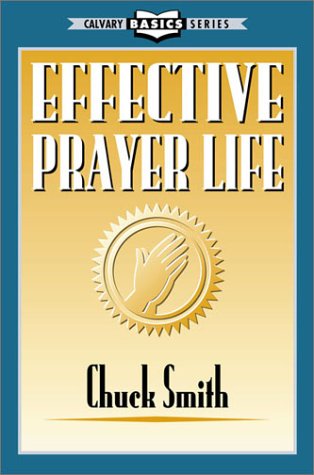
Book: Effective Prayer Life by Chuck Smith

EffectivePrayerLife

Prayer is the most joyous privilege in the world! Discover the full, beautiful experience of prayer, and be refreshed by the simplicity of having a close relationship with God.

In this book, Pastor Chuck discusses the principles of prayer, the keys to having a dynamic prayer life, and the victorious results of such a life. His practical, simplistic style will give you a better understanding of prayer and make you better equipped to fight the good fight of faith.

This book will stir in your heart a desire to “pray without ceasing”—the most important act the Christian can engage in.


TABLE OF CONTENTS

Introduction.
Chapter 1 – What Is Prayer?
Chapter 2 – The Purpose of Prayer
Chapter 3 – The Privilege of Prayer
Chapter 4 – Effective Prayer
Chapter 5 – Strength in Prayer
Chapter 6 – Pray, and I Will Answer
Chapter 7 – Sin of Prayerlessness

INTRODUCTION

Today, we are living in desperate times. Yet, the Church is not desperate before God in prayer. Jesus said to Peter, James, and John, “What? Could you not watch with me one hour?” (Matthew 26:40 NKJV). We say, “Shame on you, Peter! Shame on you, John! How terrible! Not watching with the Lord in prayer for even one hour!” But look out. Whenever you point a finger at someone else, there are three pointing back at you. Prayer is the most important activity a born-again Christian can perform. It should head your list of priorities, for certainly the world around us desperately needs prayer. Prayer will open the door for God to do a glorious work in these last days. Prayer will stem the tide of evil.

This collection of studies on prayer presents you with certain Scriptures, thoughts, and rules. When you put them into practice in your life, they will bring you into a new relationship with God and help you to experience a more effective and dynamic prayer life in which to do battle against the evil forces in these last days. We wrestle not against flesh and blood, but against spiritual powers and principalities; thus, the weapons of our warfare cannot be carnal. Prayer is the most potent weapon that we possess in our spiritual arsenal, and by it we can pull down the strongholds of the enemy. Does Satan have a stronghold on your city government? Does he have a stronghold on your husband or wife or children? Through this book you will learn how to break down these strongholds.

CHAPTER 1 – WHAT IS PRAYER?

Prayer can be expressed in three basic forms: worship, petition, and intercession, with variations within each form.

Worship

The first basic form of prayer is worship. It is a spontaneous result from the conscious awareness of God. As I realize the greatness of God and His nearness to me and His love for me, I naturally respond with deep, inner worship of Him. One day I watched a little gnat flying around. I was amazed at how small it was and yet so wonderfully designed. He was able to defy the laws of gravity, suspending himself in the air and then darting around rapidly. I thought, “God, you are so wise in the design of even small forms of life.”

Worshipping God for His creative genius is a form of prayer – that consciousness of who He is and what He has done inspires worship. When I recognize the wisdom and power of God, I stand in awe of Him. Thanksgiving and praise arise spontaneously as I become conscious of the goodness of God to me that I know I do not deserve.

Christians should engage in this form of communion and prayer constantly. We should become more conscious of Him as He speaks to us through nature. We see His power in the storm and lightning. We smell His loveliness in a rose. We see His design in a daisy. “In the rustling grass, I hear Him pass; He speaks to me everywhere.” Sometimes we verbalize our worship; often we don’t. It’s simply an overwhelming feeling within our hearts as God manifests Himself to us in a thousand different ways. We just say, “Ohhh, God is so good!” We worship Him and commune with Him in the recognition of His love and grace.

Petition

The second form of prayer is petition, as I bring my personal needs before God and ask Him for the help that I need so desperately. Day by day I cry out to the Lord for His wisdom, guidance, strength, and provision. There are some people who dismiss personal petition prayer as selfish. They say that it’s wrong to pray for anything for yourself because you ought to be thinking more of others.

As part of my initiation into the Hi Y Club in Jr. High school I had to memorize this poem.

Lord, let me live from day to day,
In such a self-forgetting way,
That even when I kneel to pray,
My prayer will be for others. Help me in
all the things I do,
To ever be sincerely true,
To know that all I do for You,
Must needs be done for others.
Others, Lord, yes others,
Let this my motto be.
Help me to live for others,
That I might live for Thee.

It is beautiful poetry that expresses truth. I should pray for others and be concerned with their needs. Nevertheless, I must also be concerned in prayer with my own needs. Call it what you want, but I have certain definite needs that must be met before I can be of benefit to others.

The Bible says, “The husbandman that laboreth must be first partaker of the fruits” (2 Timothy 2:6). In other words, you can’t give what you don’t have. Like measles, you can’t give‘em unless you got‘em. Therefore, I must first be a partaker of God’s grace, love, strength, and power. Then, as I partake, I have something to share with others.

One of Jesus’ disciples said, “Lord, teach us to pray, as John also taught his disciples.” Jesus then taught that model prayer: “Our Father which art in heaven, Hallowed be thy name. Thy kingdom come. Thy will be done, as in heaven, so in earth” (Luke 11:1–2). The first part of the prayer is addressed to God – worshipping God for what He is: “Hal-lowed be thy name.” Then comes the prayer for the kingdom of God: “Thy kingdom come.” We are to seek first the kingdom of God and His righteousness.

The very next petition is “Give us day by day our daily bread…and lead us not into temptation, but deliver us from evil” (Luke 11:3–4). These are personal petitions for my own needs. I do have needs, and God wants me to bring those needs before Him. There’s nothing wrong with praying and asking God to supply my rent money or whatever else I might need.

Intercession

The third form of prayer, intercession, is the type of prayer that can be considered work. Worshipping God is not work – that’s glorious! It’s spontaneous, beautiful communion and fellowship with God. Petition isn’t too much work because I’m so interested in what I need that I can become involved in it very easily. But when I begin to intercede, then I must labor.

Paul, in his closing remarks to the church at Colosse, makes mention of one of his fellow laborers, Epaphras. “Epaphras, who is one of you, a servant of Christ, saluteth you, always laboring fervently for you in prayers” (Colossians 4:12). Here prayer is described as work.

Through intercessory prayer I reach out beyond myself and pray, not for my own needs, but for the needs of those around me. I pray for my family, friends, and neighbors who don’t yet know Jesus Christ. I pray for the needs of those in the Body of Christ. I bring before God all the various needs of others that have come to my attention.

It is during intercessory prayer that I become aware of what prayer actually is: a spiritual battle.

The Battle

There’s a conflict taking place around us continually, a spiritual conflict. Invisible to our physical eyes is the spirit world, which is divided into two categories: the forces of good and the forces of evil. These are in constant combat with one another and diametrically opposed to each other. When I enter into intercessory prayer, I step right into the battle and begin to fight in this spiritual warfare.

Paul the apostle said that “we wrestle not against flesh and blood, but against principalities, against powers, against the rulers of the darkness of this world, against spiritual wickedness in high places” (Ephesians 6:12). Therefore, we’re to put on the whole armor of God. Paul then goes on to list the armor of God that should clothe a Christian for battle.

For the apostle said, “The weapons of our warfare are not carnal, because we’re not in a physical battle.” If we were, then we’d have worldly weapons. But because we’re in a spiritual battle, the weapons and armor of our warfare must be spiritual. Through them we pull down the strongholds of the enemy (2 Corinthians 10:4).

Once you’re fully equipped with all this spiritual armor of Ephesians 6, what are you to do? Just stand there? No! Get into the fight! How do you get into the fight? “Praying always with all prayer and supplication in the Spirit” (Ephesians 6:18). You’ve been girded for the battle – now go to it!

Battle Scenario

The scene of the spiritual conflict is right here on the earth. The purpose of the conflict is the control of the earth and the individual lives upon it.

The earth rightfully belongs to Jesus Christ. He created it and gave it to man. But man forfeited it to Satan. Jesus came and purchased it back for Himself. He redeemed us and the world through His blood at Calvary. For a while as Jesus hung on the cross, Satan thought he was the victor. But on the third day Jesus rose again, triumphing over death, hell, the grave, and Satan.

John tells us in 1 John 3:8 that Jesus was manifested to destroy the works of the devil. This He did through His death on the cross (Hebrews 2:14). He conquered Satan’s forces, spoiled the principalities and powers that were against us, nailed them to His cross, triumphed over them, and made an open display of His victory (Colossians 2:14, 15). Though the world rightfully belongs to Jesus Christ now, Satan seeks to maintain control and power over it by force. Much as when God had rejected King Saul from reigning over Israel and had the prophet Samuel anoint David in his stead, Saul, by force, tried to hold on to that which was no longer rightfully his and sought to drive David from the kingdom. So Satan seeks to hold on to that which is no longer rightfully his.

Jesus Christ also has a method of winning the world, but not by force. Jesus seeks to draw men unto Himself and into His kingdom through love. Thus, the warfare continues in this world for the control of individual lives. Satan applies tremendous force and pressure to keep people in his camp. Jesus, wooing and drawing through gentle love, seeks to persuade men to submit their lives to Him.

As you enter into intercessory prayer, you rush into the thick of the battle. It becomes work because you’re engaged against the forces of darkness and hell. You’re going against the enemy’s strongholds with prayer. You witness the grip of power that Satan has on the lives of those around you. Through prayer you can advance with the battering ram and demolish the strong-holds the enemy has on those individual lives – freeing them from the power by which he holds them captive.

This kind of prayer, the warfare praying in the Spirit, becomes real work. You begin to understand what Paul meant when he said that Epaphras was “laboring fervently” in prayer. It’s wonderful to realize that prayer is the deciding factor in this spiritual warfare.

Satan is a very stubborn enemy and an obstinate fighter. He yields only what and when he must. Therefore, your prayers must be very specific. Vague, general prayers like “God, save the world” won’t even dent the enemy. But when you bring an individual before the Lord, laying claim to that person for Jesus Christ, you begin to be specific in prayer, and Satan must yield.

“Lord, my friend, John, is bound by the power of Satan. His life is being ruined and twisted. I come against that work of Satan in the name of Jesus Christ and in the victory of the cross of Jesus Christ. I ask you, Father, to free him from this power of Satan that’s holding him today. Loose him now, that he may know the love of Jesus Christ. Lord, let your Spirit speak to his heart and bring an end to the work of Satan that’s binding him, and blinding him.” We thus recover them from the snare of the devil that is holding them as captives.

Realize that Satan is persistent. Even after you begin to see a bit of victory, you must continue in prayer to hold the ground that you’ve gained. The minute you win ground, Satan will turn right around and counterattack to regain it. Your prayers must be persistent. The ground we have taken from the enemy through prayer, must be held by prayer. Many times we make a serious mistake when we begin seeing signs of victory in the life of one for whom we have been interceding. Maybe they have gone forward to receive Christ and have started to read their Bibles, so we quit praying for them. Often the seed has not had a chance to take root yet and the enemy comes to take away the seed. We need to continue to pray long after we begin to see initial signs of victory.

The beautiful truth is that Satan has already been defeated. As we go into battle the outcome has already been determined. Jesus triumphed over Satan and, thus, Satan must yield when we come against him in the power and in the authority of Jesus Christ. Lay claim to the victory in Jesus Christ – and life after life will be set free as you come against the strongholds of Satan and tear them down with this powerful weapon of prayer!

God has made prayer available to the weak-est of His children. It’s something that everyChristian can exercise, regardless of his spiritualstate. You don’t have to be a spiritual giant to getinto spiritual warfare. And you don’t have to beafraid of the enemy as you enter in, because he’salready been defeated.

Satan knows that prayer spells his defeat.He’ll fight you more to keep you from prayerthan any other thing you do. Sometimes, he evenencourages you to other specific activities be-cause he knows how fruitless they are.

You’ll be amazed at the disturbances thatcome your way when you kneel down and startpraying. The telephone will ring. Or someonewill be at the front door. Or you’ll suddenly re-member something you’ve been wanting to do.When I pray I usually take a notepad with meso I can jot down those thoughts of the forgottenthings that need attention. Otherwise I’m tempt-ed to get up and do them immediately. Satan willdo anything to get you away from prayer.

Intercessory prayer is a real labor. It’s a realconflict in the battle against Satan. It’s the decid-ing factor, and that’s why Satan fights it so hard.

Suppose that someone attacked you on adark street and started wrestling with you. If hewere to pull a knife, the whole battle would sud-denly be centered on one thing—control of theknife. All of a sudden, you’d forget about punch-ing him in the nose. You’d be grabbing for hiswrist and trying to knock that knife out of hishand for you realize that it is the deciding factorin this battle.

Satan knows that prayer brings you victoryand spells his defeat. He knows it’s the decidingfactor in this spiritual warfare. That’s why heconcentrates all his efforts against prayer. He’lldo all he can to upset your prayer time, and keepyou from praying.

Persistence

If the answers to your prayers don’t comeimmediately, don’t give up! Paul speaks of Epa-phras “laboring fervently” in prayer for the Co-lossians (Colossians 4:12). I don’t believe that Ep-aphras said, “O Lord, bless the Church in Colosse,in Jesus’ name. Amen.” Rather, he waited uponGod, diligently sought after God for the welfareand the benefit of that church, and continuedthe practice of prayer day after day. James 5:16speaks of effective fervent prayer availing much.

Many times we give up a little bit too soon.Whenever Satan begins losing his grip he makesa last, desperate lunge. This is when we all toooften become tired and give up, quitting justshort of victory.

In his book, How to Win Friends and InfluencePeople, Mr. Carnigie tells of a Mr. Darby, a wealthyinsurance broker from the East, who was caughtup with gold fever and headed out to Colorado.He did some prospecting and discovered a veryrich vein of gold in the Rockies. He returned tothe East and convinced all his friends to investtheir money in a mining venture. They formed a corporation, bought a great deal of equipment,and mined this very wealthy vein of gold ore inColorado.

About the time that the corporation paid offall its debts, the vein of gold ran out. The inves-tors kept digging until they ran themselves intodebt again. Finally one day, a discouraged Mr.Darby ordered an end to the digging. He closedthe mine, went into Denver, and sold the mineand equipment to a junk dealer for a few hun-dred dollars. Mr. Darby headed back home.

The junk dealer hired a geologist to study themine and the area. The geologist came back witha report: “If you’ll dig three feet past the pointwhere Mr. Darby quit, you’ll find that same veinof gold.” The junk dealer became the wealthiestmine owner in the state of Colorado. Just threemore feet! I wonder how many times we, too,stop three feet short of victory.

Claim the Promises

There are many fantastic promises given tous about prayer through Jesus Christ.

Verily I say unto you, Whatsoever ye shall bind on
earth shall be bound in heaven; and whatsoever ye
shall loose on earth shall be loosed in heaven….if

two of you shall agree on earth as touching any
thing that they shall ask, it shall be done for them
of my Father which is in heaven.

—Matthew 18:18–19

The number in prayer: any two of you. Theplace of prayer: on earth. The scope of prayer:any thing. “It shall be done for them of my Fatherwhich is in heaven.” That is a broad and gloriouspromise!

Jesus also promised:

Have faith in God. For verily I say unto you, That
whosoever shall say unto this mountain, Be thou
removed, and be thou cast into the sea; and shall
not doubt in his heart, but shall believe that those
things which he saith shall come to pass; he shall
have whatsoever he saith. Therefore I say unto
you, What things soever ye desire, when ye pray,
believe that ye receive them, and ye shall have
them.

—Mark 11:22–24

What a fantastic promise! Also, Jesus said,

And whatsoever ye shall ask in my name, that will
I do, that the Father may be glorified in the Son. If
ye shall ask any thing in my name, I will do it.
—John 14:13–14

Any thing!

Another promise: “If ye abide in me, and mywords abide in you, ye shall ask what ye will, and itshall be done unto you” (John 15:7). Also, “What-soever ye shall ask the Father in my name, he willgive it [to] you. Hitherto have ye asked nothing in myname: ask [the Greek is intensive— ‘please ask’],and ye shall receive, that your joy may be full” (John16:23–24). Here the Lord is begging you to askHim anything and He said He will do it.

These are extremely broad promises to prayer.But to whom were the promises made? Jesuswasn’t talking here to the multitudes. In everycase Jesus was talking to His disciples.

Who qualifies as a disciple? Jesus said, “If anyman will come after me, let him deny himself, andtake up his cross, and follow me” (Matthew 16:24).A person who has denied himself, taken up thecross, and is following Jesus Christ can take thesepromises and lay claim to them. Anything heasks, desires, or wishes will be done.

But, by the very virtue of the fact that a dis-ciple has denied himself, he is not seeking thethings that would glorify his flesh. The very factthat he’s taken up his cross, he’s not seeking hisown glory, but reckoning himself to be dead withChrist. He is now identified only in the thingsthat God wants: committing himself, his ambi-tions, and his life totally to Jesus Christ. The truethrust of prayer is always, “Nevertheless, not whatI will, but Thy will be done.”

Only by denying yourself, taking up yourcross, and following Jesus Christ do you receiveaccess to the powerful promises of God regard-ing your prayers.

When the Answer Is No

The Lord may not give us what we ask whenHe has a higher purpose in mind for our lives.

Moses prayed that God would allow him togo into the Promised Land. God said, “No, Moses.For the sake of the people you can’t go into theland. You misrepresented Me before those peo-ple. Now they must learn the lesson of obedi-ence.” Moses, that mighty spiritual giant whocommuned face to face with God, wasn’t al-lowed to go into the Promised Land (Numbers20:7–12).

Throughout the centuries since then, parentshave told their children the story of Moses, theman of God, who was used by God to deliver thechildren of Israel from Egypt and bring them totheir own land. They tell of Moses who went up into the mountain and received the law of God inthe midst of the fire and rolling thunder; whoseface shone so that he had to cover himself with aveil; who stretched forth the rod and the Red Seaparted. Then with whispered tones they wouldsay to their children, “But Moses could not gointo the land because he disobeyed God.” Inorder to teach the future generations of the nationof Israel the lesson of the importance of completeobedience, God did not answer Moses’ prayer.

Consider the prayer of Jesus that wasn’t an-swered. Though He prayed three times— “Father,if it be possible, let this cup pass from me” (Matthew26:39)—He drank the cup. Why? Because Godwanted to bring salvation to each one of us. Itshould be noted that Jesus, though offering Hisprayer to the Father, added what is so importantto every prayer: “Nevertheless not my will, butthine, be done” (Luke 22:42). That is the key toobedience and prayer. “Lord, here’s what I want.Here’s my desire. Nevertheless, not my will, butThy will be done.” You can’t improve on that! Forthe real purpose of prayer is never to get my willdone, but His.

Ineffective Prayers

Many prayers are ineffective, they seemingly,produce nothing. They go up and yet they bringnothing down. God does answer prayer. That’sthe inspiration behind all prayer; for if God neveranswered prayer, no one would be praying any-more. But why have so many prayers been of-fered without achieving any results?

Certain things can actually hinder yourprayers from being effective. First of all, if youharbor sin within your life your prayers are hin-dered. Isaiah declared,

The LORD’s hand is not shortened, that it cannotsave; neither his ear heavy, that it cannot hear: but your iniquities have separated between you and your God. —Isaiah 59:1–2

So many times when my prayers aren’t an-swered I want to blame God. In reality, the faultis mine. There’s sin at my door. David said that ifI regard iniquity in my heart, the Lord does nothear me when I pray (Psalm 66:18).

Sin, as Isaiah said, breaks your connectionwith God. It’s like cutting the telephone cord.You may dial the number all you want. You mayspeak in eloquent and very persuasive terms. Yet,you’ve cut the cord. The message is simply goinginto the ground and not getting anywhere.

At that point prayer becomes deceptive.Many people say, “I know I’m not living as Ishould be, but I still pray.” But their prayers areof no value. Their relationship with God has beensevered because of the sin within their lives. Theirsins have separated them from their God.

Another cause for ineffective prayers is anunforgiving spirit. Jesus taught so much aboutforgiveness. When He gave us the model prayerHe emphasized one point at the end. If you won’tforgive men their trespasses, neither will your Fa-ther in heaven forgive you your trespasses (Mat-thew 6:15). It’s important to forgive, for you can-not come to God harboring a grudge against abrother without hindering your own prayers toGod.

Ineffective prayers can also be a result of self-ish motivation. James said, “Ye have not, because yeask not” (James 4:2). It’s true that in many casesyou just haven’t prayed. Many times a personwill pour out their horrible tale of woe to me. I’llask, “Have you prayed?” “Well, no.” But that’swhere you start! You have not because you asknot.

Then James went on to say, “Ye ask, and re-ceive not…”—here comes the rub—“because yeask amiss, that ye may consume it upon your lusts”(James 4:3). Behind so many prayers are selfishdesires.

When I was in high school I prayed that Godwould give me a beautiful little ‘36 customizedFord. Oh, how I lusted after that car! I told Godall the good things I’d do for Him— all the kidsI would pick up for Sunday school—if He’d justgive me that car. How could He miss?

I didn’t get it, and I know why. God could seethat in the back of my mind I was cruising aroundthe high school rapping those Smitty mufflers and getting the attention of all those good-look-ing girls on campus. God knew that a customized‘36 Ford would have puffed me up with pride. SoHe gave me a Model A.

So many of our prayers are self-centered. AsI mentioned earlier, there are needs that I haveand God wants to supply them. I should pray forthem, but I must be careful lest all my prayershave only self as the underlying motive.

Helpful Hints

Here are a few rules for prayer that I havefound to be effective. First of all, make the will ofGod your prayer. How? Discover the will of Godthrough the Word of God. God has declared toyou His will, purpose, and plan in the Bible. Giveplace to the Scriptures in your prayers. Too manytimes prayer is only a monologue—and you’redoing all the talking. But that isn’t communion.Communion is a dialogue, talking and listeningwhile God speaks to you in His Word.

Tell God your needs and the needs of othersaround you. Express to Him what you see, whatyou feel, and what you desire. Then turn to theWord, and God will speak to you. He’ll ministerto you and show you His will and plan for yourlife.

Then come again to Him: “Well, Lord, here itis in Your Word. I can see this is what You desireso I claim it in the name of Jesus Christ.” Listenand learn to hear the voice of God as He speaksto you by His Spirit. In Genesis 32 when Jacobheard that his brother Esau, who had vowed tokill him, was coming to meet him with four hun-dred men, he feared for his life. He was driven topray and as he prayed he reminded God of Hispromise. He said, “O God of my father Abraham…the Lord which saidst unto me, Return unto thy coun-try and to thy kindred, and I will deal well with thee”(Genesis 32:9). Jacob was praying on the basis ofGod’s word to him.

Prayer is to be addressed to the Father, in theauthority of the name of Jesus. Actually, you haveno right to an audience with God on your own.There’s no way you can earn such a privilege.The only way you can have an audience with theFather is through Jesus Christ. Jesus said, “I amthe way, the truth, and the life: no man cometh untothe Father, but by me” (John 14:6).

Ask the Father for your needs, but ask Him inthe name of Jesus Christ. It’s through Jesus Christthat you have the right to come, that you have ahearing, and are received. When you knock, use the name of Jesus. If I knock on His door and say,“Father, it’s Chuck here, wanting to talk to you.”

He is apt to respond, “Who’s Chuck, whatright do you have to knock on My door?”

But if when I knock I say, “Father, this isChuck and I come in the name of Jesus.” The re-sponse will be, “Come on in Chuck, good to hearfrom you.”

Use Your Weapons

More victories are wrought through prayerthan any other means. It’s shocking that, thoughGod has given us such a powerful weapon, weare defeated again and again— The problem is,though we possess the weapon we seldom use it.

As Christians, we’re so often trying to defendour weapons. For instance, when people argueagainst the Bible, we begin to defend it. The Bibleis a great weapon, a sharp two-edged sword.Don’t defend it, use it! If you’re in a duel, youdon’t say: “You had better watch out, this swordhas the sharpest steel in town. It’s been honed toa super-fine edge.” You don’t defend your sword.You use your sword!

Likewise, we’re always talking about ourweapon of prayer. Don’t talk about prayer. Pray.Use the weapons that God has given you and tri-umph over the enemy!

CHAPTER 2 – THE PURPOSE OF PRAYER

How we need to pray! Not talk about it. Nothave conferences about it. But to actually practicethe privilege of prayer.

Paul said, “Continue in prayer” (Colossians4:2). The Greek word for “continue” speaks ofpersistence and constancy. Continue steadfastlyin prayer.

Why is persistence necessary in prayer? Somepeople say that praying for the same need morethan once shows a lack of faith on our part. Yet, inthe Garden of Gethsemane Jesus prayed the sameprayer three times (Matthew 26:39–44).

Also, in speaking of his own thorn in theflesh, Paul the apostle said, “For this thing I be-sought the Lord thrice, that it might depart from me”(2 Corinthians 12:8).

Jesus taught persistence in prayer in two par-ables. In the first one He said, “Men ought alwaysto pray, and not to faint” (Luke 18:1). He then illus-trated this by the story of a callous judge and adetermined widow. The widow visited the judgeevery day saying, “Avenge me of mine adversary.”

The judge, even though he did not fear Godor man, said, “This woman will drive me crazyby coming here every day!” So, he wrote out hisjudgment in her favor. Then Jesus added, “Shallnot God avenge his own elect…? I tell you that he willavenge them speedily” (Luke 18:2–8).

At first I found difficulty with the fact thatJesus used an unjust judge as a comparison withour just God. But the parable actually shows avast contrast. If an unjust judge could be per-suaded to act by the persistence of a woman, howmuch more will our fair and loving Father bringabout a just and speedy judgment for those whoare calling upon Him.

The other parable about persistence in prayerconcerns a fellow who heard a knock on his doorat midnight. He opened the door to find some ofhis friends had come to spend the night. Want-ing to feed them before he bedded them down,he went to the cupboard but found he didn’thave enough bread. So, he went to his neighbor’shouse, knocked on the door, and said, “Open upand give me some bread! I’ve got company.”

The neighbor replied, “I’m already in bedwith my wife and children. Come back tomor-row.” But the fellow kept knocking and wouldn’tstop until he had what he needed. Because of thisman’s importunity, the neighbor finally got upand gave him the bread (Luke 11:5–10).

We see that the Bible teaches persistence inprayer. Does that mean our prayers persuadeGod to do things our way? Does God have anarbitrary reluctance to answer us, and we makeHim give in to our demands by being persistentand obnoxious? I hardly think so.

I am convinced that prayers do not and can-not change the purposes of God—though you pray fervently, though you petition with tears,though you pray for days. God is far too loving togive in just because you are weeping and perse-vering for something He knows would be detri-mental to you and would destroy you in the end.

Prayer doesn’t change the purpose of God,but prayer can change the action of God.

Jesus said, “Your Father knows the things youhave need of, before you ask him” (Matthew 6:8 NKJV).Your prayers aren’t for the purpose of informingGod of your situation. He knows all your needsbefore you ever ask Him. But your prayers openthe door and allow God the opportunity to dothose things that He’s been desiring to do, butwouldn’t do in violation of your own free will.

In John 15:16, Jesus said to His disciples,

You did not choose Me, but I chose you and ap-
pointed you that you should go and bear fruit,

and that your fruit should remain, that whatever
you ask the Father in My name, He may give you
(NKJV).

Note, He may give it to you. God knows yourneeds and desires to meet them. Prayer opens thedoor to allow Him to do those things He desiresto do. It is giving God my consent to do what Hedesires in my life. God has given me a free willand will not violate my free will. Thus, I must askin order to receive.

God knows that in one year I will need aparticular thing, because He knows all my exactneeds in advance. I don’t know my needs evena month from now. If God gave me today whatI’ll need in a year, then I might not use it as Heintends it to be used.

So, as I become aware of my needs, I cry outto God, “Help me and meet this need now.” Ihave finally become aware of the problem. ButGod has been aware of it all the time. Now whenI ask Him for help, He is free to give it to me be-cause I’ll use it as He wants it to be used.

God’s Timing

Sometimes our prayers are answered almostas quickly as they’re spoken. Eliezer the servantwas sent by Abraham on a special mission: tofind a wife for Isaac. As he came to a certain well,Eliezer said, “Lord, let a young virgin come hereto draw water and when I say to her, ‘Give me adrink.’ Let her answer, ‘Not only will I give youa drink, but I’ll also draw water for your camels.’And Lord, let her be the one you have chosen asa bride for Isaac.”

While the servant was yet praying in hisheart, a young girl came to the well to drawwater. He said to her, “Give me a drink.” Shequickly let the water jug down from her head,gave him a drink, and then said, “Not only theebut I will also draw for thy camels.” And shedrew water for the camels (Genesis 24:1–20).

This is one of those beautiful, instantaneousanswers to prayer that always thrills us. No soon-er do the prayers escape the heart than God is an-swering them.

It is also true that we have prayed manyyears for certain needs and have not seen the an-swer.

Why is it that some prayers are answered im-mediately and others seem to be delayed? Wepray for some people and they’re healed. We prayfor others and they die.

First of all, this demonstrates that we’re notin control of the situation. God is in control andHe does according to His own purpose and will.Prayers should never be thought of as changingthe purposes of God.

We have a very wrong concept of prayerwhen we think of it as changing God’s mind, al-tering God’s purposes, or getting my will done.The true purpose of prayer is to get God’s willdone—to open the door for God to accomplishthat which He has purposed to do.

Thus, we are led to the conclusion that trueprayer begins in the heart of God. God makesknown to me what is His purpose, His desire, Hiswishes. I offer it back to God in prayer, and thecycle is completed. When I pray in this manner, Iam in harmony with God’s will. In 1 John 5:14,15we read,

And this is the confidence that we have in Him,
that, if we ask any thing according to His will He

heareth us: and if we know that He hear us what-
soever we ask, we know that we have the petitions

that we desired of Him.

Actually, I am the one often changed byprayer. Many times as I am praying God willspeak to me. He will show me His way and Hisplan, which is always so much better than whatI had in mind. While in prayer, God deals withme and shows me the folly of certain things thatI have been insisting, and practically demand-ing, from Him. I respond, “Thank you, Lord, fornot answering me during the last five years.” Heknew what was best for me all the time! At thispoint in my life, as I look back, I am as thankful for the prayers He did not answer as those Hedid.

God has a plan for this earth, and He has cho-sen human instruments to do His work. Somepeople say that God can only work through man.That’s not true. God has chosen to use man. Godcould work in any way He wants. He is not lim-ited by human instruments. If we fail, God isn’tgoing to fail. At times in history God has used an-gels to do His work on earth, such as the destruc-tion of Sodom and Gomorrah.

We must not lay the heavy responsibilityof thwarting God’s purpose on any person. Wesometimes hear said, “If you fail to help in thepurposes of God, the program of God is goingto fail, and you’ll be responsible! You’ll have tostand before God and answer for that failure!”That isn’t true. God will accomplish His purposeone way or another.

By choosing to use you to do His will, Godis giving you the blessed opportunity of know-ing the joy of working together with Him. Then,as results begin to take place, He rewards youas though you did the work! When you get toheaven you’ll be rewarded for those accomplish-ments, even though it was God who did thewhole thing!

When the survival of the Jewish race wasbeing threatened by a cruel edict, Mordecai toldEsther, “If you at this point hold your peace, de-liverance will come from another quarter. Butyou’ll be destroyed” (Esther 4:14). He was warn-ing her that when they try to wipe out the Jews,she would not escape the edict, even though shewas in the palace.

Likewise, when you fail to do God’s will, de-liverance will come from another quarter. You’lllose the blessing and the reward of being a co-la-borer with God, but God’s program and purposewill not fail.

God Wants to Bless You

Second Chronicles tells us of King Asa’s call-ing upon the Lord. When he first came to thethrone, the King was faced with a very difficultsituation—the Ethiopians had invaded the landwith a million-man army and 300 chariots. KingAsa cried out to God,

LORD, it is nothing with thee to help, whether with
many, or with them that have no power: help us,
O LORD our God; for we rest on thee, and in thy

name we go against this multitude. O LORD, thou
art our God; let not man prevail against thee.
—2 Chronicles 14:11

He knew the odds against him survivingmeant nothing to God. If God be for us, who canbe against us? God and you make a majority. TheLord was with Asa, and the king went out anddestroyed the Ethiopian armies.

When King Asa returned from victory theprophet Azariah met him and said,

The LORD is with you, while ye be with him; and
if ye seek him, he will be found of you; but if ye
forsake him, he will forsake you.

—2 Chronicles 15:2

Asa began to prosper. He became very strongand powerful. In the later years of his reign hewas threatened again. But this time, the threatcame from Baasha, the king of the northern tribesof Israel, who was building fortified cities northof Jerusalem in preparation for an invasion. KingAsa took money out of the treasury and sent it tohire Ben-Hadad, the king of Syria, to invade Is-rael from the north. This caused Baasha to with-draw his troops from invading Judah and to de-ploy them to defend the northern border. It was aclever and successful strategy that worked. How-ever, rather than seeking the Lord in prayer, hesought human help. The prophet Hanani came tohim and rebuked him for seeking the aid of manrather than the help of God. The prophet remind-ed him of how the Lord had helped him againstthe Ethiopians at the beginning of his reign, andhe declared,

For the eyes of the LORD run to and fro throughout

the whole earth, to show himself strong in the be-
half of them whose heart is perfect toward him

—2 Chronicles 16:9

Here the Bible is declaring one of the basictruths of God. He is looking for people to bless.God wants to work in your life and bless you. Hewants to use you as one of His channels, as oneof His instruments. But He’s waiting for youto come into alignment with His plan. The mo-ment your life comes into harmony with the pur-poses of God, you become a channel throughwhich God’s power and love can flow to a needyworld.

God is looking for people whose hearts are intune with His desires. Thus, the greatest prayeris “Lord, bring me into harmony with Thy will.”You can’t improve on that. But it has to be more than just lip service. It must come from the heart.And that’s not easy.

There are so many things I want done, and somany of my prayers reflect selfishness. So manyof my petitions are for things that would bringme comfort, ease, and happiness. But the real pur-pose of prayer is to see the work of God accomplishedin my life and then, through my life, in the lives of oth-ers.

I believe that God intends to give you everyright thing that you pray for, but His timing isoften different than yours. Many times God de-lays the answers to your prayers for a very goodreason.

One reason God may delay an answer toyour prayer is that He desires to give you morethan what you were asking for at the moment.

Hannah is a good example of this. She hadbeen barren for years. Her husband had anotherwife with many children. Day after day Hannah’sbarrenness plagued her.

One day Hannah and her husband were trav-eling to the tabernacle while the other wife stayedat home with the kids. On their journey to Shi-loh her husband asked, “Hannah, why are you sosad?”

Hannah replied, “Give me children.”

He responded, “Am I God that I could giveyou children? Aren’t I better to you than manysons? Aren’t you satisfied with me?”

When Hannah arrived at the tabernacle theagony of her heart was so great that she couldn’teven utter her request. She felt the grief so deeplythat she just lay before God in the court of the tab-ernacle. Her lips were moving, but she made nosound with her voice.

Eli the priest passed by and saw Hannahprostrate before the Lord. He thought she wasdrunk and ordered her to stay away from wine.Hannah said, “No, I am not drunk. But the hand-maiden of the Lord is grieved because she is bar-ren. I’ve been pleading with God to give me ason. If He will give me a son, I have promised togive him back to God all the days of his life” (1Samuel 1).

That’s what God wanted to hear from Han-nah, because God needed a man. The state of thenation Israel was so corrupt that there wasn’t aman around for God to use. Before God could get a man, He had to get a woman. Therefore, Hedealt with Hannah’s heart.

Hannah had been praying for a son for manyyears—a son for her own joy and pleasure, ason that would put an end to the taunts fromthe other wife. Hannah had prayed, “Lord, giveme a son. Take away the shame.” But finally sheprayed, “Lord, give me a son. And I’ll give himback to You all the days of his life.” Hannah hadfinally come into harmony with the purposes ofGod.

The priest told her, “Go in peace. The Lordhas heard your prayer. You will have a son.” Han-nah went home and God gave her a son, Samu-el. He became a prophet, a priest, and one of themost outstanding leaders of God’s people in theOld Testament.

Yes, God wanted to give Hannah a son all thewhile. But He delayed the answer to her prayers,so that He might work in her heart until shewould be aligned with His purpose.

Do not get discouraged when God delays the an-swers to your prayers. He may want to give you somuch more than what you’ve been asking for.

God knows the right time to answer ourprayers. Jesus told His disciples to wait in Jerusa-lem until they receive:

The promise of the Father, which, saith he, ye have
heard of me. For John truly baptized with water;
but ye shall be baptized with the Holy Ghost not
many days hence…ye shall receive power, after
that the Holy Ghost is come upon you: and ye shall
be witnesses unto me both in Jerusalem, and in
all Judea, and in Samaria, and unto the uttermost
part of the earth.

—Acts 1:4–5,8

After Jesus spoke these things, while His fol-lowers were standing with Him on the Mount ofOlives in Bethany, He ascended into heaven, anda cloud received Him out of their sight.

The disciples returned to Jerusalem and con-tinued steadfastly in prayer in one accord. TheBible says that they continued to wait till the dayof Pentecost had fully come. It would have beenpossible for God to have poured out the HolySpirit on them in the first ten minutes, but for Hisown purposes He saw fit to wait approximatelyseven days (Acts 1–2).

How long are you to persist in prayer? Untilyou get an answer—either a yes or no.

Pointers on Prayer

In Colossians Paul exhorts us to “watch,”which literally means to “stay awake.” Sleepi-ness is one of the weaknesses of our flesh whilewe pray. When Jesus was in the Garden of Geth-semane praying, He found His disciples asleep.He said, “What, could ye not watch with me onehour?” (Matthew 26:40). God wants our minds tobe sharp and alert when we talk to Him. I thinkit’s insulting to talk to God when our minds arehalf–awake.

Paul also exhorts us to pray “with thanksgiv-ing” (Colossians 4:2). Our prayers should alwaysbe coupled with thanksgiving. The Psalms serveas an ideal example of this.

David prayed for everything in the Psalms—for himself, for his friends, and for his enemies.He also filled the Psalms with praises and thanks-giving unto God. They are as well-balanced withthanksgiving as with requests. Quite often, butnot often enough, people come to me and say,“I don’t have any problems to lay on you. I justwanted to praise the Lord with you! The Lord hasbeen so good to me. I want to tell you how He’sbeen blessing my life.”

That’s so exciting! I hear so many problemsas a pastor that it’s a great joy when someonesays, “No problem. I just want to tell you theLord is so good!” That’s glorious!

It’s a shame to continually lay some heavyproblem on God. We ought to be thanking Himmore for what He has already done for us.

In the early days of the United States thePuritans observed days of fasting and affliction.There was at least one day of fast each month ofthe year. Then someone said, “Let’s have a day ofthanksgiving! We won’t fast or afflict ourselves,but we’ll have a feast to thank the Lord for all Hehas done.” Thus, Thanksgiving began.

Certainly, personal petitions are necessary inour prayers. But if I only pray when I have somedesperate need in my own life and only bringpersonal petitions to God, I’m denying myself afantastic blessing. Oh, that I would go to Godwith more praises and thanksgiving!

Paul also exhorts us to pray for ministers (Co-lossians 4:3). May God help the ministers. Often,people place ministers on a pedestal and make usinto something we’re not. We’re all too human. Iwish I were more of a saint, but I’m not!

Ministers have problems just like everybodyelse. We go through the same trials, perhaps to aneven greater degree than most other Christians.Many times we’re under heavier attacks by Satanbecause of our position of spiritual authority andleadership.

Ministers need prayer. Someone asked Spur-geon about his success. He answered, “My peo-ple pray for me.” The Apostle Paul said, “Pray forus.”

What did Paul want them to pray for him?He wanted them to pray that God would open adoor of utterance (Colossians 4:3). At this pointPaul was in prison. You’d think that he would de-sire liberty. “Pray that God will open the door ofthe prison and get me out of this place!” InsteadPaul prayed that God would open the door of op-portunity to freely speak the Word.

Pray that God will help me not to be a pow-erless minister, but to be filled with His Spirit.Help me not to speak a lot, but say nothing. Praythat God will help me not to be a fantastic minis-ter, speaking only to please and excite the people.Pray that I’ll not be an idle minister, not beingthoroughly furnished in the Word. Pray that I’llnot be a cold minister and become unresponsiveto the people’s needs.

Pray that I might be a faithful minister speak-ing forth the mysteries of Christ, really demon-strating His love, setting an example before theflock, walking humbly before God as He wouldhave me to do. Pray for your ministers. We covetyour prayers. In turn, we’ll pray for you.

CHAPTER 3 – THE PRIVILEGE OF PRAYER

Everyone engages in prayer at one time oranother. Even that person who says “I don’t be-lieve in God,” cries out when the crisis looms, “OGod, help me!” We are all acquainted with prayerto some extent or another.

Prayer is one of the greatest privileges Godhas given to man. It amazes me that I can comeinto the presence of God, the Creator of this universe, and talk with Him. And what’s more—Healways listens to me!

I’m also amazed that God has given me theprivilege of talking with Him at any time. I don’thave to make an appointment or call in advance.I can come at any hour, for any need, and openmy heart before Him. And God not only listens,He’s also promised to help me! He’s promised toguide me and to provide for my every need.

I imagine one of the great mysteries amongthe angels in heaven is that man has been giventhis glorious privilege of prayer, yet he takes suchlittle advantage of it and treats it in such a pecu-liar way.Many people treat prayer as a religious workthat they must do. After they have prayed for atime, they expect a merit badge for their work.“After all, I prayed a whole hour.” As if oneshould be rewarded for talking to God!

Many people determine to pray an hour aday because it seems like an honorable thing todo. They start the hour of prayer by lifting upevery request imaginable. Then, when ten min-utes has gone by and they’ve run out of thingsto say, they start over again. They go through thelist a few more times. Finally, the hour is overand they feel good. “Praise the Lord! I’ve spenta whole hour praying.” They go their way con-vinced that they’ve done their duty and fulfilledtheir obligation.

Prayer should never be done by the clock. Itshould never be looked upon as an obligation, arequired work, or a duty.

Remember, the length of your prayer isn’timportant at all. Often, there just isn’t enoughtime for lengthy prayers. For instance, supposethat your car is stalled on the railroad tracks andthe train is heading your way. If it takes a longprayer to do the job—you’ve had it!

Jesus warned us, “When ye pray, use not vainrepetitions, as the heathen do: for they think thatthey shall be heard for their much speaking” (Mat-thew 6:7). Many people criticize the Catholics fortheir repetitious use of Hail Mary’s and Our Fa-thers. But continually repeating, “Jesus! Jesus!”or “Glory! Glory!” or any other phrase is alsousing vain repetition. When you pray you’re ac-tually talking to the Father. You should talk toHim intelligently. Don’t repeat the same wordsover and over again like a mantra. It will get younowhere.

Scope of Prayer

The Christian has one source of power in hislife: the Holy Spirit. Jesus said, “Ye shall receivepower, after that the Holy Ghost is come upon you”(Acts 1:8). He is the source of power in your life.

However, your greatest outlet of spiritualpower is prayer. I can do more for God throughprayer than I can through any other means, in-cluding service. Prayer binds the strong man ofthe house, whereas service is going in and tak-ing the spoil. I can do more than pray after I haveprayed, but I really can’t do more than pray untilI have prayed. My service to God, though im-portant, is limited to one place. Prayer, however,is limitless in its scope. It can reach around theworld.

Through prayer I can spend one-half hourof my life in South America, doing work for thekingdom of God by strengthening the hands ofthe missionaries. Then I can go to Mexico andspend some time with my friends who are min-istering there. I can help them in their ministryby praying for the effectiveness of the tracts theydistribute and the words they speak. Then I canmove into China and pray for the church there. Ican touch a world for God through prayer rightfrom my own closet.

Rewards

Jesus said, “When you pray, don’t be like thehypocrites” (Matthew 6:5). The word hypocrite inGreek is hupokrites. The actors in classical Greekdrama would wear character masks. These actorswere called hupokrites.

In other words, Jesus said, “When you pray,don’t be as one who merely puts on an act for thebenefit of other people. Don’t be as the hupokriteswho like to pray standing in the synagogues andon street corners to be seen by men.”

From this Scripture many people have as-sumed that public prayer is wrong. That’s cer-tainly not what Jesus said. Jesus himself prayedin public. The early Church also gathered togeth-er for public prayer. The Bible says the believerscontinued daily in the apostles’ doctrine, fellow-ship, in the breaking of bread, and in prayers(Acts 2:42). Prayer is an essential part of our gath-ering together.

But be careful that you’re not praying to im-press men rather than to communicate to God.This is an especially real danger for ministers, because we pray publicly so often. The real temp-tation comes at the close of a sermon, when Isubtly repeat the major points of my message inthe closing prayer to make sure the people un-derstood it. I’m supposedly talking to God, butI’m actually trying to bring my point home to thepeople one more time.

In my early ministry I was almost ruined bypublic prayer. One day a lady said to me, “Youpray the most beautiful prayers.” So I thought,“I’ll sharpen up on that. I’ll make my prayerseven more beautiful!” I became so interested inimpressing people with the beauty of my prayersthat I forgot I was actually talking to the Father.

There’s a real danger in praying to impresspeople with how righteous, godly, and spiritual-ly deep you think you are.

Jesus spoke of two rewards. The first one isgiven by men. It is given to the person who praysin public with the motivation of impressing peo-ple with how spiritual he is. He will be rewardedby someone saying, “Oh, he’s so spiritual!”

The motivation of the Pharisees was justthat—to make a display of their spirituality. Ontheir way to the synagogue they acted as thoughthey were consumed with spiritual zeal. Theyhad to stop on the street corner and say theirprayers right there! They were actually saying,“I’m so holy, I can’t wait till I get to the syna-gogue to pray!” They received their reward – thepraise of man (Matthew 6:5).

On the other hand, Jesus said to go into yourcloset, shut the door and pray to your Father whosees in secret. Then your Father will reward youopenly (Matthew 6:6).

Prayer is rewarding. Even false prayers spo-ken for man’s acclamation are rewarding. Butfrom which source do you want your reward—man or God?

Habits

Oftentimes we fall into peculiar prayer hab-its. If we’re impressed by a certain way a personprays, we’ll incorporate their idiosyncrasies intoour own prayers.

For instance, I may acquire a particular“prayer voice” by expressing my words with a lit-tle vibrato and sustain. “Oohh, God.” Of course,I wouldn’t dare talk to another person that waybecause he’d think I was weird. I wonder whatI’d do if my kids would come to me and say,“Oohhh, dear Father!” Also, praying in Old English vocabulary sounds so much more spiritual.So, I revert to King James English instead of theRevised Standard for my prayers.

Jesus said that your Father knows what youneed before you even ask Him (Matthew 6:8). So,just ask! God doesn’t need to be sold a bill ofgoods. He’s going to answer either yes or no, re-gardless of how you say it.

Jesus said, “Ask [please ask], and ye shall re-ceive” (John 16:24). By asking, you open the doorfor God to do what He’s wanted to do and tobless you like He’s wanted to bless you all along.

Form for Prayer

Jesus gave us a basic form for prayer. “Afterthis manner therefore pray ye: Our Father…” (Mat-thew 6:9). This prayer form immediately revealsthat which is vital for effective prayer, a closepersonal relationship between the petitioner andGod.

Your relationship to God is often manifestedin how you address Him.

Some people begin their prayers with “Al-mighty God.” If that’s your relationship, thenthat’s the way you should talk to Him. If youdon’t really know Him as your Father, then youshould address Him as “Almighty God” or “Eter-nal God.”

But, thank God, through Jesus Christ I canhave a beautiful Father/son relationship. “Behold,what manner of love the Father hath bestowed uponus, that we should be called the sons of God” (1 John3:1). Think of it! We’ve been called sons of God. Ican now come to Him and say, “Father!”

But only through Jesus Christ can we be sons.Those outside of Jesus Christ have a distant re-lationship to the almighty, eternal God. But you,through Jesus Christ, have come into an intimaterelationship. You may say, “Our Father, which artin heaven.”

John said, “As many as received him, to themgave he power to become the sons of God, even to themthat believe on his name” (John 1:12). God has giveneach of us “the Spirit of adoption whereby we cry,Abba, Father. The Spirit itself beareth witness withour spirit that we are the children of God” (Romans8:15,16). Because I’m His child, I naturally callHim “Father.” Relationship is of vital importancein prayer.

Jesus continues His model prayer with praiseand worship. “Hallowed be thy name” (Matthew6:9). Worship is an important part of prayer. “Enter into his gates with thanksgiving, and into hiscourts with praise” (Psalm 100:4). Too often we justrush right in and blurt out our requests. To enrichyour prayer life, just praise Him for awhile. Thenpresent your petitions.

The first two petitions in Jesus’ model prayerare in the form of intercession. “Thy kingdom come.Thy will be done” (Matthew 6:10). Jesus said, “Seekye first the kingdom of God, and his righteousness;and all these [other] things [that you’re so oftenpraying about] shall be added unto you” (Matthew6:33). “Delight thyself also in the LORD; and he shallgive thee the desires of thine heart” (Psalm 37:4).

So many times men seek happiness by directpursuit. But happiness can never be discoveredby direct pursuit. Happiness is the by-productof a personal relationship with God. If you havea right relationship with God, you will be filledwith happiness.

In prayer, seek first the kingdom of God andHis righteousness, and all these other things willbe added to you. They’ll be the by-product of aproper perspective of life. “Thy kingdom come. Thywill be done.” Put those at the top of your list, andyou’ll find that God will take care of all the otherthings you’ve struggled with and have failed toaccomplish.Y

ou can come to God and make your needsand your requests known to Him. You can openyour heart to Him and lay bear the innermost se-crets of your soul. You can have such a blessedtime by talking with the Father and finding Hishelp, strength, and guidance.

What a privilege it is to pray! May God helpyou to discover the full, beautiful experience ofprayer—not as a work, not as a task, not as aduty, not as a burden, not as an obligation—butthe most joyous privilege in the world!

CHAPTER 4 – EFFECTIVE PRAYER

The Bible teaches that faith produces an-swered prayer. Jesus said, “What things soever yedesire, when ye pray, believe that ye receive them, andye shall have them” (Mark 11:24).

I find it easier to have faith for answeredprayers when I realize the magnificent power ofthe One to whom I’m talking. In the Book of Actsthe disciples prayed, “Lord, thou art God, which hast made heaven, and earth, and the sea, and all thatin them is” (Acts 4:24).

When you pray you’re actually talking to thedivine Creator of this entire universe. Rememberthat! Too often we carry our own limitations overto God. Sometimes we know too much about thecircumstances of a situation, and we have diffi-culty praying with faith.

For example, I have a mechanical mind.Therefore, it’s very difficult for me to pray fora miracle when the engine in my car won’t run.I just lack the faith that God can start the carwhen I know quite well that the coil is weak,the points are bad, and the battery has been rundown. There’s no way I can pray, “O God, helpthis car to start!”

However, my wife doesn’t know a thingabout mechanics. She’s rarely looked under thehood of a car. She doesn’t know a distributorfrom a carburetor or an oil dipstick from a radia-tor cap. So she can have great faith whenever wehave trouble getting the car started.

I’ll say, “What are we going to do?”

She’ll say, “Let’s pray.”

I’ll answer, “Aw, come on! We can’t pray forsomething like this. It’s mechanical.”

But she’ll bow her head and say, “Lord, helpthis car to start now. You know we’ve got to getgoing. I thank you, Father, and I ask it in Jesus’name.” Then she’ll say, “Okay. Try it again.”

I’ll say, “But it’s no use!”“

Just go ahead and try it.” And the enginewill fire off!

Whom are you addressing when you pray?What limit can you place on God’s ability? Lookaround the universe at what God has alreadydone. Then figure out what His limitations mightbe. He’s quite a big God.

We sometimes pray as if we were talking tosomeone extremely limited in power. “O, Lord! Idon’t know if You can do this or not. I even hateto ask You. And if You can’t, well, that’s all right.I understand.”

Difficulty must always be measured by thecapacity of the agent called upon to do the work.Who is the agent you’re calling upon? He is God,the Creator of the universe. He is your heavenlyFather who loves you and has a deep concern foryou. Nothing is too hard for Him.

Jeremiah prayed, “Lord God! behold, thou hastmade the heaven and the earth by thy great power andstretched out arm, and there is nothing too hard forthee” (Jeremiah 32:17). That’s a good way to startprayer!

Many times we’re too overburdened with thesituation when we start to pray. It’s been sittingon our shoulders and it feels like a thousand tons.We plead, “O Lord, what can move this moun-tain? You know what the doctor said about this,Lord. Fatal in 99% of the cases. O Lord, this ishorrible!”

We’re so taken back with the problem thatwe’ve forgotten that we’re talking with the Onewho created the heavens, the earth, the sea, andeverything that is in them. It’s no more difficultfor God to cure a person in the last stages ofleukemia than it is for Him to take away a sorethroat. It’s no more difficult for God to put a newarm on a man than it is to remove his headache.

You may say, “Come on, now. There are lim-its.”

What if a starfish lost one of his arms? Wouldyou have a hard time praying, “God, put a newarm on that starfish?” No. We know that naturecauses a new arm to grow on a starfish. Cut alittle earthworm in half, and nature will make itgrow another half. But who is nature? Who creat-ed the laws of nature? Could not God, who creat-ed us and all the functions within us, cause a newarm to grow? If He can put within the earthwormthe capacity to grow another half, why would itbe so difficult for Him to put a new arm or a newleg on a person?

When we think of such miracles, we’re sty-mied from the human standpoint and carry thatlimit over to God. We say, “Don’t bother abouta new arm, God. Just help him adjust to livingwithout it.”

Sometimes God will perform miracles just toshow us that He can do it in spite of our unbe-lief.

A lady called me one time in Tucson whereI was pastoring. She said, “Oh, Chuck, pray formy little son, David. The car door slammed onhis finger. We’re at the doctor’s office and he sayshe’ll have to amputate! Please pray, Chuck, thatGod will heal it, and they won’t have to amputateDavid’s finger.”

I prayed with the mother over the phone. TheSpirit moved upon my heart and I really felt goodabout the situation. I said, “I believe God’s going to heal David’s finger! Praise the Lord and re-joice! God’s going to do a miraculous work!”

The doctor told David’s mother, “You canbring him back tomorrow. But we’ll have to makethe decision whether or not to amputate tomor-row.”

The next day she took little David back to thespecialist. He looked at the finger and said, “I’msorry, but blood poisoning has already set in. I’mgoing to have to amputate. The bone is crushedand there’s nothing else I can do.”

She called me on the phone. She was cryingso hard she couldn’t talk. “What’s the matter?”I asked. She was hysterical. Her sister took thephone and said, “Chuck, the doctor just ampu-tated the tip of David’s finger and it has her com-pletely shaken.”

I said, “Tell her I’ll meet her at the house.”

As I drove to her house I was so angry withGod! I said, “Lord, why didn’t You heal that fin-ger? You could have healed it so easily! That’snothing for You. Besides, I told her to trust andhave faith in You, and now look what You’vedone. You’ve let both of us down! I’ve got to goand talk to her now. She’s hysterical and I don’tknow what to say!”

When I got to her house I said, “June, weknow that all things work together for good tothem that love God. God has a purpose…. Itcould have been his whole finger, or an arm. Bethankful it was just the tip of the finger. Thatisn’t too bad. David will learn to adjust. Somedaywe’ll discover God’s purposes.”

It’s not easy to counsel in these situations,but I did the best I could. On my way home I wasstill angry with God. “Lord, I just don’t under-stand what You’re doing! If I were You, I certainlywould have healed that finger.”

I was upset. My faith was shattered. I couldn’thave prayed for someone’s cold that night. Thefaith of David’s mother was shattered. Though Itried to comfort her, she couldn’t be comforted.

The next morning she called me. She wasvery excited, screaming on the phone, “Chuck!Chuck! Something happened!”

I said, “What happened now?”

“It’s fabulous!” she said. “David was wres-tling with his brother and he knocked the ban-dage off his finger. I went to put the bandage back on. There’s another whole pink fingertip grow-ing out! It looks like brand new flesh!” She tookDavid to the specialist. He looked at the fingerand scratched his head. He said, “Nurse, bringme my chart.” He looked at his chart and said,“Nurse, we did amputate, didn’t we?”

She said, “Yes, doctor.”

The doctor shook his head. “That’s impossi-ble!” he said. “Could you bring David back to-morrow, please?”

His mother brought David the next day andthe doctor went through the same routine. Hesaid, “Would you mind bringing him back to-morrow?” Every day for a week David’s motherhad to bring her little boy into the specialist whowould look at the new fingertip and scratch hishead. He X-rayed it and saw that the bone wasintact. He said, “This is something fantastic! Asfar as I know, medical science has never seen any-thing like this. I have no explanation for it at all.But, of course, you know that it’s impossible for anail ever to form on that tip.”

A couple of weeks later a fingernail startedgrowing. Within two months David could holdout both hands, and you couldn’t tell which fin-ger tip had been amputated!

David went back to the doctor once a weekfor a year. The doctor took pictures, documentedthe whole event and submitted it to the Journalof the American Medical Association. The doctorwas a Jew, and David’s mother testified to himabout the power of Jesus Christ. He finally said,“I have to confess that this is a miracle of God.”

Afterwards I admitted, “Wow! You sure aresmart, God! That’s really far out!” Had Godhealed the finger before the amputation, the spe-cialist would never have believed any part of themother’s witness. He would have rationalizedthat the body healed itself. But after the amputa-tion… “You did it to blow the doctor’s mind!”

Why do we limit God? Because we are lim-ited. We need to realize to whom we’re talkingwhen we pray. Get our eyes off our problems.Get our minds on the fact that we’re talking tothe Creator of all things: God, who is so great, sovast, and so powerful!

God’s Wisdom

As you pray, it is also important to realize theextent of God’s wisdom. God knows everythingabout your life. He knows the troubles you’regoing through, the situations you’re facing, andthe problems you have.

In fact, thousands of years ago God knew theproblems you’d be facing today. He also knewthe answer He’d work out for you. God isn’ttaken by surprise. He isn’t at a loss for an answerto your problems. God has your whole situationtotally under His control.

Satan’s actions do not diminish God’s con-trol, for Satan can do no more than what God al-lows him to do. God sets the boundaries for theenemy and says, “You can move in this box, butyou can’t go outside of it.” All things are movingwithin the prescribed limits set by God.

Look at Russia, once one of the most power-ful military forces in the world. Look at the ar-maments and megaton bombs she possessed, herdelivery system of ICBM’s and their tremendouspower. The Russians were threatening not manyyears ago to bury us. But they can’t even lift abomb off the ground unless God allows them todo it. All things happen according to God’s pre-determined counsel. When you pray, rememberthat nothing is out of God’s hand. God has ev-erything under His control, and I might add, Histiming is perfect though it is often not in syncwith ours.

Once everything is in perspective and you re-alize to whom you’re praying—how great God is,how wise He is, and how completely He controlsall things—your requests won’t seem so impos-sible.“

O Lord God, You created the heavens, theearth, the sea, and everything in them. You’ve goteverything under control. You’ve written abouttoday’s world condition thousands of years ago.It’s all happening right on target just as You pre-dicted and according to Your counsel. O Lord,You know my tooth aches. Please take the painaway!” If God created the universe, it is certainlynot hard for Him to take care of this little annoy-ance.

The greater our concept of God, the smallerour problem seems. However, most of the timewe get right into the problem when we pray. “O,God! This is so big! This is so horrible!” We panicbecause the mountain seems so high. But Godcreated Mt. Everest, and He could move it to an-other part of the universe if He so desired! Jesussaid,

If ye have faith as a grain of mustard seed, ye shall
say unto this mountain, Remove hence to yonder

place; and it shall remove; and nothing shall be im-
possible unto you.

—Matthew 17:20

How big is that mountain you’re facing? “Idon’t know how I’m going to pay my bills nextweek! Where will I ever get the money?” Wheredid all the gold come from anyway? God createdit. It’s nothing for God to meet your needs. If youcan realize His power, His wisdom, His sover-eignty, then you can bring your request to Godwith confidence and ease.

In the Old Testament, King Asa said, “LORD,it is nothing with thee to help, whether with many, orwith them that have no power” (2 Chronicles 14:11).In other words, it really makes no difference toGod whether you have a big army or a small pla-toon.

Early one morning Jonathan arose and sawIsrael’s enemies, the Philistines, camped in thedistance. Most of Saul’s army had deserted andfled across the Jordan river. He looked aroundand saw that the men in his own company werefast asleep. He nudged his armor-bearer and said,“Wake up! Look at all those Philistines over there.I wonder if God wants to deliver the Philistinesto Israel today? If He does He doesn’t need thewhole army. He can deliver the Philistines to thetwo of us just as easily as to the whole army. Let’sventure over to the Philistine camp and see ifGod wants to work for Israel today.”

They came into the camp of the Philistinesand began attacking them. These two fellowsbegan the rout of the whole Philistine army! (1Samuel 14:1–18) It makes no difference to Godwhether you’re weak or strong, whether youhave a whole army or you’re alone. If God isdoing the work, that’s all that counts.

How do we engage in prayers that produceresults? How can we pray effectively? Get theright concept of God—and the rest is easy!

CHAPTER 5 – STRENGTH IN PRAYER

The strength of a believer is always relatedto his faith in God. Jesus said, “Without me ye cando nothing” (John 15:5). Unfortunately, I don’t al-ways believe that.

In fact, it seems that I often believe just theopposite. I stubbornly insist that there must besomething good I can do apart from Jesus. I’m al-ways looking for some redeeming quality within myself, some characteristic for which God mightlove me—because it seems that I’m incurablyself-righteous. “That’s all right, Lord, I’ll do thisone. You don’t have to help me this time.” Thenwhen I totally fail, Jesus reminds me, “Without meye can do nothing.”

I have proven the truth of that statement overand over in my life. Apart from Christ I can donothing. I am really weak and helpless.

On the other hand, I’ve discovered anotherbeautiful truth, one that Paul also discovered. “Ican do all things through Christ which strengthenethme” (Philippians 4:13). Apart from Him I’m total-ly helpless and have no strength. Through ChristI have strength to meet any situation and to over-come any difficulty. In myself I am weak, but inHim I am strong.

Some people are strong within themselves.They trust in their own abilities and then gloatin their independence and strength. However, nomatter how strong a person thinks he may be,there will come a day when he exhausts his ownresources and finally confesses, “I can’t do it! Ican’t go on!”

When the man who has learned to trust onlyin himself comes to that day of reckoning, it is atragic and disastrous day. But for the man whohas learned to trust in the Lord, that day is no dif-ferent than any other, because he has learned toturn every day over to God. The man who is self-reliant, self-willed, and self-made will ultimatelyfall. But the man who has learned to trust in theLord for his strength will never fall. As long asI am looking to myself and my own resources,I will always be restricted by my human limi-tations. But if I trust in God and in His resourc-es, then I have His infinite capacities available tome.

I can never face a situation which is too bigfor God and me to handle. There is no obstacleso great that God and I can’t overcome. There isno enemy too strong for God and I to defeat. Godand I make a majority in any crowd! If God befor me, who can be against me? (Romans 8:31).Learn to turn to God for your resources and yourstrength. In 2 Corinthians 12:9, Paul is speakingof his infirmities or weaknesses. He speaks of glo-rying in his weaknesses that the power of Christmight rest upon him. He said that he actuallytook pleasure in his weaknesses, for when he wasweak then he was strong. My greatest area ofweakness is where I feel strongest in my fleshand in no need of the Lord’s help. Conversely, my greatest area of strength is where I know that Iam weak and cannot make it without the Lord’shelp.

God is our source of strength. Prayer is thechannel through which God gives His strength.

Prayer in Action

Nehemiah was a man of the Word andprayer. When Hanani and the other travelersreturned from Jerusalem, Nehemiah questionedthem about his beloved city. Hanani told him ofthe bad state of affairs in Jerusalem. “The wallsare broken down. The people are demoralized.They’re barely existing. They’re an easy prey toall of their enemies. They have no defenses. Thecity is in shambles!”

When Nehemiah heard the condition of Jeru-salem, God’s holy city, he wept before the Lord.Then Nehemiah fasted, prayed, and confessed toGod his sins and the sins of the people. He alsoacknowledged the righteousness of God’s judg-ment against Jerusalem. Notice how he used theWord of God in his prayer. He said, “Lord, Yousaid by the mouth of Moses that if we turn fromYou, You would turn Your back upon us andmake us afraid of our enemies, and we would bescattered into the world. But, Lord, You also saidthat if we would turn back to You and seek Yourface and call upon You, You would hear us andrestore and rebuild the land” (Nehemiah 1:1–11).

The burden on Nehemiah’s heart was to re-store and rebuild the city of Jerusalem. The Bibleshows us how God opened the doors for Nehe-miah’s prayer to be answered.

Nehemiah was the cupbearer to the kingof Persia in Shushan. This prestigious positionbrought him into daily contact with the king. Oneday as he bore the cup to the king, the king asked,“Nehemiah, why are you looking so sad today?I’ve never seen you so glum.”

Nehemiah replied, “I’ve just received the re-port concerning Jerusalem. It is devastated andthe people are demoralized. How can I be happywhen the city I love is so desolate?”

The king said, “What would you like me todo?”

Nehemiah tells us, “I prayed to the God of heav-en. And I said unto the king…” When the kingsaid, “What can I do for you?” Nehemiah prayed,“Quick, God, help! What do I say?” (Nehemiah2:1–4).

Nehemiah prayed first and then acted. Thatis the correct order: pray, then act. If we alwaysprayed before we acted, needless to say, wewould act differently in many cases. We wouldn’tbe so apt to act rashly or inappropriately. TheBible promises, “In all thy ways acknowledge him,and he shall direct thy paths” (Proverbs 3:6). Prayerwas such an important part of Nehemiah’s lifethat it was simultaneous with his actions.

Nehemiah’s response to the king’s questionwas to ask for permission to rebuild the walls ofJerusalem. The king granted Nehemiah’s request,and sent him to Jerusalem with a company ofmen.

As Nehemiah and his men were rebuildingthe wall, their enemies gathered around themand tried to defeat the Israelites by ridiculingthem and mocking the construction of the wall.Many times Satan uses ridicule to discourage youin the work of God. He says, “Who do you thinkyou are? Billy Graham? Are you out to save theworld?” Ridicule is one of the main tools theenemy uses to thwart your efforts for God. Andit’s a powerful tool. None of us like to be ridi-culed. Too often that device actually stops a per-son’s ministry for God.

But Nehemiah did the right thing. Insteadof battling the enemy himself and answering themockery, he prayed, “Lord, You’ve heard them.Take care of them. Wipe them out. Lead theminto captivity” (Nehemiah 4:1–5). Don’t respondto ridicule by striking back. It’s much better tocommit it to the Lord and let Him be your de-fense. You’ll surely be strong in Him.

When the enemy realized that they couldn’tdiscourage the rebuilding of the wall throughridicule, they planned to attack and tear it downat night. Nehemiah heard of the conspiracy andreplied. “We made our prayer unto our God, and set awatch against them day and night” (Nehemiah 4:9).

This brings out an important point. Prayershould never be an excuse for idleness or fool-hardy action. God has given you good commonsense and He expects you to use it. If you’re beingthreatened by an enemy, pray first—but then takewhat defensive measures are necessary. Actionfollowing prayer is not a lack of faith.

Be practical. If you ask God to heal yourpoor eyesight, don’t throw away your eyeglass-es before the optometrist has a chance to retestyou and says that you’ve been healed. Prayershouldn’t lead you into reckless or careless actions. It should actually create a diligence withinyou. In fact, prayer will lead you into activitymore often than it will lead you into inactivity.Pray first, then take action.

Some people are very lazy and think thatGod is going to do all the work for them. Youquestion them about something and they use theexcuse, “I’m just leaving that in the hands of theLord.” No, the Lord expects you to act, too!

For instance, if you need a job, you don’t justsit at home and wait for someone to call. You askGod to give you one. Then go out and submitapplications every place you can. Then trust thatthe Lord will open the door to the job He wantsyou to have. Don’t just sit there and say, “Okay,Lord, bring me the job.” You don’t say that whenyou have to eat. You don’t lie in bed and say, “Ifyou want me to eat today, Lord, just drop the foodin my mouth.” You’re not passive about that, andyou shouldn’t be passive about the other areas ofyour life.“

So we prayed unto God,” Nehemiah said, “andwe set a watch against the enemy.” The Israelitesbuilt the wall with a trowel in one hand anda sword in the other. The enemy saw that theywere armed and prepared, so he didn’t attack; in-stead, he planned new ways for Jerusalem’s de-struction.

Nehemiah, knowing the enemy was trying toweaken him and the hands of his men, prayed,“God, strengthen my hands” (Nehemiah 6:9). Nehe-miah, a man of prayer, was a man of action andof strength as a result.

Man of Prayer

What constitutes a man of prayer? First, heprays about everything—little things as well asbig things. Oftentimes, we’re reluctant to prayabout the little things because we’re afraid tobother God with trivia. He’s so busy running theuniverse that He doesn’t need to help me in thesmall areas of my life. But Jesus said that ourheavenly Father is conscious of the sparrow fall-ing to the ground. How much more is He con-scious of our every need? (Luke 12:6–7).

The Bible also commands, “In every thing byprayer and supplication with thanksgiving let your re-quests be made known unto God” (Philippians 4:6).If you really love someone, it doesn’t matter howoften he calls or what he calls about, you’re justglad to hear from him. God loves you so much,He doesn’t care how trivial your need might be.He just loves to hear from you.

Jesus said, “Men ought always to pray, and notto faint” (Luke 18:1). Why then are so many peo-ple losing heart and never praying? I hear peo-ple say, “I don’t know what I’m going to do!I don’t know where to turn.” They’re fainting.Learn of God’s grace through prayer. Learn toturn every situation over to God so your lifemight be strengthened by His hand upon you.

As a result of Nehemiah’s close fellowshipwith God, the walls of Jerusalem were rebuilt infifty-two days. Others had tried to rebuild thosesame walls for almost a hundred years! Not onlythat, there was a spiritual revival among the peo-ple. While doing the physical work of God, Nehe-miah and his men also did a spiritual work. TheIsraelites became so excited that their walls wererebuilt and they could again dwell securely in Je-rusalem that they gathered together to worshipthe Lord. In the temple, Ezra the scribe broughtout the law of God and read it to the people.It was accompanied by repentance and weepingbefore God. The hearts of the people were turnedback to the Lord (Nehemiah 8–9).

One man living in prayer and fellowshipwith God can accomplish incredible results!

As I look around today, I see that we’re liv-ing in a needy world. We need people who live infellowship with God, who know the strength ofGod, and who are willing to pray for God’s workto be done. Why not be that man of prayer for thesake of this poor, lost world, nation, city, school,or perhaps even your own family.

CHAPTER 6 – PRAY, AND I WILL ANSWER

I am always interested in the prayers wefind in the Bible. And I’m especially interested inthose prayers that produced results. The prayerof Jabez in the Old Testament is one such exam-ple. In studying his words, we can learn somevaluable insights into prayer.

Which God Do You Serve?

First of all, the Bible declares that when Jabezprayed, he “called on the God of Israel” (1 Chroni-cles 4:10). What God do you call upon when youpray?

I’ve met people who live very carelessly andrecklessly. From outward observances they leadvery sinful lives. When we start talking and theyrealize that I’m a minister, they usually interject,“I know that I’m not living like I should, but Ipray every night. I never go to sleep without say-ing my prayers.”

When these people pray, “Now I lay medown to sleep, I pray thee Lord…” —whom arethey addressing? Who is the true “Lord” of theirlives?“

Lord” is not so much a name as it is a title.People serve many different gods, many differ-ent lords. Who is the lord of your life? It’s impor-tant to know the one you’re addressing in yourprayers. Jesus said that not all who say, “Lord,Lord” are even going to enter the kingdom ofheaven.

God told Jeremiah that when the people of Is-rael call to Him, He would no longer hear them.The next time they’re in trouble, they were not toask God for help. Let them call on the gods thatthey’ve been serving (Jeremiah 11:12,14). Thuswhen Israel cried, “O god, help us,” they mighthave been calling on Baal, or Molech, or Ashtor-eth.

It’s a tragic day when God finally says to aman, “I’ve had it! You’ve lived a careless life andyou’ve worshipped and served everything butMe, but when you’re in trouble you call on Me.Next time you’re in trouble, just call on the godsyou’ve been serving.”

Your god is really the supreme passion ofyour life. For instance, many people today wor-ship and serve their intellects. “To know and tounderstand,” they say, “is the greatest good. Icannot accept the idea of a supreme being be-cause I do not believe in anything I cannot bringinto the confines of my mind.” Therefore, whenthey pray, “O god,” they’re actually praying totheir own intellects.

In ancient times people named and wor-shipped a multitude of gods. But we’re too so-phisticated today to give ancient names to ourgods. A person today might serve his passionsbut, if asked who his god is, he wouldn’t say, “Venus, the goddess of love.” He’d just say, “I’ma lover. I believe a person should seek the bestthings of life. Love is the ultimate. Therefore, tomake love is the chief goal of man.” When hecries, “O god,” he might as well be crying “OVenus!”

There are others who deify the pleasure prin-ciple. They live and work the entire week withone thing on their mind: the weekend. “Fridaynight we’ll get in the camper—with the threewheeler on the back, the boat on top, and thedune buggy behind—and we’ll head out for theriver! Wow, what a weekend we’ll have!” Allweek long they’re thinking of the thrills, excite-ment, and pleasures they’ll have on the weekend.Every night they tinker around at home in prepa-ration to go Friday night.

There was an ancient faith whose believersalso worshipped pleasure. They called their godMolech. Many people today, when they cry “Ogod,” are actually crying to Molech because, inreality, he is their god.

There are others who deify the power prin-ciple. “Might is right.” They seek to possess andto have. They’re constantly scheming to get moremoney in order to get more possessions. Theirminds are always analyzing how to cut this, in-crease that, invest here or there. They take secondjobs. Their interests are centered around money,money, and more money. This is the worship ofthe old god Mammon. When these people are introuble, they cry, “O god!” But their god Mam-mon can’t hear.

It’s important to realize that the prospect ofyour prayers being answered is totally depen-dent upon the one whom you petition. You mighttell me, “Chuck, I need one hundred thousanddollars. You don’t know how desperately I needit. If I don’t get it, I don’t know what I’m going todo!”

You could plead with me for a whole week,two weeks, or two years, but you don’t have achance of getting that amount from me. I justdon’t have it. You’re petitioning someone whohas no power or capacity to answer.

When the prophets of Baal were beseechingtheir god to send fire to their altar, they cried allmorning. “O Baal, send fire!” But there was nofire. About noon Elijah said, “Fellows, I bet theproblem is that your god has gone someplace.Or else he’s sleeping. Why don’t you cry a littlelouder? Maybe then he’ll hear you.” They started crying louder, and soon they were cutting them-selves and leaping on their altar to get Baal’s at-tention! (1 Kings 18:26–29). They could have goneon forever, and still no fire would have comedown to consume their sacrifice. Why? Becausetheir god had no capacity to answer.

Deification of love, money, pleasure, or in-tellect is to deify impersonal, impotent forces. Inthe hour of real need these gods can producenothing. But when I cry to Jehovah, the God ofIsrael, I know that he is able to do far more abun-dantly than all that I ask or think (Ephesians3:20). There’s no end to God’s power. When I cryto Him, He is able to meet my needs. “One hun-dred thousand dollars?” He asks. “Is that all?”It’s nothing for God to meet my need, no matterwhat it might be.

When Jehovah God is the agent I call upon,nothing is too difficult for Him. But if Venus,Molech, Mammon, or Baal are the agents I callupon to do a work, then I’m really in a bind. Inthe hour of real need, when I cry in desperation,they just aren’t there to help.

Life is so empty for the people who live forpleasure. I’ve stood beside many people in theirtime of need. When their child is lying on a hos-pital bed and the doctor walks out of the operat-ing room shaking his head, they look at me as ifto say, “Do something, preacher!” Their god ofpleasure is so empty at that time. He has so littlecomfort, help, or hope to offer.

But when you worship Jehovah and call uponHim as your Lord, it’s glorious to know that He isable to help. And not only able to help, but will-ing and wanting to help.

Paul said to the Athenians on Mars Hill, thatthe God he wanted to talk to them about, theOne they called the unknown God, is the Onewho created the heavens and the earth and ev-erything in them. “In Him we live, and move, andhave our being” (Acts 17:22–28). That’s the One Icry to when I call upon God—the One who rulesme and is Lord of my life.

Petitions of Jabez

Now let’s look at Jabez’s petitions. First of all,Jabez called upon the God of Israel, saying, “O,that thou wouldest bless me” (1 Chronicles 4:10).Jabez wasn’t ashamed to say, “Bless me.” AndI’m not ashamed to ask God to bless me. I wantGod to bless me. I want every blessing that Godhas for me. If I’m to be a blessing to others I mustfirst receive the blessings of God.

Now notice the blessings that Jabez request-ed. First of all he said, “Enlarge my coast” (1Chronicles 4:10). The Jews had come into thePromised Land, but much of the land was in thehands of the enemy. God had promised them theentire land, but they had not yet obtained the fullpromise of God. Thus Jabez prayed, “Lord, en-large my coast,” or actually, “Help me to possessall that You’ve given me.”

I pray this in my own life. “Lord, help meto possess all that You have given and promisedto me.” God has given to us rich and preciouspromises. We can be living in a glorious spiritualatmosphere, as we live in the heavenlies in ChristJesus. But instead we choose to drag along onthe bottom of the pile, groveling in the dirt. Youmay enjoy it down here, but I enjoy it up there.Thus I pray, “Lord, bless me and help me to pos-sess all that You have given to me. I thank Youfor what You’ve already done for me, Lord, butYou’ve promised so much more…”

After all, why should you close the door onwhat God wants to do for you? Some people say,“I really don’t feel I need the gifts of the Spirit.”Personally, I need everything that God has to giveme. Not only do I need everything that God hasoffered to give me, I desire everything that Hehas to give.

When I come to God, I don’t close any doors.I say, “Okay, Lord, here I am. Do things Your way.Don’t let me put any restrictions in Your path. En-large my coast, and allow me to possess all thatYou have promised.” Whenever I try to dictate toGod what blessings I will accept, and which I re-ject, I’m actually exalting my own wisdom aboveHis. I’m saying that I know my needs better thanHe knows. “You can do this and this for me, God,but I don’t want You to do that.”

Not me! I pray, “Enlarge my coast, Lord.Bless me. Do all that You want to do in my life.”

Then Jabez prayed, “That thine hand might bewith me” (1 Chronicles 4:10). It is so importantthat I have the hand of God upon my life in allthe things I do. It’s dangerous to undertake anyproject without God’s hand upon me.

Moses said to the Lord, “If thy presence go notwith me, carry us not up hence” (Exodus 33:15).Lord, don’t lead me anywhere You’re not goingto be with me. I can go forth with assurance, com-fort, and power when I know that God’s hand isupon my life. I need no longer tremble.

Jabez’s next petition was, “Keep me from evil”(1 Chronicles 4:10). This is such an importantprayer that Jesus included it as the last petitionin the Lord’s Prayer. “Deliver us from evil” (Mat-thew 6:13). The evil one is always trying to drawus into his snare.

I so easily fall into the snare of the enemy andallow hatred to begin to master my life, bitternessto control me, or some evil way to get its gripupon me. It’s difficult to live a righteous life. Infact, it’s not possible by our own human energy.It takes the power of the Spirit of God in me tolive righteously.

Then Jabez continued, “Keep me from evil, thatit may not grieve me” (1 Chronicles 4:10). The pri-mary result of evil is very rarely grief. The pri-mary result of evil is quite often thrills and excite-ment. Evil often has the appearance of being veryprosperous. “It looks like such an easy way tomake a quick buck. Of course, it isn’t quite hon-est. But look at the profits you can make. Andlook at what you can do with the money that youget from the profits!”

The primary result of evil may be joy, excite-ment, pleasure, or possessions—but the end re-sult of evil is always grief. You may not thinkso right now. Sin may seem very exciting to youtoday. But a wise man will always consider thefinal destination of the path he is taking. Whereis your path leading you? If it is a path of evil,my friend, it is leading you to grief. In Psalm 73,Asaph said that he was envious of the foolishwhen he saw the prosperity of the wicked. Thisalmost stumbled him in his walk and commit-ment to the Lord until he considered the end re-sults of their wickedness.

In the Proverbs, Solomon warned his sonabout the prostitute.

The lips of a strange woman drop as an honey-
comb, and her mouth is smoother than oil: But her

end is bitter…her feet go down to death; her steps
take hold on hell.

—Proverbs 5:3–5

At first glance sin may look exciting, but theend result is death and hell. Solomon declared,“There is a way which seemeth right unto a man,but the end thereof are the ways of death” (Proverbs14:12).

Answers

What was the result of Jabez’s prayer? TheBible said, “God granted him that which he request ed.” Praise the Lord! Jabez asked God to bless himand God did bless him. He asked the Lord to en-large his coast and the Lord enlarged his coast.Jabez said, “Lord, keep your hand upon me,” andGod kept His hand on him. He said, “Lord keepme from evil,” and the Lord kept him from evil.

It’s glorious to know that I can pray and if Ipray according to the will of God, the Bible prom-ises,

If we ask any thing according to his will, he

heareth us: and if we know that he hear us, what-
soever we ask, we know that we have the petitions

that we desired of him.

—1 John 5:14–15

I can pray with confidence for God to blessme, enlarge my coast, keep His hand upon me,and keep me from evil—for this is the will of Godfor my life.

Ask Him and you, too, shall receive. Jesussaid, “Ask [please ask], and ye shall receive, thatyour joy may be full” (John 16:24).

CHAPTER 7 – SIN OF PRAYERLESSNESS

In your walk with the Lord, God will lift youup to the highest level you allow Him, and He’lldo His best for you on that level. But, unfortu-nately, so many times we limit what God wantsto do in our lives by insisting on our own wayinstead of yielding to His way. God would do somuch more for us, but so many times we’re toobusy insisting, “This is the way I want it, God!”In demanding my own way, I go from God’s best to second or third best. His work in my life isoften limited because I reject His divine way.

Such was the case with Israel. Israel was oncea theocracy, a nation governed by God. But thetime came in Israel’s history when the people nolonger wanted God to rule over them. They de-manded a king like all the other nations. This wasa time of national disaster as Israel deterioratedfrom a theocracy to a monarchy.

God accommodated the demands of the peo-ple and commanded Samuel to anoint Saul asking. God did not wipe out the Israelites and say,“I’m through with you!” They were still God’speople. He did the best He could under their im-posed conditions…and He appointed a king forIsrael.

However, God wanted them to know thatHe was displeased with their decision. ThroughSamuel He told them that He was going to sendrain on their wheat fields. The rain came and thepeople grew fearful. They cried to Samuel, theirprophet, “We’ve sinned! Pray to God for us thatwe will not die, for we have added to all of ourother sins by asking for a king.”

Samuel answered, “Don’t be afraid. Eventhough you have sinned, you’re still God’s peo-ple. He has chosen you for His name’s sake.”Then he said these amazing words:

Moreover as for me, God forbid that I should sin
against the LORD in ceasing to pray for you.
—1 Samuel 12:16–23

According to this passage, it is actually a sinnot to pray. How many times are we guilty of thesin of prayerlessness! Think of what a reproach itis to God when you do not pray.

God is the Creator of the universe. “All thingswere made by him; and without him was not any thingmade that was made” (John 1:3). The One who hascreated this vast universe has given you an in-vitation to come, talk, and fellowship with Him.He has invited you to enter into His presenceto share any problems or needs you might have.Yet, so many times we ignore this invitation.

Imagine that in your mail was a letter whichhad the engraved, full-color, embossed seal of thePresident of the United States. You tear open theletter and find a formal invitation to the WhiteHouse with all expenses paid. What would youdo? Toss it away? No. The President, whetheryou agree with him or not, is an important per-son. Would you fail to respond? Of course not.

If you respond to a human being’s invitationwith graciousness, think of the reproach whenGod, who has invited you to come and have fel-lowship with Him, is refused.

You may say, “I just don’t have time to pray.”Do you have time to watch television? We havetime to do the things we really want to do. There-fore, God must assume that we really don’t wantto fellowship with Him. And that’s a correct as-sumption.

Our flesh rebels against prayer because it’san exercise of the spirit. That is why I get so tiredas soon as I start to pray. I say, “I’m too sleepy,Lord.” My flesh is rebelling against the spiritualexercise of prayer.

The spirit and flesh are always warringagainst each other. Whenever I enter into spiritu-al exercise, my flesh rebels against it. I find anyexcuse possible. “I’m too upset to pray” or “I’mtoo weak to pray.”

Prayerlessness actually hinders the work ofGod. You may ask, “Isn’t God sovereign? Can’tHe do whatever He wants to do? Doesn’t Herule over the entire universe? Aren’t His purpos-es going to be accomplished no matter what?Then how can prayerlessness hinder the work ofGod?”

It is true that God is sovereign. But it’s alsotrue that God has created us as free moral agents.We have the capacity to choose and act freely, andGod respects your free moral agency. He will notforce His will nor His desires upon your life. Hehas given you the ability to choose, and He hon-ors your choice.

God has ordained that His work on earth bewrought through prayer and by our agreeing to-gether in prayer.

In Psalms it declares that the Hebrew nation“limited the Holy One of Israel” (Psalm 78:41). Anunlimited God was limited by man’s unbelief.What is it that keeps you from prayer? Unbelief.You can actually limit the work God wants to doby your unbelief.

Jesus said,

Ye have not chosen me, but I have chosen you,
and ordained you, that ye should go and bring
forth fruit, and that your fruit should remain: that
whatsoever ye shall ask of the Father in my name,
he may give it you.

—John 15:16

God wants to give you many things, but Hewill not give them until you pray. By prayeryou’re actually opening the door to let God dothe things He wants to do. I believe we have seenonly a small fraction of what God has wanted todo—because of our lack of prayer.

God commands us to pray. Therefore, notto pray is an act of disobedience against God.The Bible says, “Pray without ceasing” (1 Thessa-lonians 5:17), and “Men ought always to pray, andnot to faint” (Luke 18:1). Failure to pray is a sinbecause I am disobeying the actual command ofGod.

We need to pray for one another. It is a sin if I,as a pastor, fail to pray for my flock. The Scripturesays, “Pray one for another” (James 5:16). “Bear yeone another’s burdens, and so fulfill the law of Christ”(Galatians 6:2).

Sometimes, we may pray about a certainproblem in another person’s life. When the prob-lem doesn’t immediately go away, we become sodiscouraged that we decide to quit praying forhim altogether. We become so upset with otherpeople’s failures, even though we may have thesame faults in our lives. Our sins always lookhorrible when someone else is committing them!

Samuel had prayed that God would changethe people’s minds so they would no longer insiston a king. Samuel wanted God to rule and reignover the nation. But after all his prayers the chil-dren of Israel still insisted on a king. Samuel eas-ily could have become disgusted and said, “I’mnot going to pray for those stubborn, stiff-neckedpeople anymore! They have what they asked for.Let them reap the consequences.” But he didn’t.He said to them, “God forbid that I should sinagainst the Lord in ceasing to pray for you” (1 Samu-el 12:23).

Causes of Prayerlessness

If you examine yourself, you’ll find a varietyof reasons for the lack of prayer in your life. Thefirst cause is the lack of time.

In this society we’ve allowed ourselves to be-come busier than God originally intended. Whenthe Lord first created our bodies He intended forman to live at a much easier, more relaxed pacethan we live today. Today, our lifestyle and oursociety make it difficult to find time to be alonewith the Lord.

Also, it is extremely difficult to find an un-disturbed place to pray. It’s getting harder andharder to find a quiet place to be alone with the Lord. This world is becoming more congestedand overcrowded, and Satan does everything hecan to interrupt any quiet times you may havewith the Lord.

For instance, you may go for a week withoutone telephone call. But, if you get lonesome andwant the telephone to ring, just kneel down andpray. It may be a wrong number, but you can besure the telephone is going to ring, or someonewill be at the front door, or one of the childrenwill come in crying. So many disturbances makeit difficult to pray.

Another hindrance to prayer is the tendencyto let your mind wander. You begin to pray aboutcertain things. Quite soon your mind has takenyou surfing—the waves are great, that next setlooks like a beauty—oops, “Sorry, Lord!” Yourmind has taken a little side journey.

Another problem which causes a lack ofprayer is drowsiness. We live under such pres-sure most of the time that any free moment is amoment to rest. For instance, if you kneel downbeside your bed and put your head in your armsand start to pray—that’s a real good position tosleep! You soon doze off in the middle of a prayer.After a while your legs and knees begin to ache.It wakes you up. You suddenly realize, “I’ve beensleeping on the job!”

It’s even worse if you decide to lie in bedand pray with your head on the pillow. Now, Idon’t discourage that completely. I go to sleepevery night talking to the Lord. I enjoy commun-ing with the Lord till I’m asleep. But it is neces-sary to have a prayer time that’s much more ac-tive and alert.

Solutions

What can we do to overcome our problemof prayerlessness? I have a few practical sugges-tions. As far as time is concerned, we must dis-cipline ourselves and take time for prayer. You’llnever find time to pray. You must make time.

Life is made up of priorities. Since you cannever do all that you want to do, you must al-ways sacrifice the less important things for themore important ones. A wise man makes gooduse of his time and keeps his priorities in properperspective.

Prayer is the most important activity youcould ever engage in. It should be at the top ofyour priority list of things to do. You need to take the time for prayer even if you have to skip yourtime to eat or read the evening newspaper!

Secondly, find a place that is undisturbed. Itmay take some doing, but make the effort. Manytimes I go for a walk or take a drive to get alonewith the Lord. I also wake up much earlier thanthe rest of my family. Prayer is more important tome than my sleep, and the phone rings very sel-dom in the early morning.

To keep my mind from wandering, I usuallyvocalize my prayers. It’s true that God knowswhat’s in my heart, but when I try to pray outof my heart my mind often wanders. For a mo-ment I’m thinking, “Lord, take care of this andthat. Thank you for this…” and pretty soon I’msurfing again! But when I vocalize my prayer, Ihave to think about what I’m saying. That causesme to concentrate on my conversation with theLord.

I’ve found that it’s best for me to pray whilesitting in a chair. I don’t even close my eyes be-cause that can get dangerous!

As a child I was always told that if I didn’tclose my eyes, the Lord wouldn’t hear me. Apastor once mentioned that when he was play-ing basketball in junior high, the team decidedto pray before the game. Some kid said, “Allright, everybody close your eyes or we’ll lose.”He peeked to see if they were all closing theireyes—and they lost. He felt guilty over that gamefor years!

However, in the Scriptures we are told to praywithout ceasing (1 Thessalonians 5:17), whichcertainly indicates that prayer is not a position ofthe body. If I have to kneel down to pray, prayerwithout ceasing would mean that I would neverget off my knees. Likewise, God does not expectus always to pray with our eyes closed, becauseprayer without ceasing would mean that I wouldnever again open my eyes! Whether my eyes areopen or closed, God hears all my prayers just thesame.

I have found a good solution to drowsinessor sleepiness while praying is walking. As I’mwalking I can’t fall asleep. Sometimes I even walkback and forth in a room. Other times I go for awalk in a field or in the yard and talk to God.Some of my most fruitful and blessed prayertimes have been during walks.

When I pray I talk to God just like I talk tomy closest friend. I don’t use any fancy tones orget wild and yell. God knows the real me. I don’t need a “prayer tone.” I talk to Him in a verymatter-of-fact way. I tell Him all my problems,doubts, and questions. I try to be as honest withHim as I can. I might as well because He knows ifI’m not! If I try to gloss over something, the onlyone who’s getting fooled is me. God isn’t fooled.

I may say, “Lord, you know I don’t reallyhave the depth of love for this fellow that I shouldhave.” This is an attempt to hide the truth andmake me look not as bad as I am. I might as welltell Him the truth. “God, I hate him. I can’t standhim. I’d like to punch him in the nose every timeI see him!” Be honest, and then repent!

Also, I talk to God in a conversational way.This means that I must listen, too. After all, Godwants to talk back to me. I find such joy andblessings as I come into this communion and fel-lowship with the One who created me.May God forgive us our sin of prayerlessness.

May God help us to pray fervently. And may wesee the mighty work of God accomplished in thisdesperate world through our prayerfulness.


How to Become a Christian

First of all you must recognize that you are a sin-ner. Realize that you have missed the mark. This istrue of each of us. We have deliberately crossed theline not once, but many times. The Bible says, “Allhave sinned and fallen short of the glory of God”(Romans 3:23). This is a hard admission for many tomake, but if we are not willing to hear the bad news,we cannot appreciate and respond to the good news.

Second, we must realize that Jesus Christ died onthe cross for us. Because of sin, God had to take dras-tic measures to reach us. So He came to this earth andwalked here as a man. But Jesus was more than justa good man. He was the God-man—God incarnate—and that is why His death on the cross is so signicant.

At the cross, God Himself—in the person of JesusChrist—took our place and bore our sins. He paid forthem and purchased our redemption.

Third, we must repent of our sin. God has com-manded men everywhere to repent. Acts 3:19 states,“Repent therefore and be converted, that your sinsmay be blotted out, so that times of refreshing maycome from the presence of the Lord.” What does thisword repent mean? It means to change direction–tohang a U-turn on the road of life. It means to stop liv-ing the kind of life we led previously and start livingthe kind of life outlined in the pages of the Bible. Nowwe must change and be willing to make a break withthe past.

Fourth, we must receive Jesus Christ into ourhearts and lives. Being a Christian is having God Him-self take residence in our lives. John 1:12 tells us, “But as many as received Him, to them He gave the right tobecome children of God.” We must receive Him. Jesussaid, “Behold, I stand at the door and knock. If anyonehears My voice and opens the door, I will come in…”(Revelation 3:20). Each one of us must individuallydecide to open the door. How do we open it? Throughprayer.

If you have never asked Jesus Christ to come intoyour life, you can do it right now. Here is a suggestedprayer you might even pray.

Lord Jesus, I know that I am a sinner and I amsorry for my sin. I turn and repent of my sins right now.Thank You for dying on the cross for me and payingthe price for my sin. Please come into my heart andlife right now. Fill me with Your Holy Spirit and helpme to be Your disciple. Thank You for forgiving meand coming into my life. Thank You that I am now achild of Yours and that I am going to heaven. In Jesus’name, I pray. Amen.

When you pray that prayer God will respond. Youhave made the right decision–the decision that will im-pact how you spend eternity. Now you will go to heav-en, and in the meantime, nd peace and the answers toyour spiritual questions.

Taken from: Life. Any Questions? by Greg Laurie, Copyright © 1995. Used by permission.


How to get this resource:

Book: Charisma vs. Charismania by Chuck Smith

CharismavsCharismania

This book is a scripturally balanced look at the person and work of the Holy Spirit. And will equip you to avoid the extremes surrounding the subject of the Holy Spirit and arm you with solid biblical teaching.

In the words of Chuck Smith, Charisma is a beautiful, natural anointing of God’s Spirit upon a person’s life, enabling him or her to do the work of God. Charismania is a fleshly endeavor to imitate charisma. It is any human effort to do the work of the Spirit in the energy or ability of the flesh.

These displays of charismania take on many forms and always draw attention to the person rather than to Jesus Christ. Pastor Chuck believers that the Holy Spirit does work in the lives of Christians today, and he offers a sane, scriptural approach that will encourage all believers to look to the Holy Spirit for guidance.

How to get this resource:


Charisma vs. Charismania by Chuck Smith

Table of Contents

CHAPTER 1 – Searching for the Answer
CHAPTER 2 – The Holy Spirit Is God
CHAPTER 3 – The Person of the Holy Spirit
CHAPTER 4 – The Work of the Spirit in the Life of the Believer
CHAPTER 5 – The Agapé Love of God
CHAPTER 6 – The Word of God Becomes Real
CHAPTER 7 – The Work of the Holy Spirit in the World
CHAPTER 8 – Something More
CHAPTER 9 – Speaking in Tongues
CHAPTER 10 – When Are Tongues to Cease?
CHAPTER 11 – Why Charisma Often Becomes Charismania
CHAPTER 12 – Receiving the Power
CHAPTER 13 – A More Excellent Way
CHAPTER 14 – A Final Word

Chapter 1 – Searching for the Answer

I spent much of my childhood and adolescent years trying to prove I was normal even though I didn’t go to movies or dances. In the Pentecostal church I attended, movies and dancing were considered horrible sins.

Since I couldn’t join my friends in their worldly activities, I asked them to attend church with me, for we were constantly being exhorted to witness for Christ by bringing friends to church. The problem was that almost every Sunday the pastor would warn of the evils of Hollywood, dancing, drinking, and smoking. He used to say, “If God wanted man to smoke, He would have put a chimney on top of his head.” Besides this, the service was always interrupted by two or three “messages in tongues” and interpretations.

Many times as I was seated with my unsaved friends that I had brought to church, Mrs. Newman would start breathing funny. I had learned that this was the prelude to her speaking in tongues, so I would quickly pray, “Oh, God, please don’t speak in tongues today; my friends won’t understand.” Either God wasn’t hearing me or Mrs. Newman wasn’t listening to God, because she would stand up, shaking all over, and deliver God’s message for the day in a loud, high-pitched voice. I would die inside as my friends giggled beside me. I hoped they weren’t committing the unpardonable sin.

I was always tense after the service as I waited for my friends to ask the inevitable question, “What was that?” I had a hard time explaining it because I didn’t fully understand it myself.

As a child I couldn’t help but wonder about these “messages in tongues” that I heard. Sometimes a short message was followed by a long interpretation or else a long message was followed by a short interpretation. At other times I would notice repeated phrases in the message in tongues and wonder why there weren’t correspondingly repeated phrases in the interpretations.

The Mounting Questions

There were other things that bothered me about the church I attended. I wondered why, if we were the most spiritual church in town and had the most power, the other churches had so many more members. I was told that most people were looking for an easy way to heaven, and that the other churches were larger because they told the people what they wanted to hear. If our church did that, it would be full too—of people bound for hell.

Another problem I had with our church was its lack of love. I knew that the fruit of the Spirit is love, so I couldn’t understand why there were so many church splits. It seemed that there were always some members who wanted to get rid of the pastor and others who supported him. People left our church so often that, if all the former members of the church returned, we would have had the largest church in town!

Somehow, leaving our church was tantamount to leaving the Lord. Those who had left had surely backslidden in their search for an easier way to heaven. However, I often found myself wishing I could go to the Community Church or the Presbyterian Church. Then on Sunday night I would feel convicted for my desire to “backslide,” and I would go forward to the altar and get “saved” again.

I tried to prove that I was normal by excelling in school. I worked to be the smartest kid in the class, the fastest runner in the school, and the one who could hit the ball farther than anyone else. Unfortunately, most of the other kids in my Sunday school class tried to prove they were normal by smoking, drinking, and running around with the tough gangs at school. Very few of them remained in Sunday school past junior high. Through the grace of God, and with deeply committed parents, I somehow survived.

The Results of My Quest

As strange as it may seem, I am convinced today that the dead orthodoxy of many churches could be enhanced by the gifts of the Holy Spirit in operation within the body. Not the unscriptural excesses I observed as a child, but the gifts exercised in a solid, scriptural way, with the Word of God as the final authority guiding our faith and practice.

With this in mind, I began a search of the Scriptures for a sound, balanced approach to the Holy Spirit and His work in the church today. There must be a middle position between the Pentecostals, with their overemphasis on experience, and the fundamentalists, who, in their quest to be right, in too many cases have become dead right. The results of my quest are recorded in part in this book, which I pray that God might use to lead you into the fullness of the Spirit-filled life.

Charisma is a beautiful, natural anointing of God’s Spirit upon a person’s life, enabling him or her to do the work of God. It is that special dynamic of God’s Spirit by which a person seems to radiate God’s glory and love.

Charismania is an endeavor in the flesh to simulate charisma. It is any effort to do the work of the Spirit in the energies or abilities of the flesh—the old, selfish nature of a person. It is a spiritual hype that substitutes perspiration for inspiration. It is the use of the genius, energy and gimmicks of man as a substitute for the wisdom and ability of God. It can be demonstrated in such widely divergent forms as planning and strategy sessions, devising programs for church growth, raising funds for the church budget, or wild and disorderly outbursts in tongues that disrupt the Sunday morning message. Whatever lacks a sound biblical basis and demonstrates a lack of trust in the Holy Spirit to accomplish His purposes in the church apart from the devices and abilities of man is the work of the flesh.

The Balanced Position

This book will seek to present a scripturally balanced position between the detractors who say, “The devil makes them do it” and the fanatics who say, “The Holy Spirit made me do it.” It will also show who the Holy Spirit is and will describe His proper work in the world, the church, and the life of the believer.

We do not ask you to blindly accept all the premises, but we encourage you to search the Scriptures to see if these things are so. “Prove all things; hold fast that which is good” (1 Thessalonians 5:21).

Chapter 2 – The Holy Spirit Is God

Since the purpose of this book is to bring you into a full, personal, and soundly biblical relationship with God the Holy Spirit, we need to first show that the Holy Spirit is one of the three Persons of the Godhead.

The church has accepted throughout its history that there is one God who exists in three Persons: the Father, the Son, and the Holy Spirit. In the Scriptures we find Them working together in total harmony for the redemption of man. Paul confessed to Timothy that the Godhead was a great mystery; for us to try to fully comprehend it is a futile expenditure of mental energy.

Many cult groups (such as Jehovah’s Witnesses) take advantage of this gulf between the finite and the infinite to attack the triunity of God by denying the deity of Jesus Christ and passing off the Holy Spirit as an essence. Other groups deny the existence of the Father and the Holy Spirit, and say that Jesus alone is God. One of the common marks of every cult is a denial of the deity of Jesus Christ and the Person of the Holy Spirit.

The Triune God

Because this is one of the areas that the enemy constantly attacks, we must affirm not only the fact of the deity of the Holy Spirit, but also why we believe in His deity. The word trinity is not found in the Bible, but it is a convenient term that theologians use to describe the three Persons of the one God. Perhaps the term triunity would more accurately describe God. He is not 1 + 1 + 1 = 3, but 1 x 1 x 1 = 1.

In Genesis 1:1 we read, “In the beginning God…” The Hebrew word translated God is “Elohim,” which is plural for El (God in the singular). In Hebrew there is a singular, dual, and plural tense. “God” in the singular is El, in the dual is Elah, and in the plural is Elohim. There can be no denying that the word Elohim at least suggests the triunity of God.

Continuing in Genesis 1:2 we read, “…the Spirit of God moved upon the face of the waters.” The Holy Spirit is the first Person of the Godhead to be identified separately in the Bible. In Genesis 1:26 we read, “And [Elohim] said, Let us make man in our image, after our likeness.” He did not say, “I will make man after my image.” In other words, the three Persons of the Godhead were speaking jointly.

The Attributes of the Holy Spirit

To establish that the Holy Spirit is God, we will first show that attributes which can be ascribed to God alone are ascribed to the Holy Spirit. One of the divine attributes is the eternal nature of God. He has always existed. In Hebrews 9:14 we read that Christ through the eternal Spirit offered Himself without spot to God. If the Spirit is eternal, and this is an attribute that can only be ascribed to deity, then the Spirit is God. Notice also how the three Persons of the Trinity are linked in the verse.

Another attribute of God is His omniscience. God knows all things, as James said in Acts 15:18: “Known unto God are all his works from the beginning of the world.” This attribute is also ascribed to the Holy Spirit. In 1 Corinthians 2:10–11 we read, “But God hath revealed them unto us by his Spirit: for the Spirit searcheth all things, yea, the deep things of God. For what man knoweth the things of a man save the spirit of man which is in him? Even so the things of God knoweth no man, but the Spirit of God.” Here the knowledge of God is attributed to the Spirit of God.

Another attribute of deity is omnipresence. God exists everywhere in the universe at once. In Psalm 139:7 David asks, “Whither shall I go from thy spirit? Or whither shall I flee from thy presence?” God exists in the heavens, in hell, and in the uttermost parts of the sea. The Spirit is with me now where I am, and at the same time He is with you wherever you may be reading this book right now. God is omnipotent. This is a word used to express that He is all powerful. When Sarah laughed at the announcement that she was to have a son in her old age, the angel of the Lord asked, “Is any thing too hard for the LORD?” (Genesis 18:14). Jesus said, “With God all things are possible” (Mark 10:27). In Luke 1:37 He said, “With God nothing shall be impossible.” The angel said to Mary when she questioned him on how she, a virgin, could bear a child, “The Holy Spirit shall come upon thee, and the power of the Highest shall overshadow thee” (Luke 1:35). Here the Holy Spirit and the power of the highest are used synonymously.

The Works of the Spirit

Not only are divine attributes ascribed to the Holy Spirit, but so are divine works. One of the divine works is that of creation. The entire Trinity was active in creation. In Genesis 1:1 we read, “In the beginning [Elohim] created the heavens and the earth.” In John 1:1–3 we read, “In the beginning was the Word, and the Word was with God, and the Word was God.… All things were made by him; and without him was not any thing made that was made.” The Spirit was also an active force in creation. In Genesis 1:2 the Spirit is described as moving over the face of the waters. The Spirit was in conference with the Father and the Son when God said, “Let us make man in our likeness” (Genesis 1:26). In Psalm 104:30 we read, “Thou sendest forth thy Spirit, they are created.”

Another work of God is that of giving life. We recognize that God is the giver and sustainer of life. In 2 Corinthians 3:6, as Paul was referring to the letter of the law, he said, “The letter killeth, but the spirit giveth life.” In John 6:63 Jesus said, “It is the spirit that [maketh alive].”

The Bible was written by the inspiration of the Holy Spirit, yet we properly refer to the Bible as the Word of God. Second Peter 1:21 tells us, “For the prophecy came not in old time by the will of man: but holy men of God spake as they were moved by the Holy [Spirit].” In 2 Timothy 3:16 Paul declares, “All scripture is given by inspiration of God.” Peter says that the writers were moved by the Holy Spirit and Paul says that they were inspired by God. Thus the Spirit is recognized to be God.

This is why many Scriptures in the Old Testament which declare that the Lord spoke are attributed to the Holy Spirit when quoted in the New Testament. In Isaiah 6:8–9 the prophet said, “I heard the voice of the Lord, saying, Whom shall I send, and who will go for us? Then said I, Here am I; send me. And he said, Go, and tell this people, hear ye indeed, but understand not; and see ye indeed, but perceive not.” When Paul quoted this passage in Acts 28:25–26 he said, “Well spake the Holy [Spirit] by Isaiah the prophet unto our fathers, saying, …hearing ye shall hear, and shall not understand; and seeing ye shall see, and not perceive.” Isaiah said the Lord spoke; Paul said the Holy Spirit spoke. They can both be right only if the Holy Spirit and the Lord are one.

The Trinity Working Together

In Acts 5:1–11 we have an interesting account of discipline in the infant church as God was seeking to preserve its purity. Motivated by love, many Christians attempted to establish a Christian community by selling all their possessions and turning the proceeds over to the apostles, so that the Christians might have all things in common. A certain couple, Ananias and Sapphira, sold their property, but together decided to hold back a share of the price for themselves. When Ananias brought his portion to Peter, Peter asked, “Why hath Satan filled thine heart to lie to the Holy [Spirit], and to keep part of the price of the land? While it remained, was it not thine own? And after it was sold, was it not in thine own power? Why hast thou conceived this thing in thine heart? Thou hast not lied unto men, but unto God” (Acts 5:3–4). Peter said that Satan had filled the heart of Ananias to lie to the Holy Spirit, then declared that he had lied to God, thereby making the Holy Spirit and God one.

Throughout the New Testament we see the Trinity working together or coupled together. When Jesus commissioned the disciples to go out and teach all nations (Matthew 28:19–20), He told them to baptize in the name of the Father, and of the Son, and of the Holy Spirit. These three names distinguish the three Persons of the one God.

In 2 Corinthians 13:14, in his apostolic benediction, Paul said, “The grace of the Lord Jesus Christ, and the love of God, and the communion of the Holy [Spirit] be with you all. Amen.” Here again the three Persons of the one God are linked together.

In 1 Corinthians 12:4–6 Paul says, “Now there are diversities of gifts, but the same Spirit. And there are differences of administrations, but the same Lord. And there are diversities of operations, but it is the same God which worketh all in all.” In verse four he refers to the Spirit, in verse five to the Lord (Jesus), and in verse six to God (the Father). So, though there may be diversities in the gifts and in their operation and administration, there is a unity because God is behind it all.

Access Through the Spirit

At this point you may be thinking, “Well, what difference does it all make whether the Spirit is God or just an essence from God?” Because the Spirit is a part of the Godhead, it is proper to worship Him, and we are correct when we sing, “Praise Father, Son, and Holy Ghost.” God has ordained that we relate to Him through the Spirit. It is in the realm of the Spirit that man can touch God. It is my spirit brought into union with the Holy Spirit. Jesus said, “God is a Spirit, and they that worship him must worship him in spirit and in truth” (John 4:24). Paul also said, “The Spirit itself beareth witness with our spirit” (Romans 8:16). If I am to have communion with God, I must recognize the Holy Spirit and realize that He is the One that makes this fellowship possible.

Man has never had direct access to the Father; this is a common fallacy among people who forget the awesome holiness of God. When God manifested Himself on the Holy Mount to the Jewish people (Exodus 19), He had them set boundaries around the mountain so they wouldn’t get too close to the manifestation of God and be put to death. When the people saw from afar the awesome demonstration of God, they said to Moses, “You speak to us and we will hear, but don’t let God speak to us lest we die.”

The veil in the tabernacle demonstrated the separation that must exist between the Holy God and an unholy people. This veil could only be penetrated after an elaborate cleansing and sacrifices by the high priest, and this only one day in the year, and by only one man, the high priest.

Jesus said, “No man cometh unto the Father, but by me” (John 14:6). Jesus told the Jews that they really didn’t know the Father. He also told them that Moses would be the witness against them. They do not follow the prescribed way to God that was given to Moses by God, but today seek to approach Him on the basis of their good works without sacrifice. Sin has always been the barrier between man and God, and until something is done about man’s sin, there can be no approach to God. In Isaiah 59:1–2 we read, “Behold, the LORD’s hand is not shortened, that it cannot save; neither his ear heavy, that it cannot hear: but your iniquities have separated between you and your God, and your sins have hid his face from you, that he will not hear.” Jesus provided a way to cleanse us from our sins, thus making the approach to God possible. Through faith in Jesus Christ my spirit is made alive, and thus can be united with God’s Spirit. In this way God and man are joined in the Spirit.

Chapter 3 – The Person of the Holy Spirit

Because we want you to have a personal encounter with the Holy Spirit, we will next show that the Scriptures teach that the Holy Spirit is a Person, rather than merely an essence, force, or power. You can have raw power without personality, such as electricity, but it is difficult to have an intimate, close relationship to such impersonal power.

The word spirit in Greek is “pneuma,” which is in the neuter gender. Because of this, in early church history a brilliant theologian named Arius began to promote the idea that Jesus was less than God, having been created by God, and that the Holy Spirit is just the “essence” of God. This became known as the Arian heresy, and it still exists and attracts a wide following. The Nicaean Counsel stripped Arius from his position and branded his teachings as heresy. The Holy Spirit is more than just an essence or force; He is a Person. You shouldn’t worship a force or essence. Can you imagine singing the doxology, “Praise Father, Son, and Essence”? He is a Person, and as one of the Persons of the Godhead He is worthy to be praised. If we do not believe in the personality of the Holy Spirit, we deny Him the praise and worship due Him. If we do not realize that the Holy Spirit is a Person, we find ourselves in the position of seeking to relate to a force or essence. We would be saying, “I need to yield my life to it,” or, “I need more of it in my life.”

Knowing, Acting, Feeling

That He is a Person is clearly shown in the Scriptures. Characteristics are ascribed to Him that can only be ascribed to persons. A person is a being with a mind, will, and feelings. If in the Scriptures these characteristics are ascribed to the Holy Spirit, then it must be concluded that the Spirit is a Person. In 1 Corinthians 2:10–11 we read, “But God hath revealed them unto us by his Spirit: for the Spirit searcheth all things, yea, the deep things of God. For what man knoweth the things of a man, save the spirit of man which is in him? Even so the things of God knoweth no man, but the Spirit of God.” Here reference is made to the Spirit possessing knowledge. Raw force or power possesses no knowledge. It would be absurd to replace the word essence for Spirit in the text, for you would have the “essence” searching all things!

In Romans 8:27 Paul says, “And he that searcheth the hearts knoweth what is the mind of the Spirit, because he maketh intercession for the saints according to the will of God.” Here reference is made to the mind of the Spirit, a characteristic not associated with just an essence. In 1 Corinthians 12:11 Paul, concerning the gifts of the Spirit, says, “But all these worketh that one and selfsame Spirit, dividing to every man severally as he will.” So the Holy Spirit possesses a will, a trait associated with personality.

In Romans 15:30 Paul associates the emotion of love to the Spirit. A force or power cannot love. You do not associate love apart from personality. It is interesting that, although I have read or heard scores of sermons on God’s love, or the love of Jesus Christ for us, I have yet to hear a sermon on the love of the Holy Spirit. Yet this must be one of the chief characteristics of the Spirit, as this is the fruit He produces in our lives. The Holy Spirit does possess feelings and can be grieved, because Paul in Ephesians 4:30 admonishes the church not to grieve the Holy Spirit of God. Think how foolish it would sound to say you have grieved the essence.

The Personal Words

Throughout the Scriptures personal pronouns are used to refer to the Holy Spirit. In John 14:16 Jesus said, “And I will pray the Father, and he shall give you another Comforter, that he may abide with you for ever.” Here the pronoun “he” is used for both the Father and the Spirit. If you believe in a personal God, you should also believe in a personal Spirit. In that same passage Jesus went on to say that the world could not receive the Spirit because they did not see Him or know Him; Jesus said that you know Him, for He dwells with you.

Notice how many times Jesus uses the personal pronoun for the Holy Spirit. In John 16:7–14 Jesus repeatedly uses the personal pronoun to refer to the Holy Spirit. “Nevertheless I tell you the truth; It is expedient for you that I go away: for if I go not away, the Comforter will not come unto you; but if I depart, I will send him unto you. And when he is come, he will reprove the world of sin, and of righteousness, and of judgment: of sin, because they believe not on me; of righteousness, because I go to my Father, and ye see me no more; of judgment, because the prince of this world is judged. I have yet many things to say unto you, but ye cannot bear them now. Howbeit when he, the Spirit of truth, is come, he will guide you into all truth: for he shall not speak of himself; but whatsoever he shall hear, that shall he speak: and he will shew you things to come. He shall glorify me: for he shall receive of mine, and shall shew it unto you. All things that the Father hath are mine: therefore said I, that he shall take of mine, and shall show it unto you.” In the Greek, the personal pronouns “he” and “him” are used for the Spirit over and over in Scripture.

The Spirit in Action

Personal acts are ascribed to the Holy Spirit in the Scriptures. In Acts 13:2 we read, “The Holy [Spirit] said, Separate me Barnabas and Saul for the work whereunto I have called them.” Again, to insert “power” or “essence” for the Spirit is incomprehensible. How can an essence or power speak? In Romans 8:26 we are told that the Holy Spirit Himself makes intercession for us with groanings which cannot be uttered. Again, try to conceive a mere force making intercession! If the Holy Spirit were just an essence or force where He is mentioned in Scripture, you should be able to insert the words “force” or “essence” and do no damage to the meaning of the text. But such a thing is obviously impossible, because the Holy Spirit is a Person. The Holy Spirit testifies of Jesus Christ in John 15:26, and He teaches the believers and brings things to their remembrance in John 14:26. In Acts 16:2, 7 the Holy Spirit forbade Paul and his companions to go into Asia and would not allow them to go into Bithynia. In Genesis 6:3 we find that the Holy Spirit strives with man.

The Holy Spirit can receive treatment as a Person. He can be offended. It is impossible to conceive of offending “the power” or “the breath.” Your breath can be offensive, but you can’t offend your breath! In Ephesians 4:30, Paul exhorts, “Grieve not the Holy Spirit of God.” The Holy Spirit can be lied to. This is the accusation that Peter brought against Ananias: “You have lied to the Holy Spirit.” It is also possible to blaspheme the Holy Spirit. Jesus said that this was such a heinous sin that there was no forgiveness for the person who did it. He said, “You can blaspheme me and be forgiven, but not the Holy Spirit.” Here Jesus makes the distinct separation between Himself and the Holy Spirit.

The Holy Spirit is identified with persons. Paul said, “It seemed good to the Holy [Spirit], and to us” (Acts 15:28). Try making sense by inserting wind or power in this verse!

The Holy Spirit is a Person; He is not just the essence of God. You need to come into a personal relationship with Him so that you might begin to experience His love and His power working in your life as He guides you in your spiritual walk.

The Power of the Spirit

Have you ever felt that you should share with a person his or her need to accept Jesus Christ, yet you didn’t have the nerve to bring up the subject? Have you ever gone past a college, observed the thousands of students, realized that most of them are lost, and then wondered how they could possibly be reached for Christ? Do you ever think of the billions of people who have never received a true presentation of the gospel, and then wonder how it might be accomplished?

To Peter, who denied his Lord on a one-to-one basis with the young maid, and to the rest of the disciples (who fled when the going got tough) the commission of Jesus to go into all the world and preach the gospel to every creature must have seemed a totally impractical as well as an impossible command, and indeed it was. There is no way that eleven insignificant men from Galilee could reach the world for Jesus Christ. That is why Jesus told them to wait in Jerusalem until they received the power of the Holy Spirit, for it was by this power that they were to be witnesses to the uttermost parts of the world.

Is this experience of the power of the Holy Spirit something that God intended only for the early church? Do the Scriptures indicate that the time would come when we did not need to depend on the power of the Spirit, but through our perfected knowledge of the Scriptures we could do God’s work on our own? Is the church that was begun in the Spirit now to be perfected in the flesh? What is the answer to the church’s impotence? Why has the church failed to stop the mad downward plunge of the corrupted world around us?

Paul warns us in Hebrews 4 to fear that we do not come short of receiving the promise of God to enter into His rest. Is it not also appropriate for us to fear that, if God has given us a promise of power in our personal lives and power in the corporate body of the church, we might come short of it?

The Promise of the Father

In Acts 1 we read that the disciples were with Jesus in Bethany, from where He would soon be departing from them and ascending into heaven. The clouds would receive Him out of their sight. He was giving to them their final instructions, which were of the utmost importance. In Acts 1:4 Jesus told them not to depart from Jerusalem, but to wait for the promise of the Father, which, He said, “Ye have heard of me.” In Luke 24:49 Jesus said, “And, behold, I send the promise of my Father upon you: but tarry ye in the city of Jerusalem, until ye be endued with power from on high.” In both places Jesus referred to the promise of the Father, which is no doubt a reference to Joel 2:28–29, where God promised, “And it shall come to pass afterward, that I will pour out my spirit upon all flesh; and your sons and your daughters shall prophesy, your old men shall dream dreams, your young men shall see visions: And also upon the servants and upon the handmaids in those days will I pour out my spirit.” This is confirmed in the second chapter of Acts, when the crowd that had assembled as a result of the supernatural phenomena accompanying the outpouring of the Holy Spirit was asking the question, “What does this mean?” Peter in explanation replied, “This is that which was spoken of by the prophet Joel,” and he quoted the prophecy of Joel. The promise of God was that the day would come when He would pour out His Spirit, not just upon special individuals, but upon all flesh.

The Promise of the Savior

Jesus had also promised the Spirit to His disciples in John 14:16–17, where He said, “And I will pray the Father, and he shall give you another Comforter, that he may abide with you for ever; Even the Spirit of truth, whom the world cannot receive, because it seeth him not neither knoweth him; but ye know him; for he dwelleth with you, and shall be in you.” When Jesus promised the Holy Spirit, He referred to Him as “another Comforter.” The word translated comforter comes from the Greek word parakletos, which literally means “to come alongside to help.” This is the basic ministry of the Holy Spirit to the believer. He is there to help us. Up to this time Jesus had been alongside His disciples, helping them. They had rightly come to depend upon His help. He was the Master of every situation.

When the storm threatened to sink their little boat, Jesus rebuked the winds and the waves, and there was a great calm. When the tax collector was demanding unjust taxes, Jesus told Peter to go down and catch a fish and take the coin out of its mouth and pay the taxes. No matter what situation arose, Jesus was always alongside to help.

Now He has told them that He is leaving them. He won’t be with them as in times past. Their hearts must have been troubled by His words, and they were afraid to face the future without Him. So He promised that He would not leave them without help, that He would ask the Father, and He would send them another Comforter or Helper to abide with them forever: the Spirit of truth. For our Christian walk, we are completely dependent upon the help of the Holy Spirit. It is impossible to do any worthwhile Christian service apart from His help.

Waiting in Jerusalem

Because the words “tarry in Jerusalem” are used in Luke’s Gospel, many Pentecostals have established “tarrying meetings” as the way by which the power of the Holy Spirit is to be received in the believer’s life. It should be noted that the command was to “tarry in Jerusalem,” so to be entirely scriptural, the tarrying meetings should all be in Jerusalem!

It is obvious that Jesus was not establishing a universal method by which the Holy Spirit would be imparted to believers in all ages. He was only encouraging them to wait for just a few days in Jerusalem until He sent the Holy Spirit as a gift to the church. Once the Holy Spirit was given on the Day of Pentecost, it was never necessary to tarry for Him again, and we do not find in the book of Acts any tarrying meetings, nor are they advocated in the New Testament as the method by which the gift of the Holy Spirit is to be received.

Dynamic Power for You

In Acts 1:8 Jesus promised His disciples that they would receive power when the Holy Spirit had come upon them, and that through this power they would bear witness of Christ to the uttermost parts of the earth. The Greek word translated power is “dunamis.” Our English word dynamic comes directly from this word, and that describes what the Holy Spirit is to be in us—the dynamic by which we live and serve God. Without this dynamic the Christian life is impossible and service is fruitless. What glorious new dimensions the power of the Holy Spirit brings into the believer’s life—the power to be and to do all that God wants!

It is not God’s will that your life in Christ be dull and drab, or that your service be a chore. God intends that your walk with Him be full of joy. He wants you to have power and victory in your life. If your life in Christ is not dynamic and victorious, God has something more for you. The promise of the gift of the Holy Spirit is “to you and to your children and to all that are afar off, even as many as the Lord our God shall call.”

Chapter 4 – The Work of the Spirit in the Life of the Believer

What is the intended work of the Spirit in the life of the believer? As we have already noted in John 14, His name “Comforter” indicates His coming alongside us to help us. I have not found my Christian walk to be easy. I find that my flesh fights me all the way. With Peter, I too have often discovered that the spirit indeed is willing, but the flesh is weak. I understand what Paul was talking about in Galatians 5 as he spoke of the warfare between the flesh and the spirit. If God has help for me, I’m ready for it; I want all the help I can get! I never want to set limits on what God wants to give me, or what He wants to do in my life. I do not want to be guilty, as were the Israelites in the wilderness, of limiting God (Psalm 78:41). By the same token, I am not looking for experience for experience’s sake; I want only the genuine work of the Holy Spirit, but I want it all.

Trusting the Spirit

In the discourse of Jesus to His disciples, beginning in John chapter 14, He is seeking to prepare them for His departure. He is talking much about His leaving them and returning to the Father. He also speaks much to them of the provisions which the Father and He had made for them by the power of the Holy Spirit. He would be there to help them. As they had learned to trust in Jesus for any situation or emergency that might arise, they must now learn to trust in the Holy Spirit. He will now be their Helper.

Jesus spent His three years with His disciples teaching them the truth of God. Now their Teacher is departing to return to the Father, but the students will not be on their own; this Helper, the Holy Spirit, will now teach them all things and will recall to their remembrance all the things that Jesus had said to them (John 14:26).

Perhaps you’ve had the experience of sharing the gospel with someone when he or she asked a question that immediately stumped you; but as you began to answer, the Scriptures started coming into your mind, and you were pleased and satisfied with the answer you gave the person. This is the recall work of the Spirit.

The Holy Spirit helps us to understand the things of God. Many times I have been frustrated in an attempt to explain some spiritual truth to a non-believer. It seems so clear and obviously evident, yet he or she cannot seem to grasp it. If you are dealing with things concerning the Spirit of God, the natural man “receiveth not the things of the Spirit of God: …neither can he know them, because they are spiritually discerned” (1 Corinthians 2:14).

Dead Versus Living Spirit

While attending college I had a sociology professor who believed in the dichotomy of man, and I believed in the trichotomy of man. Many times we expressed our differing views to each other. I was frustrated that he could make no distinction between the soul and spirit of man, but believed them to be synonymous. One day as I was leaving class frustrated after another discussion in which he seemed to have deliberate blindness, it was as though the Holy Spirit brought 1 Corinthians 2:14 to mind. Then I realized that as an unregenerate person his spirit was dead, so I was speaking to him of mysteries which he could not know. He did not and could not know of the spirit of man until he was born of the Holy Spirit. In 1 Corinthians 2:15 Paul says, “He that is spiritual [understands] all things, yet he himself is [understood] of no man.”

Anyone who lives only on the body conscious plane is living on the animal level of existence. His mind is ruled and dominated by his body needs; he does not understand the things of the Spirit, for his own spirit is dead. No wonder he seeks to relate himself to the animal kingdom, for he is living as an animal, a body-dominated consciousness. When a person is born again by the Spirit, his own spirit comes alive and, now joined to God by the Spirit, he is encouraged through the Word to live a Spirit-dominated life. As he does, he begins to have a Spirit-dominated consciousness.

Letting the Spirit Lead

As we live after the Spirit, our thought patterns are different because we are now thinking of God and how we might please Him and serve Him. The mind of the Spirit is life and peace (Romans 8:6). What a tremendous help the Holy Spirit is to us as He teaches us the things of God and helps us to understand them! The Bible seems to come alive with meaning and excitement as Scripture after Scripture seems to almost jump off the page to minister to us.

In John 16:13 Jesus promised His disciples that when the Spirit of truth had come He would guide them into all truth, and would show them things to come. It is so necessary to have that guidance of the Holy Spirit into all truth. Jesus warned of false prophets that would be wolves, yet appear in sheep’s clothing (Matthew 7:15). There are men who come among the flock of God and appear to be part of it, but whose main motive is to prey upon the flock. They bring in damnable heresies and seek to draw men after themselves. In Acts 20:29–30 Paul warned the elders of the church in Ephesus, “For I know this, that after my departing shall grievous wolves enter in among you, not sparing the flock. Also of your own selves shall men arise, speaking perverse things, to draw away disciples after them.”

Peter warns in 2 Peter 2:1, 3, “But there were false prophets also among the people, even as there shall be false teachers among you, who privily shall bring in damnable heresies, even denying the Lord that bought them, and bring upon themselves swift destruction.… And through covetousness shall they with feigned words make merchandise of you: whose judgment now of a long time lingereth not, and their damnation slumbereth not.”

Sensing the Phony Prophets

Note one of the marks of the false prophet: “…with feigned words make merchandise of you.” I regularly receive computer typed letters from noted evangelists that fit Peter’s description perfectly. These letters will say such things as, “Benny, God laid you on my heart this morning, and I have been in prayer for you. I just can’t get you off my mind, Benny; is everything all right? Is there some special need that I can pray about? Please write me immediately, because I love you, Benny, and I want to help you! Incidentally, my ministry is in one of its greatest financial crises ever. We are going to have to close down some of our great works for God unless we get your help immediately. If you don’t have fifty dollars to send me, maybe you could borrow it elsewhere and help me keep God’s faith work going. Plant your seed of faith today. God will help you repay the loan you get. Your partner in faith.”

My name is not Benny, but somehow that is the way it has gotten onto their mailing lists. These types of deceitful letters seek only to make merchandise of the people, and on the authority of God’s Word I do not hesitate to call their authors false prophets.

This is charismania in one of its most blatant forms and is practiced by most of the charismatic evangelists, especially those who emphasize divine healing. I always marvel that they can have such faith for my healing and so little faith for their own financial needs.

It is beautiful to see how the Spirit will warn you when someone starts to get off in his doctrine. Quite often you cannot pinpoint the error immediately, but you know that something isn’t quite right. The Spirit has been given to the believer to guide him into all truth.

Learning Things to Come

The Holy Spirit also shows us things to come. When Daniel was seeking a fuller understanding of the time of the end and the things he had written, he was commanded to “shut up the words, and seal the book, even to the time of the end: many shall run to and fro, and knowledge shall be increased” (Daniel 12:4). As Daniel persisted in his questioning, again the Lord said, “Go thy way, Daniel: for the words are closed up and sealed till the time of the end. Many shall be purified, and made white, and tried; but the wicked shall do wickedly: and none of the wicked shall understand; but the wise shall understand” (Daniel 12:9, 10).

It is by the help of the Holy Spirit that a clearer understanding of the coming again of Jesus Christ has been given to the church. Paul the apostle was shown by the Spirit some of the things that were to come upon his life as he said to the elders of Ephesus in Acts 20:22–23: “And now, behold, I go bound in the spirit unto Jerusalem, not knowing the things that shall befall me there: save that the Holy [Spirit] witnesseth in every city, saying that bonds and afflictions [await] me.” Later, as Paul continued his journey toward Jerusalem, Agabus the Prophet took Paul’s belt, bound himself with it, and said, “Thus saith the Holy [Spirit], So shall the Jews at Jerusalem bind the man that owneth this girdle, and shall deliver him into the hands of the Gentiles” (Acts 21:11). Here is a classic example of the Holy Spirit showing Paul the things that were to come into his life.

Another example from Paul’s life of this work of the Spirit is found in Acts 27:21–24: “But after long abstinence Paul stood forth in the midst of them, and said, Sirs, ye should have hearkened unto me, and not have loosed from Crete, and to have gained this harm and loss. And now I exhort you to be of good cheer: for there shall be no loss of any man’s life among you, but of the ship. For there stood by me this night the angel of God, whose I am, and whom I serve, saying, Fear not, Paul; thou must be brought before Caesar: and, lo, God hath given thee all them that sail with thee.”

The Mighty Hand of God

In a small prayer group we decided to pray one for another; we had the person to be prayed over sit in a chair in the center of the group. When it was my turn to be prayed for, someone spoke a word of prophecy by the Holy Spirit declaring that God’s hand of blessing was going to come upon my ministry in a great way, that the people would come to hear the Word in such numbers that there would not be room in the church to contain them. The prophecy went on to declare that I was being given a new name which meant shepherd, for the Lord was going to make me a shepherd of many flocks.

Up until this time I had been struggling for almost seventeen years in the ministry with such limited success that I was contemplating leaving the ministry for some other type of work. The church I was then pastoring was running around one hundred in attendance in spite of all our efforts to increase its size through giving free hamburgers to everyone who brought a friend to Sunday school. As these words were being spoken, I was in my heart much like the man upon whom the king leaned—who, when he heard Elisha’s promise of God’s bountiful provision to come upon the starving inhabitants of Samaria, said, “If God should open windows in heaven, could such a thing be?”

Fortunately, God was merciful to me, for my fate was not the same as his; I have both seen the fulfillment of the prophecy and have been able to partake of it as we see the greatly expanded church facility filled to over-capacity, not just once, but three times on Sunday mornings, and as we minister by cassette tapes and videotapes to hundreds of Bible study groups all over the world.

Power to Conquer

The work of the Holy Spirit in your life if you are a believer is to give you the power to be a witness for Jesus Christ, to give you the power to be all that God wants you to be. One of the most frustrating things in the world is trying to live the Christian life in the energy of the flesh. The Bible speaks of the frustration in Romans 7, where Paul speaks of how, when he tried to keep the law of God and to do good, he found that “when I would do good, evil is present with me. And the good that I would I do not. And that which I would not I do. Oh wretched man that I am!” Paul describes in Galatians 5 how the flesh wars against the spirit and the spirit against the flesh, and how these two are contrary to each other. Jesus said to Peter, “Watch and pray, that ye enter not into temptation: the spirit indeed is willing, but the flesh is weak” (Matthew 26:41). Because of the weakness of our flesh, we cannot live the kind of life that the Lord would have us to live and that we ourselves would like to live before the world.

God desires that your life be a true representation of Him in this world. God wants the world to see Jesus Christ in you. He wants your actions and reactions to reflect Him. He wants you to be His witness, representing Him. But if you attempt to be His witness, if you try to react like Christ, you’ll find how difficult and frustrating it is to do this—in fact, how impossible it is because of the weakness of the flesh.

The Perfect Witness

Many Christians find themselves in that frustration of knowing what is right and wanting what is right, but somehow not doing what is right. The Bible says of Jesus Christ that He was the true and faithful witness; He was a witness of the Father. If you want to know what God is like, just look at Jesus Christ, because He was the true and faithful Witness. When Philip cried out, “Lord, if You’ll just show us the Father, we’ll be satisfied,” Jesus replied, “Have I been so long with you, and yet hast thou not known me, Philip? He that hath seen me hath seen the Father; and how sayest thou then, Shew us the Father? Believest thou not that I am in the Father, and the Father in me? …Believe me that I am in the Father, and the Father in me, or else believe me for the very works’ sake. Verily, verily, I say unto you, He that believeth on me, the works that I do shall he do also” (John 14:9–12). Jesus then gave the promise of the Holy Spirit to them.

Jesus faithfully represented God in every action. He demonstrated to us that God is interested in the physical, emotional, and spiritual welfare of man. God is interested in your sufferings; God is interested in your sorrows. God is interested in your pains; God is interested in your weaknesses. Jesus never came upon a sorrowing scene without bringing victory and joy to it. He never faced the weakness of humanity without imparting the strength of God.

The Great Helper

God wants to help you in your weakness, so He has sent another Comforter, One to come alongside you and help you. Jesus said, “Ye shall receive power when the Holy Ghost comes upon you.” You will receive this dynamic. When I think of the power of the Holy Spirit, it is first the power to be what God wants me to be, and this extends into every area of my life: power in my prayer life, power for a holy walk, power to be and do. Here the promise is power, and it is related to being a witness for Jesus Christ: “Ye shall be witnesses.”

We make a mistake when we think of witnessing as something we do; in reality it is something that we are. So often witnessing is associated with passing out tracts on the street corner, or going door to door to declare the gospel, or sharing the four spiritual laws with our neighbor over a cup of coffee. These are all forms of sharing our faith, but doing them does not make us witnesses of Jesus Christ. Being a witness is more than speaking words; it is living a life. The word witness comes from the Greek word martus, which transliterated into English is martyr. We think of a martyr as one who dies for his faith; however, it is really one whose life is so totally committed to his faith that nothing will dissuade him from it, not even the threat of death. His death does not make him a martyr; it only confirms that he was truly a martyr. Many Christians testify of Jesus Christ without ever being a true witness.

More Than Just Words

What a person says is often meaningless because he is not living a life that backs up what he is saying. If you are trying to share with someone the love that Jesus brings, yet your life is filled with hatred, bitterness, and jealousy, he will not respond to what you are saying because your life is contradicting what you are saying. If you go around saying, “You really need to know the joy of Jesus Christ; He’ll give you such joy,” but you’re always depressed and pessimistic, your life isn’t a witness of what you’re saying. People will observe your depression and discount what you said. If you say, “You need to know the Lord so you can have real peace in your heart, the peace that passes all human understanding. Receive Jesus and have peace”—but your life is torn up and you’re constantly nervous and worried and filled with anxiety, people will look at your anxiety and worry and won’t hear what you’re saying about peace. Your words can be totally drowned out by your actions. It is more important that the activities of your life be a witness for Jesus Christ, and then your words become meaningful. If your words aren’t backed up by your life, your words really have no good effect at all.

A lot of people think, “I’m a witness for Jesus—I go down to the beach and pass out tracts. I share the four spiritual laws wherever I go.” That doesn’t make you a true and faithful witness. Your life must be in full harmony with God, so that when people look at your life they say, “There’s something different about that person.” Saying it doesn’t make you a witness; living it does.

The Lord wants to give us the power to be a witness. He will empower us through the Holy Spirit, for in our own selves we are weak and failing. God wants us to be strong. God wants us as witnesses for Him.

Peter as a Failure

In Mark 14:53–54 we read, “And they led Jesus away to the high priest: and with him were assembled all the chief priests and the elders and the scribes. And Peter followed him afar off, even into the palace of the high priest: and he sat with the servants, and warmed himself at the fire.” As we follow the story through to verse 66 we read, “And as Peter was beneath in the palace, there cometh one of the maids of the high priest: and when she saw Peter warming himself, she looked upon him, and said, And thou also wast with Jesus of Nazareth. But he denied, saying, I know not, neither understand what thou sayest. And he went out into the porch; and the cock crew. And a maid saw him again, and began to say to them that stood by, This is one of them. And he denied it again. And a little after they that stood by said again to Peter, Surely thou art one of them, for thou art a Galilean, and thy speech agreeth thereto. But he began to curse and swear, saying, I know not this man of whom ye speak. And the second time the cock crew. And Peter called to mind the word that Jesus said unto him, Before the cock crow twice, thou shalt deny me thrice. And when he thought thereon, he wept” (verses 66–72).

Earlier that evening Jesus had said, “All of you are going to be offended tonight because of me.” But Peter had replied, “Lord, though they all be offended, I will never be offended.” And Jesus had responded, “Peter, before the cock crows twice you will deny me three times.” At this point Peter began to get very vehement, and he said, “Lord, even though they slay me, I would never deny You!”

Peter thought he was a true martyr, and I believe he was perfectly sincere. I know exactly how he felt when he made his boast to the Lord, for his spirit was willing and he really felt he had all it took to die for Jesus if necessary. But when the chips were down, Peter didn’t have it; when this young maid asked, “Weren’t you with Jesus?” Peter responded, “I don’t know what you’re talking about!” Later she said to a group standing there, “He is one of them,” and Peter denied Jesus again. Then those standing by said, “Surely you are one of them; you have a Galilean accent.” Then Peter began to curse and swear, saying, “I don’t know the man!” Then came the reminder of what the Lord had predicted: the rooster began to crow. when Peter heard this he went out and wept. How many times I have wept over my own weakness and my own failure! I didn’t want to fail the Lord; I didn’t want to let Him down; I really wanted to stand for Him. But the pressure was too great, and I was not a witness—I failed. How bitter is that failure; how hard it is to realize, “Oh Lord, I failed You again.” We get to the place where we don’t even want to promise Him anything anymore, because we just know we’ll fail Him again.

I can identify with Peter; I know exactly how he felt when he heard that rooster crowing. I know exactly that misery—“Oh, God, I’m so sorry I failed You again.” Must we go on forever in our Christian experience failing our Lord? No. Thank God we don’t have to go on failing—He has promised to us the power to be what we could never be through our own strength or strong wishes.

Peter as a Witness

A few weeks later Peter faced the same group of men who had incited the murder of Jesus: “It came to pass on the morrow, that their rulers, and elders, and scribes, and Annas the high priest, and Caiaphas, and John, and Alexander, and as many as were of the [family] of the high priest, were gathered together at Jerusalem. And when they had set them in the midst [that is, Peter and John and the lame man] they asked, By what power or what name have ye done this? Then Peter, filled with the Holy [Spirit], said unto them, Ye rulers of the people, and elders of Israel, if we this day be examined of the good deed done to the impotent man, by what means he is made whole, be it known unto you all, and to all the people of Israel, that by the name of Jesus Christ of Nazareth, whom ye crucified, whom God raised from the dead, even by Him doth this man stand here before you whole. This is the stone which was set at nought of you builders, which is become the head of the corner. Neither is there salvation in any other: for there is no other name under heaven given among men whereby we must be saved” (Acts 4:5–12).

When they saw the boldness of Peter they marveled (Acts 4:13). This is a different fellow from the one who a few weeks earlier stood on the porch of the palace and denied his Lord. What a different man! Reading the two accounts, you wouldn’t believe it was the same person. What made the difference? The difference lies in that little phrase “filled with the Holy Spirit.” Jesus had said to His disciples, “They are going to bring you before the magistrates and the judges, and when they do, do not worry about what you are going to say. Don’t make any little prepared speeches, for in that hour the Holy Spirit will come upon you, and it will be the Holy Spirit who speaks through you. You shall receive power; you shall be witnesses.” The Holy Spirit is the Helper, the One who helps you to be all that God wants you to be—a true and faithful witness of Him.

The Only Source of Power

The Holy Spirit gives us the power to be a true and faithful witness of Jesus Christ—the power of truly representing Him on the job, in the home, or in the classroom—so that when people look at us they will see the love, the peace, and the beauty of Jesus Christ in our actions and attitudes. They will see a person who is at peace in the storm. That is the power that we need if we are to be His witnesses, for we cannot be a true witness of Him in our own strength or ability; without the power of the Holy Spirit we will fail every time the real issue arises and the pressure is on. It is not until we learn to rely completely on the Holy Spirit that we experience this power.

One of our most common mistakes is that when we see an area of weakness in our life we immediately try to compensate for it and to correct it ourselves. We say, “I’m sorry, Lord; I’ll never do that again. I promise you, Lord.” We mean what we say, yet we do it again. The problem is that we are trying to correct the issue ourselves, thinking that somehow, if we will only work at it a little harder or try a different approach, we can change and correct the weaknesses of our own character and nature.

It is not until we are brought to the total desperation of the helplessness of ourselves, and give up and surrender, that we know the joy of His victory. It wasn’t until Paul cried out, “Oh wretched man that I am!” that he recognized the truth about himself and no longer looked for “Who has another program that I can try?” or “Who has another formula?” Paul gave up and cried out for a power outside himself: “Oh wretched man that I am! Who shall deliver me? I can’t deliver myself.” He gave up trying to deliver himself and he recognized that he was wretched.

Then he answered his own question: “Thanks be unto God that, through the promise of Jesus Christ and the power of the Holy Spirit, God has provided for my victory.” As we move into Romans 8 we read all about the Spirit-led, Spiritfilled, Spirit-directed, Spirit-empowered life. Paul concludes the chapter by saying that we are “more than conquerors through Him who loved us.”

What a different story from the defeat and sad despair of the weakness of the flesh in chapter 7! What a glorious cry of victory—“More than conquerors through him that loved us. For I am persuaded, that neither death, nor life, nor angels, nor principalities, nor powers, nor things present, nor things to come, nor height, nor depth, nor any other creature, shall be able to separate us from the love of God, which is in Christ Jesus our Lord” (Romans 8:37–39).

That glorious cry of victory is possible because of the empowering of the Spirit when I give myself up and turn myself over to God and receive that power, that dynamic from God. At this point I allow the Holy Spirit to do His work within my life, the work that God has designed for Him to do.

Not My Own Power

The effect of this is that I cannot stand up and boast to you about what a wonderful person I am or about the wonderful witness I am for my Lord or about the wonderful way I react in tough situations. All boasting is now in God’s work through His Spirit. I am still a wretched man, but thank God I have been delivered from my wretchedness through the power of the Holy Spirit. When I face a pressured situation now, and things are pushing in on every side, thank God the pressure doesn’t even build up anymore. It’s almost like sitting on the outside and watching the Spirit work rather than being involved. All of a sudden I say, “Thank God! That’s not me; that’s not the way I react!”

A retired naval officer accepted Jesus as his Lord a while ago. He had a foul tongue, as many military people do. After he accepted the Lord he was really all-out for Jesus. When he was about six months old in the Lord, he was out in the backyard mowing the lawn with his power mower, whistling as he bubbled in the joy of the Lord. As he was busy mowing and not watching very closely, he went under a tree and a limb caught him right in the forehead and laid him on his back.

As he lay there on his back, all of a sudden he got excited. He went running into the house, grabbed his wife, and said, “Honey, guess what happened to me!” She looked at his bloodied face and asked, “What happened to you? What did you do?” He replied, “That’s not what it is; it’s what I didn’t do! When it happened I didn’t cuss! Not even one bad word!” She responded, “Honey, do you know that I haven’t heard you use a bad word in six months?” He asked, “You haven’t?” The Lord had taken away his foul tongue without his even realizing it, until a situation came along that was so apt to arouse the old nature that suddenly he realized that God had given him the victory.

Changed on the Inside

That’s the beautiful way of the Holy Spirit; He works in such a way that many times the work is already accomplished, and we don’t even realize it. We’re changed from within; that’s the method of the Spirit. It’s the change from within that comes out, which is exactly the opposite of the method by which we have been trying to do it. We have been trying to force the changes from the outside in. We can sometimes be successful in changing the outside, but if the inside isn’t changed, what is in will eventually come out.

It is important that the Spirit do the changing from within. When this happens, only God can receive the glory. Where is my boasting? It is excluded. There is no way I can boast, because what I was I still am. But thanks be to God for His grace: through the power of His Holy Spirit I am now a new creature in Christ Jesus. The old nature I count as dead. Does this mean that I never get angry? No, I wish it did. But it does mean this: whenever I do get angry and fail, I say, “Lord, let Your Spirit work. Give me the power, Lord; I can’t do it. You will have to do it, Lord; give me the power.” In one area after another in my life, when I yield that area of weakness to the power of the Holy Spirit, I begin to experience real changes as the Spirit works within me and conforms me into the image of Christ.

Closing the Door?

In the Sermon on the Mount Jesus made a very remarkable statement, one that must have puzzled those who heard it. In Matthew 5:20 He said, “For I say unto you, That except your righteousness shall exceed the righteousness of the scribes and Pharisees, ye shall in no case enter into the kingdom of heaven.” It is our desire, goal, and prayer that we might enter into the kingdom of heaven. But it would seem that Jesus was actually closing rather than opening the door of the kingdom of heaven when He made this astounding statement, for the Pharisees practiced being righteous. They spent their lives trying to interpret the right action, then sought to do it. When Jesus said to His disciples, “Except your righteousness exceed that of the scribes and Pharisees, you shall in no wise enter the kingdom of heaven,” I imagine that a sorrowful sigh went through them as they gave up hope of ever entering.

Then Jesus went on to close the door even tighter, because He began to give a series of illustrations to explain what He meant—illustrations of how the law was wrongly interpreted by the scribes and Pharisees. Then He contrasted that with how the law was originally meant to be understood. The basic flaw in the Pharisees’ interpretation of the law was that they were interpreting it so they could fulfill it and feel good about it. They were interpreting the law to live comfortably with it—but you can’t live comfortably with the law. They had begun to feel that they had fulfilled the law, and were going around doing their little righteous acts and thinking they were righteous.

But Jesus showed them that, though their actions were correct, their attitudes were wrong, and thus they were sinners, for the law was spiritual. The law wasn’t intended to deal with just the outward actions of man; it was intended to deal with the inner attitudes of man. When the law says, “Thou shalt not murder,” you can’t really sit back comfortably and boast in yourself by saying, “Well, I’ve never killed anybody.” If you feel smug and self-righteous that you have kept that law, remember that Jesus said, “The way God meant this is that you are not even to hate your brother.” The attitude of hatred, Jesus said, was equivalent to the action of murder, as far as the violating of the law.

So it would seem that Jesus was closing the door to the kingdom of God. Finally we get to the last verse of Matthew 5, where it seems like He bolted and locked it, for there He said, “Be ye therefore perfect, even as your Father in heaven is perfect.”

I Give Up

All of a sudden I realize I cannot attain what God requires of me, because no matter how hard I try, I can’t be perfect. I have failed, and there is no way I can fulfill God’s requirement or the command of Jesus Christ. It’s not that I don’t want to be perfect. The Lord knows I’d love to be perfect, especially when I’m wrong. It would be nice to always do the right thing; it would be nice to always have the right reaction; but I don’t. Many times I have a very wrong reaction to things, and that’s when I wish I were right.

This is what psychologists call our superego—the picture of our ideal self, what we really want to be, and what we would be if circumstances were only different. In contrast to this is our actual self, our real self, our ego—that which we really are. Psychologists tell us that our mental problems are sometimes caused by the disparity between the two. If the real you is far removed from the ideal you, then you may have great mental conflicts. The closer together the ideal you and the real you are, the better adjusted person you are.

If you go to a psychologist because you are mentally disturbed, he will attempt to discover what you really think you should be—the ideal you—and where in your actual self you are failing. Often he will then try to bring down your concept of the ideal you. He will seek to show you that your values are so high and pure that they are impractical. Often he will seek to lower your standards in order to remove your inner conflicts.

However, when the Lord works on us, He does the opposite. He tries to bring the real you closer to the ideal you. Man working on the problem would bring the ideal you down; the Lord working on the problem would bring the real you up to match the ideal. But God requires of us that which we cannot attain, that which we cannot give.

God’s Provision

There is no way that I can fulfill the divine ideal for my life, so God, realizing that, has made provision for me. Knowing that I cannot attain to His divine ideal, God sent His only begotten Son to take all of my failures, all of my sin, all of my shortcomings—and to accept the responsibility for them and to die in my place. God, knowing that I cannot fulfill the divine ideal, has inaugurated a substitute plan so that now what God requires of me is only that I believe in His Son, Jesus Christ.

I can do that! Though I cannot be perfect as God has ideally required of me, I can believe in Jesus Christ, which is God’s actual requirement for me. You see, God has now made the kingdom of God open and available to all of us because all it takes is for us to believe in Jesus Christ. When people came to Jesus and asked, “What shall we do that we might work the works of God?” Jesus answered, “This is the work of God, that you believe on Him whom He hath sent.” You cannot stand before God in that day of judgment and try to excuse yourself by saying, “Well, God, I just couldn’t be perfect. I’m just human; I just had all these faults, and I just couldn’t keep your requirements, so I just gave up because I figured there’s no sense trying.” God will reject your excuse because God has only required that you believe in Jesus Christ, the provision that He made for your failing and sinful self. God has made the kingdom of heaven available for everyone. You don’t have to be perfect to get there. All you have to do is believe on God’s provision through Jesus Christ.

But when you believe on Jesus Christ, and you open the door of your heart and invite Him to come in, then as the Spirit of God comes in He begins to work within you and change you. The Bible says, “If any man be in Christ, he is a new creature, old things are passed away; behold, all things are become new” (2 Corinthians 5:17). God’s Spirit begins to work in your life to do in you what you couldn’t do for yourself. God’s Spirit begins His work of change in you, strengthening you, helping you, and conforming you into the image of Jesus Christ.

God’s Ideal

As we look around us today and seek to understand God by His creation—God’s purpose for man and what His intention was when He created man and placed him on the earth—we cannot discover this truth, for we do not see man fulfilling that ideal. The only place we can discover what God really intended man to be is in Jesus Christ. He is what God intended when in that divine council they said, “Let us make man in our image, after our own likeness.”

What did God intend? Look at Jesus Christ and you’ll know, for Jesus said, “I do always those things that please the Father.” The Father said about Christ, “This is my beloved Son, in whom I am well pleased.” As we look at Jesus Christ we see what God intended man to be. We cannot look at Adam, because Adam fell, even though God did not intend for man to fall. We cannot look at ourselves, because we have fallen, even though God didn’t intend for us to fall. But if we look at Jesus Christ, there we find the divine ideal, that which God intended when He created man. It is the purpose of God that, through the work of His Holy Spirit in your life, and through the power of the Spirit to bring about changes in you, He will bring you into the likeness or image of Jesus Christ.

In Ephesians 4:13 we see what God wants to do in us. Paul declares, “Till we all come in the unity of the faith and of the knowledge of the Son of God, unto a perfect man, unto the measure of the stature of the fullness of Christ.” That’s what God is working in us today. That’s the work that God seeks to accomplish in our lives through His Holy Spirit, bringing us unto the perfect man, unto the measure of the stature of the fullness of Christ. In Romans 8:29 we read of the work of the Holy Spirit within us, conforming us into the image of God’s Son. It is God’s predestined purpose for us that He, by the Holy Spirit, might conform us into the image of His Son.

How it Works

In 2 Corinthians 3:6–18 Paul talks about the Old Testament period when God first gave the law. When Moses came down from the mountain having been there in the glory of God’s presence, his face shone so that he had to put a veil over his face when he talked with the people (verse 13). But then in verse 18, in contrast to this veil, Paul said, “We all with [unveiled] face beholding as in a [mirror] the glory of the Lord, are changed into the same image from glory to glory, even as by the Spirit the Lord.”

It is when I look at God’s divine ideal in Jesus Christ that the Holy Spirit works in me, changing me from glory to glory into the image of Christ. I believe that this is a lifelong work. The Holy Spirit has not completed His work in my life by a long shot. But, praise the Lord, He’s working. And, praise the Lord, I’m not what I was—I’m being changed! Those changes are taking place, though I confess that they’re taking place too slowly for my own desire. I would love to have them made all at once.

Whenever the Holy Spirit shows me an area that needs working on, whenever He opens up the light and causes me to see my true self and how far it is from what God would have me to be, immediately I think, “Oh, let’s get to it; let’s conquer.” I step in and try to be better, and I keep trying to be better, but the harder I try the worse I get, until I get to the place of defeat and giving up. Then I cry out, “Oh God, I’m so wretched. I cannot do it.” He replies, “Good. Now will you step aside and let Me work? You’ve been in My way.” He is not interested in my self-righteousness; He is not interested in my help. He wants to do His work in me unhindered by my fumbling efforts, because even if He used my fumbling efforts to help give me the victory, I’d be going around boasting in my fumbling rather than in my God. God lets me fail until in despair I cry out for help. As I yield myself to the Spirit of God and allow Him to do His work, He conforms me into the image of Jesus Christ.

I’m No Match

I must be brought to the place of acknowledgment and recognition that I cannot rid myself of the flesh or its desires or weaknesses. I’m no match. As long as I’m struggling and trying, I cannot make it; I will fail.

We’re sinners; we need to recognize that fact; there is nothing we can do about it ourselves. We have to call out for a power greater than our own. That’s what Paul was doing in Romans 7 when he said, “O wretched man that I am! Who shall deliver me from the body of this death?” (verse 24). He called out for a power greater than himself, and when he did so, he found the power.

When we with open face behold the glory of the Lord we are changed from glory to glory. God is changing us—changing our attitudes. By our Adamic nature we are very selfish and self-centered. It begins very early in life; you can see it in small children as they say “mine”; it’s one of the first words they learn outside of “mama” and “dada.” You see them clutching their possession, and you don’t dare try to take it away from them or you will hear about it in no uncertain terms. If you take their bottle away, you’ve got a fight on your hands—screaming, hollering, and kicking. It’s just fortunate that they are as small and weak as they are, or they would tear the crib to pieces! They are blessed little children, but they have the Adamic nature.

As long as I am selfish and self-centered, I am not what God wants me to be. God does not want me to be self-centered. God does not want me to be interested in my own welfare first. The Lord wants me to be interested in other people and to share what I have with them in their need. That is what Jesus was talking about in Matthew 5 when He said, “Be ye therefore perfect; even as your Father in heaven is perfect.” But this isn’t natural; it’s supernatural, and we can attain it only by the supernatural power of the Holy Spirit coming in and changing our attitude concerning ourselves and our possessions.

Not only does He change the attitude (which is the most important thing), but the changed attitude changes action. Too often we try to do it the other way around. It seems that our philosophy is to change a person’s actions and hope that by changing his actions we can change his attitude. Psychologists say that if we act out emotion we will get the corresponding emotion. But God is interested in truly changing the attitude of our heart, and this changed attitude brings the changed action of our life.

The Change from Within

The gospel and the Holy Spirit work from the inside out. My heart is changed and my attitude is changed, and thus my actions reflect the changed attitudes within. The Holy Spirit working in me is changing me from glory to glory, bringing me into the image of Jesus Christ. How? By my looking at Him with unveiled face. How do I see Him? I can only see Him in the Word, and the Spirit makes the Word alive to my heart.

Peter tells us in his second epistle that God has given us exceedingly rich and precious promises, and that by these we are made partakers of the divine nature. It is there in the Book, but you must behold Jesus in the Book; you must look for Him there. Many people read the Bible with their faces veiled. It takes the Holy Spirit to open the Bible, to take the veil off their eyes so they can understand. The work of the Holy Spirit within us is so important. We cannot be what God would have us to be apart from the working of the Holy Spirit within our life.

No one knows me as well as I know myself except the Lord, and He knows me better than I know myself. A lot of things that I thought about myself I discovered were not true. Many of the things in my ideal self-image did not turn out like I thought they would. When I looked at myself through rose-colored glasses, I looked very rosy! But when the Holy Spirit broke my glasses, I was surprised. But He had to. He had to destroy my illusions of myself in order to deal with those areas of my life that I refused to acknowledge to Him. He had to bring them forth and reveal them in all of their ugliness so that He could then work to rid me of them.

A Son of God

I know that I am now a son of God, not through any righteousness of my own, but by my faith in Jesus Christ. “As many as received him, to them gave he power to become the sons of God, even to them that believe on his name” (John 1:12). Because I believed on Jesus Christ, God gave me the power to become a son of God. So now I know I am a son of God, and that to me is absolutely glorious. If I am a son, then I am an heir. I am an heir of God and a joint heir with Jesus Christ, and I do not know anything that could be more glorious than that.

God is working on my inner man by His Holy Spirit, but my problem is that though I am new on the inside, I am still the old Chuck on the outside. But the old Chuck is actually dead, so I have got to drag this old corpse around until the day that God finally delivers me from it. With my mind and with my heart I serve the Lord, but so many times with my body I am controlled by my own selfish desires. This old corpse gets heavy and hard to carry around. There are times when I groan, desiring to be delivered, not that I would be an unembodied spirit, but that I might be clothed upon with that new body which is from heaven, that I might be like Him, as I see Him as He is.

I am a son of God. I have a renewed spirit in an unredeemed body. God is not going to take this body into heaven, praise the Lord! “This corruption must put on incorruption.” A change is starting to take place now: “We with open face beholding the glory of the Lord are changed…” This particular word changed in the Greek is “metamorphoo.” The word is used to describe a change of body, as when a caterpillar is changed into a butterfly. Paul said that all creation groans and travails together until now, waiting for the manifestation of the sons of God, namely, the redemption of our bodies.

Like Christ Forever

I should never be satisfied with myself or with my present state of development until I am like Jesus Christ. David said, “I shall be satisfied when I awake in Thy likeness.” The morning I wake up and take a deep breath of air, and there is no smog, and I feel so different, and I realize that this corruption has put on incorruption—then I will be satisfied, for I will be like Him, for I will see Him as He is. That is what the Spirit is bringing me to; that is the purpose of the work of the Holy Spirit in my life. He will not be satisfied until He is finished and brings me into complete conformity to the image of Christ.

The final change will take place at the coming again of Jesus Christ for me, whether it be by death or the rapture of the church. At that time the old nature will be put off and the final change made, but I should not wait for that day. Even now, as I look to Jesus, the process of change is taking place. We should be closer to the image of Christ this year than we were last year, and next year than we are this year, for we grow in grace and in the knowledge of Him, and the Spirit working in us should be bringing us more and more into His likeness.

Mature or Just Old?

I love to be around saints who have been walking with the Lord for fifty, sixty, seventy years. I mean those who have really been developing in their walk. I know there are some who have been around fifty, sixty, seventy years but are still in their spiritual crib, and that is tragic. If you see a child that is just four or five months old, and his arms sort of wave excitedly, and he says, “Da da da…” you think, “That’s beautiful; look how smart he is—what a beautiful child!” But if your child were twenty-one years old, and when you walked into the room he was lying on the bed and started smiling and saying, “Da da,” it would no longer be a thrilling, exciting emotion—it would be very tragic.

That is the tragedy about so many people in the church today. After fifteen or twenty years they are still at the same level of development. They are still banging their cribs. They have still got the same petty gripes. They are still upset with the message of last Sunday, and they are still divided in their little factions. They have not progressed at all. They are spiritual monstrosities because there has never been any development, and the problem is that there are so many of these Christians that it isn’t even novel enough to be a curiosity. They are all over the place. They just have not delved into the Word of God to really behold the face of the Lord. They have not allowed the Word of God to really penetrate and the Spirit of God to really teach and instruct them in the things of the Lord or to reveal Jesus unto them in the Book.

How Far to Go?

Oh, that we would yield ourselves to the Holy Spirit now, that He might do His work in us, conforming us into the image of Jesus Christ! How far does He have to go in your life? Have you ever taken one of these little self-evaluation tests to discover if you are appealing or a social bore? In 1 Corinthians 13 is a very simple little self-analysis test that you can take to find out how far the Spirit has come in your life in just one area: the area of love, one of the most important areas. Beginning with verse 4, the definition of this word love is given: “Love suffers long and is kind; love envies not, love vaunts not itself, is not puffed up, does not behave itself unseemly, seeks not its own, is not easily provoked, thinks no evil, rejoices not in iniquity, but rejoices in the truth; bears all things, believes all things, hopes all things, endures all things. Love never fails.”

You say, “What’s that got to do with me?” Take out the word love and put your name there instead. Then read the list again. “Chuck suffers long and is kind. Chuck envies not, Chuck vaunts not himself, is not puffed up, does not behave himself unseemly, seeks not his own, is not easily provoked, thinks no evil, etc.” To the degree to which the text seems to be incongruous, to that degree I have failed from attaining what God wants me to attain. God help me to yield myself to the Holy Spirit so that He might do His work in me, so that what I have tried to do and failed— what I want but cannot achieve or attain—might be accomplished for me by His power.

Chapter 5 – The Agapé Love of God

If a person did not make it to heaven he could blame a lot of people or circumstances, but there is one Person he will never be able to blame, and that is God. Someone might say, “It’s the church’s fault—I tried the church but it just didn’t do anything for me.” He might blame some poor example of Christianity that he saw: “Well, he said he was a Christian; but I saw the way he lived, and I decided I wanted nothing to do with that.”

But one Person you can never blame is God. When I think of all that God has done to bring us salvation, I realize what a fight it is not to be saved. The Bible says, “If God is for us, who can be against us?” God so loved the world that He gave His only begotten Son, and then God sent His Spirit into the world to convict us of our sins and to draw us to Jesus Christ. He points out our own helplessness, and then points to Jesus Christ as the Answer—the Way, the Truth, and the Life.

Starting the Real Work

Once we have been brought to this point of coming to Jesus, and we say, “Okay, Lord, take over my life”—the moment we surrender ourselves to God—the Holy Spirit begins His work in us in earnest. The moment the door of our heart is open to receive salvation, the Holy Spirit comes into our life, and He begins to make those necessary changes within, conforming us into the image of Christ and empowering us to be the kind of person the Lord would have us to be. He gives us knowledge and understanding in the things of God, so that suddenly the Bible becomes a totally new book to us. As we start to read, it begins to come alive, because the Spirit begins to open up our understanding and fill our heart with God’s agapé love. But it first takes our coming to Jesus and submitting our life to Him.

Jesus said in Revelation 3:20, “Behold, I stand at the door, and knock: if any man hear my voice, and open the door, I will come in to him, and will sup with him, and he with me.” It actually means “eat supper with him.” In the Orient, the greatest method of communion with a person was to eat with him. In eating together with a person, you have created a unity or a bond. Since you have partaken of the same food, it now becomes part of both of you, and so you become part of each other. The people of the Orient placed great significance on the breaking of bread together and the drinking from the same cup, because it created an affinity, a unity. It is interesting to note that Jesus always liked to eat supper with people. He enjoyed that oneness, that identity with people.

It is significant that Jesus says, “I’m standing at the door knocking; if you will open the door, I will come in and eat supper with you.” He will come into your life and you can begin that beautiful, intimate relationship with Him in which you become a part of each other. This is all done through the work of the Holy Spirit. The moment I open the door and believe on Jesus, the Spirit does a marvelous work for me and in me. In Ephesians 1:13 and following, we read about this work of the Holy Spirit in sealing the believer. Paul describes for us all the fantastic blessings that we have as children of God. He begins in 1:3 by saying, “Blessed be the God and Father of our Lord Jesus Christ, who has blessed us with all spiritual blessings.” Then he begins to list some of those glorious blessings with which God has blessed us.

Blessed Beyond Description

The Christian is actually the most blessed person in the world. God has just blessed us until we cannot take any more. And after He is all through blessing us here, He is going to receive us into the eternal glory, where He is going to bless us forever. Paul talks about the blessings of God: He has chosen us, predestined us, accepted us, redeemed us, forgiven us, made known to us the mystery of His will, and given us an inheritance. In Ephesians 1:13 Paul says, “In whom ye also trusted after ye heard the word of truth, the gospel of your salvation: in whom also after that ye believed.”

It all begins with hearing “the word of truth, the gospel of your salvation.” Paul said, “How can they believe on Him whom they have not heard?” It is necessary for faith that you first hear the message that God loves you with an everlasting love, and that because He loves you He sent His Son to take your sin and die in your place, so that which kept you from God could be put aside and nothing would hinder your fellowship with God.

God said through the prophet Isaiah, “The LORD’s hand is not shortened, that he cannot save; neither is his ear heavy, that he cannot hear: but your sins have separated between you and your God” (Isaiah 59:1–2). That is always the tragic by-product of sin—separation from God. Sin in my life separates me from God. God did not want that separation, but sin had to be dealt with, so God sent His Son to take my sins—to die in my place—so that I would not have to be separated, and could come back into fellowship with God.

If you are born again, you heard God’s good news for you, and you trusted after you heard. First there was the hearing and then the believing of what God said. Then, after you believed, after you opened the door, you were “sealed with that Holy Spirit of promise.”

God’s Seal of Ownership

The seal was used in ancient days primarily as a stamp of ownership. The city of Ephesus was a major port where goods from Asia were brought and then shipped to other places, including Rome. The merchants from Rome would come to Ephesus to buy their goods there. Then they would seal those goods with their signet ring in wax. When the ship arrived at Puteoli (the port where they would land the goods going to Rome), the merchant would claim his goods, proving his ownership by his own personal seal. If someone else started to claim the goods, the merchant could say, “Those are mine. That’s my stamp of ownership.”

The beautiful biblical truth is that, once I believed, God sealed me with His own personal stamp of ownership. He actually claimed me as His own possession, so that when the enemy would try to claim me, God would say, “Keep your hands off—he’s mine!” That seal of God’s ownership is the Holy Spirit. When you believe in Jesus Christ, the Holy Spirit comes into your life, and the indwelling of the Holy Spirit in your life is God’s seal, God’s mark of ownership by which He claims you as His own.

Treasured by God

I do not understand why God prizes me so highly, but He does. In Ephesians 1:18 Paul says, “…that ye may know what is the hope of his calling, and what the riches of the glory of his inheritance in the saints.” He’s saying, in other words, “May God open up your eyes to realize how much He treasures you!” I pray that God would open my eyes by the Spirit so that I might find how much God treasures me. That to me is glorious—that God would treasure me. For His own reasons God treasures us, and He has placed His seal on us. The Holy Spirit within us is God’s seal. We are also told this in 2 Corinthians 1:22: “Who hath also sealed us, and given the earnest of the Spirit in our hearts.” In Ephesians 4:30 we are commanded, “Grieve not the Holy Spirit of God, whereby ye are sealed unto the day of redemption.”

The Future Claim

God has put his stamp of ownership on you at this point because He is claiming you as His own, even though your redemption is not yet complete. That is why the merchants put their stamp of ownership on their merchandise— because they had not yet claimed their goods in the home port. So wherever these goods went they were marked; they had the seal of ownership. In the same way God has put His seal of ownership on you, though He has not yet claimed His purchased possession. Our redemption is not yet complete, but the Holy Spirit is that seal and “the earnest.”

In Ephesians 1:14 Paul declares, “Which is the earnest of our inheritance until the redemption of the purchased possession, unto the praise of his glory.” The Holy Spirit is not only the seal of God’s ownership, but He is also the earnest, which means a deposit or down payment. God has every intention of completing your redemption. He has made the deposit or down payment—the Holy Spirit. God is declaring His intention of completing His transaction for you.

This redemption will not be complete until we are freed from this body. This body is the thing that is still dragging us down. Paul said, “We who are in this body do groan.” In Romans 8:22 he describes how we “groan and travail.” All of creation is actually groaning and travailing together until now. Romans 8:23 says, “And not only they, but ourselves also, which have the firstfruits of the Spirit, even we ourselves groan within ourselves, waiting for the adoption [literally being placed as sons], …the redemption of our body.”

The End of the Old Body

Robert Service, in his poem “The Cremation of Sam Magee,” speaks of hurrying on “with a corpse half hid that he couldn’t get rid.” It was lashed to the sleigh, but he couldn’t get rid of it because he had made this promise on Christmas Eve. That is the way we Christians are. We have a redeemed spirit which is alive unto God, but we have to carry around this old corpse of our body. It hangs on wherever we go, until someday we finally get rid of our load. Paul said, “We who are in this body do groan, earnestly desiring to be delivered, not that we would be unclothed, but that we might be clothed with that body which is from heaven” (see 2 Corinthians 5:1–4). That will be the completion of our redemption. That is what I am waiting for.

Some people are troubled to think they are going to get rid of this body. It doesn’t trouble me. The apostle Paul said, “We know that when the earthly body of this tent is dissolved, we have a building of God not made with hands, eternal in the heavens.” This body that I now possess has been passed down to me through my ancestry; all the gene factors have been passed down the line, so I am a composite of my ancestry. I have picked up all the inherited characteristics of man’s failure, and so here I am in my groaning body.

The New Body from Heaven

The new body that I am going to have will not be passed down through failing man; it will be given to me directly from God. It is not going to be subject to pain or fatigue or gimpy football knees or so many of the other things I have experienced in this body. It is going to be coming to me directly from God. Paul calls this present body a “tent” in 2 Corinthians 5:4. You never think of a tent as a permanent place to live. If you have to live in a tent, it is all right for a few weeks in the mountains on vacation, but you do not like to think of it as a permanent place to live. It is so much better to move out of the tent into a real house. God is planning to redeem us completely.

The redemption includes not just a redeemed body, but a new body. With my mind I want to do the will of God. With my mind I want to turn it all over to God. Completely and fully I want to live the kind of life that God wants me to live. There is no problem with my heart and my mind. My problem is that my body keeps dragging me down. It keeps pulling me back and pulling me down, so that I do not always do those things that I want to do. I am pulled down by my body appetites. I cannot be all that I want to be, so I groan. All creation around us is groaning, waiting for the day of redemption, when God lays claim to that which is His. He has His stamp of ownership on it, and one day He is going to come down and say, “This is it.” He is going to release my soul and spirit from my body and immediately incorporate it into that new body which is from heaven.

The Suffering World

The same is true of this world. Right now the whole world is suffering as the result of sin: “All creation groans and travails.” Every thorn, they say, is an undeveloped blossom. Thorns have come as a result of the curse. And a thorn is just a mark of groaning creation—wanting to blossom out, but unable to. All creation suffers under the curse of sin, waiting for that day of deliverance, waiting for that day when God redeems what He has purchased.

Jesus purchased the world, but He has not yet claimed it. It belongs to Him, but He has not claimed it. It is still under Satan’s control. But one of these days very soon He will come back to claim what He purchased. We read about this in Revelation chapter 5. There is a scroll in the right hand of Him who sits upon the throne. An angel declares in a loud voice, “Who is worthy to take the scroll and loose the seals?” John responds, “I began to weep because no one was found worthy.” The elder replies, “Don’t weep, John; the Lion of the tribe of Judah has prevailed to take the scroll and to loose its seals.” So John says, “I turned and saw Him like a Lamb that had been slaughtered, and He took the scroll out of the right hand of Him who sits upon the throne.” This scroll is the title deed to the earth. Who is worthy to take it? Who is worthy to claim it? No one but Jesus, for He purchased it on the cross, and He is coming back to lay claim to His purchased possession. And I am His purchased possession!

My Assurance

The work of the Holy Spirit today in my life is that of having sealed me. So His indwelling gives me real assurance. When Satan comes and begins to badger me because of the weakness of my flesh and my failures, and begins to tell me that God is not interested in me and God does not love me and is not going to save me, I say, “Satan, you are wrong! I have God’s seal; He has marked me; He has stamped me with His seal of ownership. The Holy Spirit indwells me. God has sealed me! He has given me the deposit, and He is coming to claim what He has redeemed.”

When we get to heaven (either when Jesus comes for us at the rapture or when we die), we will have our redemption complete. The work of Christ will be finished in us, and we will share forever in the glorious kingdom of God without any further hindrances of this body. We will be able to love, to share, to give, and to relate with one another without any restrictions or limitations.

What a glorious day! What a glorious work of God in sealing us and giving us the earnest of the Spirit until that day of the redemption of the purchased possession!

The Agape Love of Christ

Another work of the Holy Spirit in the life of the believer is to bring us the agapé love of Jesus Christ. Jesus said to His disciples, “By this sign shall men know that ye are my disciples: that ye love one another.” The word translated love is the Greek word “agapé,” which is rarely found in Greek outside the Bible. It is a word that was used by our Lord Jesus Christ to define a quality of love above an ordinary experience of love. The English language is restricted in some ways, and perhaps most limited in its ability to express love. The French say, “You Englishmen have one way to tell a woman you love her. We have a hundred.” They are expressing how much freer and fuller the French language is than the English language in this respect. Within the Greek language are several words for love, but we are limited to just the word love in English. I love peanuts, I love Cracker Jacks, and I love my wife. I have to use the same word to describe my feelings for hot fudge sundaes as my feelings for my children. Yet what I feel toward hot fudge sundaes is entirely different from what I feel toward my children or my wife. I am stuck with the one word “love.”

Love’s Three Words

In the Greek language there is a word for love on the physical plane—the word Eros. It is easy to see the English words that we get from this Greek word, such as “erotic.” It is love on the purely physical plane. This word has become vogue among young people today, and I guess older people, too. They say, “Let’s make love,” and by this they are referring to an Eros experience, which does not necessarily involve true love at all.

The Greeks have a second word for love, a love on a higher plane than the physical—the mental plane, an emotional relationship. The word is Phileo. This is far deeper than Eros, because this involves deeper interaction with another person. Phileo is developed by conversing and finding out that we like the same things. We have a lot in common; we appreciate each other, and through a mutual sharing we come into the Phileo experience of love.

Agapé love is total love. It is love in the deepest area; it is true spiritual love. Eros is not true love. If I say “I love you” in the Eros realm, what I am really saying is “I love me, and I want you because I’m in love with me, and I need you.” If someone says, “I can’t live without you,” that does not express deep love for you—it only shows that he is thinking of himself. Eros is extremely selfish. It is self-love.

Phileo love is reciprocal: “I love you because you love me; I love you because you laugh at my jokes; I love you because we like so many of the same things; I love you because we get along well together and have a lot of fun when we’re together. I love you because you’re a pleasant person, and we have a great time together.”

The Highest Love

Agapé love remains loving even if there is not a return of love. It is a deep love that gives and asks nothing in return. The love is so deep and so great that it just keeps on giving. In fact, that is the chief concern of agapé: giving. The word agapé is such a vast, broad word that it is difficult for us to even define it in the English language. It is impossible for us to understand it apart from the Spirit of God and His revelation to our heart, because it is not a natural love; it is a supernatural love. The Bible says, “God is agapé.” It is a divine love, and it is probably best defined for us in 1 Corinthians 13.

First of all, Paul points out the supremacy of this agapé love. It is more important that you have this kind of love than that you have spiritual gifts. Paul said, “Though I speak with the tongues of men and of angels, and have not love (agapé), I am become as sounding brass or a [clanging] cymbal.” You may have very powerful oratory; you may have a silver tongue; you may be able to express yourself extremely well. But if you do not have agapé love, it is no more meaningful than just clanging on a cymbal. It is a meaningless sound.

Agapé is more important than the gifts of prophecy or the word of knowledge or the gift of faith, for “though I could prophecy and understand all things, and though I had all knowledge and faith so that I could remove mountains, if I have not agapé, I am nothing.” Paul continues, “and though I bestow all my goods to feed the poor…” agapé love is even more important than sacrifice. You may sell everything you have and feed the poor, and give your body to be burned, making the supreme sacrifice, but if you do not have agapé love, it profits you nothing.

Now Paul goes on to define this kind of love. “Love suffers long and is kind.” This means that agapé love receives abuse and suffers long. It takes and takes and at the end of the taking is still kind. You have heard people say, “All right, I’ve taken and taken, and that’s it; now I’m going to get even.” That is not agapé. Agapé takes and takes and then is still kind. It is not crying for vengeance. “Love envieth not; love vaunteth not itself, is not puffed up, doth not behave itself unseemly, seeketh not her own [does not insist on its own way], is not easily provoked.” (The word easily was inserted by the translators. They could not quite understand “is not provoked.”) Love “thinketh no evil; rejoiceth not in iniquity, but rejoiceth in the truth; beareth all things, believeth all things, hopeth all things, endureth all things.” Agapé love “never fails.”

Love’s Two Signs

Jesus said, “By this sign shall men know that ye are my disciples, because ye love [agapé] one another.” This really becomes the most powerful evidence to the world that we are the disciples of our Lord Jesus Christ. This agapé love should be working within our lives and making us one with each other, giving preference to one another, not exalting ourselves or forming cliques, but just sharing that oneness of love that makes us all one together. We should share together with one another the goodness and grace of God, freely giving as we have freely received of God’s love and grace. As this agapé love works within our lives, it becomes the sign to the world that we are truly Christ’s disciples.

In 1 John 3:14 we read, “We know that we have passed from death unto life, because we love the brethren.” Again, the word agapé is used. Not only is it a sign to the world that we are Christ’s disciples, but it is a sign to us that we have passed from death to life. As God’s love begins to work in my life, it becomes a sign to me that I have passed from death to life, because I have this love for the brethren, for those within the body of Christ.

The Source of True Love

Because this is a divine love, its source is in God. It is not something I can generate. It is not something I can work up within myself. This has been one of the difficulties within the Christian community—knowing that we are to love all believers, but also knowing that there are those whom we do not truly love. So we try to work up an artificial love. We try to talk ourselves into it. But agapé love does not originate with me; agapé’s origin is in God. God is agapé. I cannot develop it; it is something that has to come to me as a work of God within my life. If I find that I am lacking in this love, I cannot really do anything about it myself; I must just confess this lack to God and ask Him to plant that agapé within me.

Many Christians have been totally frustrated because they have tried to produce this agapé. They have sought so hard to love with this divine love, but they cannot do it. Its origin is in God, and it has to come from God as a gift to you, and then it goes forth from your life. If you find yourself lacking in this agapé, the only thing you can do is to ask God to fill your heart with agapé through the Holy Spirit. Do not browbeat yourself and become defeated in your spiritual walk because you find that you do not have this agapé as you should; just ask the Lord for it.

Chapter 6 – The Word of God Becomes Real

As we have been considering the work of the Holy Spirit in the life of the believer, we have seen how He gives us the power to be all that God would have us to be. Next we saw how He conforms us into the image of Jesus Christ: “We, with open faces beholding the glory of the Lord, are changed from glory to glory, even into this same image by His Spirit working in us.” Next we saw how He brings to us the agapé love of God, helping us receive it and then giving us the capacity to love with God’s agapé love, for the Holy Spirit has shed the love of God abroad in our hearts and in our lives. Now we would like to study the work of the Holy Spirit in the life of the believer, making the things of God and the Word of God real to us.

Eye Has Not Seen

In 1 Corinthians 2:9 Paul wrote, “Eye hath not seen, nor ear heard, neither have entered into the heart of man, the things which God has prepared for those that love him.” This Scripture has often been misinterpreted. In fact, I think that of all the Scriptures in the Bible that have been misinterpreted or quoted out of context, this verse ranks near the top. You usually hear this Scripture quoted in regard to heaven. Heaven, we are told, is going to be so glorious, so marvelous, so beautiful that “eye hath not seen, nor ear heard, neither have entered into the heart of man, the things that God has prepared for those that love him.”

All the time in church as I was growing up, this is the way I heard this passage quoted, and so the first ten years in my ministry I interpreted it like this too. Then one day I read the whole context and realized that Paul was not talking about heaven. Paul was talking about the things that God has for His people right now—those things that God has for us because He loves us and we love Him. What is Paul saying? The natural man cannot see, he cannot know, he cannot understand those things that God has for us. That is what he is talking about. The natural man’s eye cannot see, his ear cannot hear, and neither has it entered into his heart those things that God has for us because we love Him. Peter tells us that even the angels desire to look into the things that God has in store for His church. It no doubt amazes them that God would actually come and dwell within us.

Notice what the next verse says: “But God has revealed them unto us.” Paul is not talking about heaven. He is talking about the present glories of the life empowered by the Holy Spirit. “God hath revealed them unto us by his Spirit: for the Spirit searcheth all things, yea, the deep things of God. For what man knoweth the things of a man, save the spirit of man which is in him?” (1 Corinthians 2:10–11). In other words, who really knows what is in your heart except you? You may be putting on a pretty good front; it could be that you are deceiving a lot of people. I really do not know what is in your heart. You know. You know what is covered and veiled and what you are hiding from everybody else. So, Paul is saying, “What man knows the things of a man except the spirit of man which is in him? Even so the things of God knows no man, but the Spirit of God” (1 Corinthians 2:11).

The Revealing Spirit

There are things God knows (for example, aspects of God’s love) that man does not understand; only the Spirit of God understands. Paul continues, “We have received, not the spirit of the world, but the spirit which is of God; that we might know the things that are freely given to us of God” (1 Cor. 2:12). The Holy Spirit reveals those things that God has freely given us. “Which things,” Paul says, “also we speak, not in words which man’s wisdom teacheth, but which the Holy [Spirit] teacheth, comparing spiritual things with spiritual. But the natural man receiveth not the things of the Spirit of God: for they are foolishness unto him: neither can he know them, because they are spiritually discerned” (1 Cor. 2:13–14).

A lot of people have made the mistake of trying to discover what the Bible is all about on their own. They have read the Bible to discover its message, but they did it with only their human intellect. This usually ends in failure. They try to read, but they get nowhere. They say, “I’ve tried reading the Bible, but I can’t see what anybody gets out of it. I just can’t understand it.” That’s exactly what Paul is saying: “The natural man cannot understand the things of the Spirit, neither can he know them.” It is impossible for the natural man or the natural mind to comprehend the things of the Spirit because he lacks the capacity to do so. You could say with equal logic that a blind man cannot appreciate the beauty of the sunset or a deaf man cannot enjoy the music of a concert, because he lacks the capacity by which these things are appreciated and understood. Unless the Holy Spirit opens our heart and our mind to these things, we just cannot understand them.

Seeing and Not Seeing

One of the most difficult things is to have a clear understanding of an issue and wonder why someone else does not have the same clear understanding. It is so plain! It is so obvious! Why can’t you see it? It is right there—look! But if they are not spiritually awakened, if the Spirit of God is not dwelling in them, they can look all day and still not see it. This understanding and enlightenment must come through the power of the Holy Spirit to open up the things of God to our hearts. Paul prayed for the Ephesian believers in 1:17 that God might give to them the Spirit of wisdom and revelation in the knowledge of Him. The work of the Holy Spirit is to let us know that glorious grace of God bestowed unto us, that work of God in our behalf and that which God wants to do within our lives. How tragic it is that people are seeking to live the Christian life and understand the Christian walk without the help of the Holy Spirit! It simply cannot be done.

God has made available unto us all that is necessary for life and godliness. God has not left a single thing out; no matter what the situation is that we might be facing, God has the way out for us. God has already made His provision. The Holy Spirit makes us aware of those things that God has already freely given us, so that we can then appropriate the work of God for our particular need and situation.

I do not sit down to read the Word of God without first saying, “Oh Holy Spirit, open my mind and my heart to receive and understand the Word of God.” I dare not approach the Word of God with my own natural intellect. It will just be a blur. I need the help of the Holy Spirit to teach me what God has said. In 1 John 2:27 we read, “Ye need not that any man teach you: but as the same anointing teacheth you of all things.” So we can look to the Holy Spirit to teach and guide us as we study the Word of God.

Learning of Jesus

When we are talking with people who have just committed their lives to Jesus Christ, we seek to emphasize the importance of learning about Jesus. Jesus said three things: First, “Come unto me”; next, “Take my yoke upon you”; and then, “Learn of me.” Salvation is more than just coming to Christ: it is taking His yoke upon us; it is submitting our lives to the mastery of Jesus Christ; it is turning the reins of our life over to Him. But then if I am to grow, I must learn of Him.

Many a person has failed to continue in the grace of God because he has not learned of Jesus Christ; he has not grown in his knowledge of Him. There is only one way you can learn of Jesus Christ, and that is by reading the Word of God. The Word of God is the only spiritual food for the new Christian, the spiritual babe; you cannot grow apart from the Word of God and the knowledge of God and Jesus Christ through the Word. It is vital for your Christian experience and for your Christian growth.

Which Way Is Right?

I am always instructing people, “Before you start to read, just pray, ‘Lord, open my eyes and let me see, open my ears and let me hear what the Spirit would have to say through the Word.’” Some people say, “There are so many interpretations that I just get confused.” I am not asking you to read some man’s interpretation of the Bible. Just read the Bible itself. Some people ask, “How do you know your way is right? Maybe Joe Smith was right, or maybe the Jehovah’s Witnesses are right, or maybe Mary Baker Eddy was right. Everyone has his own interpretation. How do you know you’re right?” Let me say this: I am not at all worried what you will come to believe by just reading the Bible. I believe that the Holy Spirit is able to teach you—right out of the Bible itself—all that you need to know. I do not encourage you to read some interpretation of man. I encourage you to just read the Bible and let the Holy Spirit teach you what God has said.

I am not worried about how you are going to interpret the Bible if you just read the Bible alone. I am not worried about you getting off into some false doctrine or some weird trip if you are just reading the Bible. I am worried about the weird trips that you get on when you read some of the junk that is going around supposedly interpreting the Bible.

Learning and Recalling

Jesus said, “The Holy Spirit will come alongside you and help you; He will teach you all things and then bring all things to your remembrance, whatever I have commanded you.” Notice that He will bring all things to your remembrance. What does that mean? This means that the things have to be planted there in order to be brought to remembrance. He cannot bring something to your remembrance that has not been planted in your mind first. It is important that you read the Word of God. David said, “Thy Word, O LORD, have I hid in my heart, that I might not sin against Thee.” You may not remember what you read five minutes after you read it, yet a crisis situation may arise in your life and all of a sudden a Scripture pops into your mind. What has happened? The Holy Spirit has brought to your remembrance that which had been placed there, and now in this moment of emergency the Holy Spirit has helped you.

In John 16 Jesus was talking with His disciples just before going to the Garden of Gethsemane, where He was to be arrested. This was the last night that Jesus was sharing with His disciples before His crucifixion. He said to them in verse 12, “I have yet many things to say unto you, but ye cannot bear them now.” He had been with them for three and a half years teaching them, and now there were many things that He still had to say to them, but they were not capable of receiving them. So He said, “When he, the Spirit of truth, is come, he will guide you into all truth: for he shall not speak of himself; but whatsoever he shall hear, that shall he speak; and he will shew you things to come” (John 16:13). Jesus was saying, “I have a lot of things to say to you; you can’t handle them now, but when the Spirit of truth is come, He will lead you into all truth, and He will show you things to come.” The Spirit of God is given to us to teach us the things of God; the Spirit of God is given to us to lead us into the truth of God, and then to show us things that are going to come.

Knowing What’s Coming

Concerning His showing us things to come, the apostle Paul said in writing to the Thessalonian church, “Ye, brethren, are not in darkness, that day [that is, the day of the Lord, the rapture of the church] should overtake you as a thief. Ye are all the children of light” (1 Thessalonians 5:4–5). What is he saying? He is saying that the day of the Lord, the coming of Christ for His church, should not take us by surprise. It should not catch us unaware. If we are walking in the Spirit, if we are being led by the Spirit, He is showing us things to come and is keeping us alert as to the day in which we live.

I am really shocked at how blind many people are to this age in which we live. I was on a radio show panel one night in Los Angeles when I mentioned the second coming of Jesus Christ—His soon return. All the other panel members (who were religious leaders) thought that it was horrible to think that the Lord is coming soon, and that we ought to be more interested in making this a better world. I replied, “You’ve been trying to do that for a long time, but we’re in the worst mess ever.” I am surprised that they are not discouraged; you have to credit them for that! When you try so hard to make a better world but it just gets worse and worse, if you are not discouraged by now, you have got some kind of grit. But I think a person has to be totally blind to look around today and say, “How lovely! Things are getting better!”

They are not facing reality. I am a realist. The church, in its endeavor to make the world a better place to live, has just about wiped itself out. The methods by which they are seeking to make the world a better place to live are things I do not understand. When some church groups support African terrorist organizations and the PLO, I hardly see how this can contribute to a better world.

The Tragedy of Blindness

The frustrating thing about walking and being led by the Spirit is that when the Spirit shows you things that are so obvious and plain, you just cannot understand why the next fellow cannot see them. But the reason he cannot see them is because the natural man cannot understand the things of the Spirit: “…neither can he know them, for they are spiritually discerned.” There are those who are such obvious counterfeits, yet people are deceived by them. It is like seeing the portrait of a smiling Abraham Lincoln on a five dollar bill; it is so obvious that it is phony, and yet people are just as blindly duped and taken in. You think, “Can’t you see? They’re ripping you off. He’s a phony.” But they do not have the gift of discernment, and thus they are totally fooled. It is the hardest thing to see so clearly and not to understand why other people cannot see the issues as clearly as you can.

The return of Jesus Christ is so near; we are right at the end of the times of the Gentiles, and it is so obvious that the coming of the Lord is at hand. The Scriptures are so clearly fulfilled, and yet people are totally oblivious to this whole prophetic picture; they are blinded and continuing their lives as if they are going to be here forever. Unless the Holy Spirit had revealed the Second Coming to us, we would never have known it.

The Real Source of Truth

When John said, “You have need that no man should teach you, but the anointing which you have received will teach you all things,” does this mean that I am not to fellowship at church, but to stay home and read my Bible, allowing the Holy Spirit to teach me there? No. Paul tells us that the Holy Spirit has placed pastors and teachers in the church for the perfecting of the saints for the work of the ministry. But the truth still stands that only the Holy Spirit can teach you, and if you receive any truth at all from God, you receive it only because the Holy Spirit has made it true and brought it to you, opening your heart to understand it. I might be bringing God’s truth to you, and all of a sudden you say, “I see it! Oh, thank you, Chuck!” No, do not thank me, because you would never have seen it unless the Holy Spirit had revealed it to you.

Another person reading the same page did not catch it. He is still in as much darkness as he ever was. He does not understand it at all; it went right over him. “Well, why did I see it and he didn’t?” Because the Holy Spirit taught you the truth; you were ready for it. It was time for you to know, and the Holy Spirit opened your heart and taught you the truth. I perhaps declared the truth, but you cannot receive it or understand it unless the Holy Spirit brings it to you. Your understanding of spiritual things can only come through the Holy Spirit.

Two Kinds of Teachers

It also follows that you cannot teach the truth of God except by the Holy Spirit, for how can you teach what you do not understand? This means that, though a man may know Greek and Hebrew fluently, and though he may have committed the Old and New Testaments to memory in the original languages, and though he may know all the commentaries, if he is not filled with the Spirit, he cannot be a true guide in the things of God. You would do better to listen to a young man without a seminary degree who is filled with the Spirit. An uneducated, but Spirit-filled servant of God is a truer guide to scriptural truths than a Ph.D. who is not born again. No man can truly understand the things of the Spirit except the Spirit teach him, and no man can truly teach the things of the Spirit except the Spirit anoint him to teach.

Knowing the Greek language is very beneficial to understanding the New Testament, but the fact remains that it is the work of the Holy Spirit to teach us the things of God, to bring them to our remembrance, to make the things of God real in our life, to open up our understanding of these spiritual things and to the work that God has done for us. It is the Holy Spirit who makes us aware of the things that are coming to pass in the world around us and alerts us to the day and the hour in which we live. Thank God for the Holy Spirit in our lives, making God’s Word come alive and making us the partakers of those rich things that God has freely given us!

Chapter 7 – The Work of the Holy Spirit in the World

The Holy Spirit has an important work to accomplish in the world. We have been looking at the work of the Holy Spirit in the life of the believer: conforming us into the image of Christ, opening unto us the things of God, and bringing us the agapé love.

But what is the work of the Holy Spirit in the world? Jesus said in John 16:8: “He will reprove the world of sin, and of righteousness, and of judgment.” Then Jesus continues by saying, “Of sin, because they believe not on me.” There is one ultimate sin that man will have to answer to God for—the sin of not believing in Jesus Christ. When Christ died, He died for the sins of the world: “All we like sheep have gone astray; we have turned every one to his own way; and the LORD hath laid on him the iniquities of us all” (Isaiah 53:6). Christ took upon Himself the sins of all mankind. He died for the sins of the world, so that there is one ultimate sin that will condemn you before God, and that is the sin of rejecting God’s plan of salvation for you through Jesus Christ. Man was already condemned before Jesus came. Jesus said, “I didn’t come to condemn the world; I came that the world through me might be saved. He who believes is not condemned, but he who believes not is condemned already, because he has not believed on the only begotten Son of God.” That is the ultimate sin that will condemn a man—not believing in Jesus.

The Greatest Sin

The unpardonable sin basically boils down to this: the continual rejection of Jesus Christ as our Savior, which is actually blasphemy against the Holy Spirit because the Holy Spirit has come to reprove you of sin. He “reproves the world of sin” because it does not believe on Jesus. As He reproves us of sin, showing us that Christ is our only hope of salvation, if we continually reject the Holy Spirit’s message to our heart, that is blasphemy against the Holy Spirit. If we continue in that rejection there is no forgiveness, not in this world nor in the world to come.

There is only one issue, and that is our relationship to Jesus Christ. There are some people who fancy themselves as not too bad. They are good, moral people; for the most part they are honest and have always been a faithful family person. They have never committed any great crime, and as they look at themselves they say, “I’ll take my chances; I’m about as good as anybody.” But in reality, if they have not received Jesus as their Savior, they are condemned; they are guilty of the worst sin—the rejection of God’s plan of salvation and of His infinite love. So the Holy Spirit is in the world today to reprove the world of sin, “because,” Jesus said, “they believe not on me.”

Do you believe in Jesus Christ as your Savior? Have you committed your life to Him? If you believe in Him and have committed yourself to Him, you are saved. If you do not believe in Him and have not committed yourself to Him, you are condemned, and the Holy Spirit will reprove you of your sin because of your disbelief in Him.

Totally Pure

The second thing the Holy Spirit is reproving the world of is righteousness. Jesus made a very interesting statement about this. He said, “Of righteousness, because I go to my Father, and ye see me no more” (John 16:10). After appearing to His disciples after His resurrection for about forty days, Jesus led them as far as the city of Bethany and then told them that they were to go back to Jerusalem and wait there for the promise of God. They would receive power when the Holy Spirit came upon them, and they would become Christ’s witnesses throughout the world. Then Jesus ascended into heaven, and a cloud received Him out of their sight. Acts 1:10, 11 tells us that two men stood by them in white apparel, and they said to the disciples, “Ye men of Galilee, why stand ye gazing up into heaven? This same Jesus will come again in like manner as ye have seen Him go.”

What does the ascension of Christ into heaven tell us? What was God saying to us by the ascension? God was bearing witness that this is the standard of righteousness that He will receive. Jesus lived the kind of righteous life that the Father will accept into heaven. What is it saying to you if you want to go to heaven by your own righteousness or your own good works? The only way you will ever make it to heaven is to be as righteous, as pure, as holy as Jesus Christ. If you come anywhere beneath that standard of righteousness, you will not make it in. When you look at it that way, you might as well give up, because even though you may be a very good person, and even though you may be the best person in your house and in your neighborhood, unless your righteousness is as perfect as that of Jesus Christ, there is no getting into heaven. That is the standard of righteousness that God will accept. The Holy Spirit is reproving the world of righteousness, Jesus said, “because I go to the Father and you see me no more.”

Satan Defeated

Finally Jesus spoke of the Holy Spirit as reproving the world of judgment. The Spirit is not reproving the world of the judgment that is to come; that is not what Jesus said. He said in John 16:11, “Of judgment, because the prince of this world is judged.” He was not talking about the future judgment that man will have to face when death and hell deliver up the dead that are in them and they all stand before the Great White Throne judgment of God. The Holy Spirit is not talking to us about that. He is talking to us about judgment “because the prince of this world is judged.” What did Jesus mean by that?

When we gave our heart to Jesus Christ and turned our life over to Him, it was not the end of our problem with sin. We still had problems because of our flesh. And Satan, knowing our weaknesses, was there to exploit these problems to their fullest. But what the Holy Spirit is testifying to us is that the prince of this world is judged. When Jesus went to the cross, and there bore our sins and died in our place, the prince of this world was judged, so that through our relationship to Christ we can have power over sin; it no longer needs to reign in our bodies.

Paul said that sin should no longer reign as king in our mortal bodies, but that Christ might now reign. In the second chapter of Colossians, Paul speaks of the victory of Jesus over the principalities and powers of darkness that were spoiled through the cross. He said, “having nailed the handwriting and ordinances that were against us to the cross, He spoiled the principalities and the powers [rankings of evil spirits] which are against us, having triumphed over them, making an open display of His victory in the cross.”

The prince of this world was defeated at the cross. His power to control your life and to force you to do those things contrary to God’s righteousness and God’s way was taken away from him, so that you can enter into the victory of Jesus Christ. Now you can know freedom from sin and can have power over sin in your life. “Of judgment because the prince of this world is judged” means that the Lord has made provision for you to be free from whatever sin has been blighting your life. Paul says, “The old man [the old nature] was crucified with Christ.” The prince of this world, Satan, was judged at the cross. And through our identification with Jesus Christ in our new life—through the power of His Spirit—we can be free from sin.

What If I Sin?

What does it mean if I do sin? It means that I have not taken advantage of what God has made available to me through the power of the risen Christ and the Holy Spirit. God has given to me all that is necessary to live the life that He wants me to live, but it is important that I take advantage of what God has done for me—that I exercise the power that He has given to me. This does not mean that I have sinless perfection; it does not mean that I am never going to sin again. But it means that if I do sin I cannot blame God for it and say, “Well, that’s just the way God made me.” All I can blame is my own failure to yield to the power of the Spirit and the victory of Christ. I am aware that in some of your lives Satan has taken a very strong foothold. Some of you are bound by habits that have kept you in spiritual defeat all your Christian life. You have never been able to really enjoy your full joy in Christ, because there has been this sin or failure that has plagued and hounded you all the way along. I know that some of you have been praying about this for months; you have been crying out to God. You have been seeking God’s help through diligent prayer, but you find that your flesh is so weak. You find yourself falling back into the old patterns, into the old path, almost to the point of despair. You are discouraged, and Satan begins to lie to you: “There’s no way out. You’ll never make it. You might as well give up.”

You Can Conquer

But you can make it, for God has made victory over sin available to you through the power of the Holy Spirit. Satan was judged at the cross, so any power that Satan exercises in your life is usurped power; he has no authority or right. But he is very bold; he is very brash. He moves in where he has no right. He takes what he can, by whatever method he can, even though he has no legal right of being there because you have been purchased by Jesus Christ; you are now His possession. Satan was judged at the cross, and any power or authority that he seeks to exercise in your life is false. When you come against him in the name of Jesus Christ and in the power in the victory of Christ, Satan must yield. Because he has no legal authority or right to be there, he must submit. He has been defeated at the cross, and he must yield to the victory of Christ as you take that victory that is yours. Because Satan was judged, he has no real authority in your life at all. If you want to demand that he go, there is no way he can stay.

Let the True King Reign

God told Samuel the Prophet to go down to the house of Jesse and anoint one of Jesse’s sons to be king over Israel, because God had rejected King Saul from ruling. Fearing Saul, Samuel went secretly down to the house of Jesse and had Jesse bring his sons in. The first one came in—good looking, a big fellow—and Samuel thought to himself, “This must be the one!” But the Lord said, “No, man looks on the outward appearance, but I look on the heart. This isn’t the one.” So one by one, Jesse had his sons pass through, and every one the Lord rejected, until finally Samuel said, “Don’t you have any more?” Jesse said, “There is just one more, but he’s just a lad and he’s out watching the sheep.” Samuel said, “Call him.”

As David came running in from following the sheep, God spoke to Samuel and said, “That’s the one.” David stood there as Samuel took a cruse of oil and poured it over his head; oil ran down over David as he stood there, and the anointing of God came upon him—God’s anointing to reign over God’s people. But it is interesting that even though God anointed David as king over Israel and the throne belonged to David, Saul was still sitting on it. For the next few years Saul did his best to drive David out, chasing David over the mountains like a partridge, until David even despaired of his own life. Saul did his best to hold on by force to that which was no longer his. But because of God’s edict, Saul finally fell on his sword at Mount Gilboa, and the throne that had belonged to David for quite a while became David’s, and he sat upon the throne and reigned.

God has ordained that Satan should no longer reign in your life. When you gave your life to Jesus Christ, you became His property, and God wants to reign in your life today. The prince of this world has been judged. Some of you he has been trying to hold onto for a long time; though you have submitted your life to Christ, Satan is hanging in there. It is time that you take the authority that God has given to you, and through the power of the Holy Spirit demand that Satan leave you alone. The Bible promises us that if we resist the devil, he will flee from us.

Pray Specifically

Satan not only goes in and takes what is not his, but he tries to hold onto what no longer belongs to him. He is very stubborn; he does not let go easily; so our prayers must be specific. I think that Satan really enjoys the generalized prayers of the believer. They do not even hurt. “God, save the world.” That is so general that it does not get anything accomplished. You have got to be specific. “Lord, I claim the victory of Christ over this area in my life. Lord, I dedicate this area to you; I want Christ to come and sit on the throne. Thank You, Lord, for judging Satan. Thank You, Lord, for victory over him. And now, Lord, move him off; You move in and sit on the throne, and rule and reign in my life.” Be specific!

Take and Hold

But once Satan is driven out, he counterattacks and tries to take back the territory from which he has been driven. Jesus said that when an evil spirit goes forth from a man, he goes out through dry places seeking a house to inhabit, and, finding none, he comes back. I find that there is always that counterattack, that attempt to reestablish the foothold. So that which is taken in the name of Jesus Christ must be held in the name of Jesus Christ.

Many times a person having initial victory says, “Oh, praise the Lord! The Lord has given me the victory!” And he lets his guard down. He thinks, “Oh, I’ve got it made. I don’t have to worry about that anymore.” Then Satan comes right back. He has been kicked out the front door, so he comes right around to the back door. He slips right in while you are in the living room shouting the victory; he comes back in through the kitchen! What we take we must hold through the power of the Holy Spirit.

Chapter 8 – Something More

Recently a young man came up to me and said, “I accepted Christ several years ago, but I was never too excited about it. I found reading the Bible uninteresting. In fact, my mind would wander, and I couldn’t really concentrate on the Word. I never really knew what it was to worship God, and my prayer life was erratic. But since I was filled with the Spirit a few months ago, my life has completely changed. I have a great love for the things of God. I can’t seem to get enough of the Word, and now I love to fellowship with the believers. What a great change has happened in my life since I was filled with the Spirit!”

This story, with variations, has been told to me hundreds of times over by those who have found that there is something more than just having the Spirit indwelling their life at conversion. We do recognize that every born again believer has the Spirit dwelling in him. Writing in 1 Corinthians 6:19, Paul declares that our bodies are the temples of the Holy Spirit who dwells in us. He also declares in 1 Corinthians 12:3 that you cannot call Christ Lord except by the Spirit.

The Spirit and the Believer

There are three Greek prepositions used in the New Testament to designate the different relationships of the Spirit to the believer: para, en, and epi. In John 14:17 Jesus said to His disciples concerning the Holy Spirit, “Ye know him; for he dwelleth with [para] you and shall be in [en] you.” Here a twofold relationship is expressed: para (with) and en (in). The Holy Spirit was with us prior to our conversion. He is the One who brought us conviction of sin and revealed Christ as the answer. When we accepted Jesus as our Savior and invited Him into our lives, the Holy Spirit began to indwell us.

But God has something more—the beautiful empowering through the epi relationship. Note that this is what Jesus was promising His disciples just prior to His ascension. In Luke 24:49 He said, “Behold, I send the promise of my Father upon [epi] you” or “over you.” In Acts 1:8 He said, “But ye shall receive power after that the Holy [Spirit] is come upon [epi] you.”

We read in Acts 10:44 that the Holy Spirit descended “upon” the Gentile believers in the house of Cornelius: “While Peter yet spake these words, the Holy [Spirit] fell upon [epi] all of them which heard the word.” In Acts 19:6, when Paul laid hands upon the Ephesian believers, the Holy Spirit came upon [epi] them.

We read in Acts 8 that Philip had gone to Samaria and preached Christ unto them; many people believed Philip’s preaching of the things of the kingdom of God and the name of Jesus Christ, and they were baptized. If there is just one baptism (Ephesians 4:5), then we must accept that at this point the Samaritan believers were baptized by the Spirit into the body of Christ (1 Corinthians 12:13), and the Holy Spirit began to indwell them. It is obvious, however, that there was yet a further relationship to the Holy Spirit to be received, for when the church in Jerusalem heard that the Samaritans had received the gospel, they sent Peter and John unto them that they might pray for them to receive the Holy Spirit, for as yet He had fallen upon [epi] none of them.

The Overflowing Life

When Paul came to the church in Ephesus and found that the believers’ experience was lacking, possibly in love or joy and zeal, he asked them, “Did you receive the Holy Spirit when you believed?” If the full relationship with the Spirit is attained simultaneously with conversion, the question makes no sense. The question itself acknowledged a relationship deeper and beyond the conversion experience. What they were lacking was the epi relationship with the Holy Spirit, for that is what resulted when Paul laid his hands upon them in Acts 19:6: “and the Spirit came upon [epi] them.”

Being filled with the Spirit adds new dimensions of love, joy, and exuberance to the Christian life. If Paul the apostle would meet you and begin to share the glories of Christ with you, would he be apt to ask, “Did you receive the Spirit when you believed?” God wants your life not to just be indwelt or even filled with the Spirit. He wants your life to overflow.

The Eight Day Feast

In John 7:37 we read, “In the last day, that great day of the feast, Jesus stood and cried, saying, If any man thirst, let him come unto me and drink.” This was the Feast of the Tabernacles, the feast in which God’s people remembered His divine preservation of their fathers as they wandered for forty years in the wilderness. In Leviticus 23 we read that when they observed this feast they were to make little booths and were to move out of their houses and dwell in the booths for the eight days of the feast. As tradition developed, they were to leave enough space in the roof thatches so that they could see the stars at night, to remind them that their forefathers had slept under the stars for forty years. Also, enough space was to be left in the walls so that the wind could blow through, so they would remember that even though their fathers were exposed to the elements for forty years, God miraculously preserved them.

At the temple during this feast, each day the priests would make a procession to the Pool of Siloam, where they would fill their large water jugs and then come in procession up the many steps to the temple mount. As the people were singing the glorious hallel psalms, the priests would pour out the water on the pavement; this was to remind the worshipers of the water that came out of the rock in the wilderness when it was smitten by Moses, and of God’s supernatural preservation of their fathers in that dry wilderness.

It is said that on the eighth day, the last day (which was known as the great day of the feast), the priests did not make a procession to the pool to fill the jugs with water. On this day there was no pouring out of water on the pavement. This also was significant, for it was an acknowledgment that God had fulfilled His promise; He had brought them into the land that was well watered and flowing with milk and honey, and they no longer needed that miraculous supply of water out of the rock.

It was on this day, the great day of the feast, that Jesus stood and cried, saying, “If any man thirst, let him come unto me and drink!” Jesus is talking of that universal spiritual thirst that every person experiences.

Basic Human Needs

Mankind is a trinity of body, soul, and spirit. It is difficult, if not impossible, for man to separate himself into these three entities because we are totally integrated—body, soul, and spirit—so that anything that affects me physically will affect me mentally, and can also affect me spiritually. Anything that affects me mentally also affects me physically. More and more the psychologists are discovering the close relationship between our emotions and our physical health. By the same token, whatever affects me spiritually will also affect me emotionally and physically, so that when a person is born again, it has an effect upon his whole being: spirit, soul, and body.

Abraham Maslow has identified and catalogued in order of strength our body drives, which are known as the homeostasis. These are the beautiful built-in mechanisms that God created to monitor our bodies to keep the proper balance that will sustain and perpetuate life. Maslow has identified the strongest of these drives as the air drive: the body monitors the oxygen levels in the blood and demands that oxygen be replenished when it gets too low. The body’s response is to start panting as the rate of the heartbeat increases. Next in order is the thirst drive, then hunger, then bladder, then sex, and so on in a declining order. These drives all involve man’s physical needs.

The sociologists have also listed what they call our sociological drives. Man thirsts, or has a drive, for love. There is also a need for security. And there is the need to be needed.

Down in the deepest part of man, in the area of his spirit, there is also a very strong thirst or drive. This is the thirst of man’s spirit for a meaningful relationship with God. The attempt of the psychologist to understand human behavior will always be limited until he recognizes the spiritual dimension of man. The strongest drive and the deepest need of man is to know God. In Psalm 42:1, 2 David said, “As the hart panteth after the water brooks, so panteth my soul after thee, O God. My soul thirsteth for God, for the living God.” Paul declared in Philippians 3:7, 8 that everything that was once important to him he counted loss for the excellency of the knowledge of Jesus Christ. Paul explains in Romans 8 how God has made man subject to emptiness; he was deliberately designed that way so that man could never be complete apart from God. Nature seeks to fill the vacuum, so man by nature has sought to fill this spiritual void with a variety of physical or emotional experiences

The Needs Are Distinct

The thirsts we experience are separate and distinct, so that we cannot satisfy a physical thirst with an emotional experience. If you were lost in the desert, walking across the hot sand, and the moisture level of your body was getting dangerously low, you would feel a tremendous physical thirst. As your body dehydrated, you would lose your strength. Let us say that you are finally lying in the hot sand, instinctively digging for water, when someone comes over the sand dune, spies you there, and says, “Oh, I know who you are. I want you to know that I have had a secret love for you. I think you are the greatest person in the world, and I love you tremendously.”

While this person might be fulfilling your emotional need for love, you are dying of thirst in his arms, for you cannot satisfy a physical thirst with an emotional experience. In the same way, you cannot satisfy an emotional thirst with a physical experience, and this has created some problems in our present society.

One-sided Fulfillment

We are living in a culture in which most of the physical needs of the person are being adequately cared for, yet quite often there is a tragic lack of fulfillment of the emotional needs. Many times parents have difficulty understanding their children’s actions of rebellion against the home. I have heard them say, “I’ve given my child everything; I cannot understand how he can do what he is doing.” When they declare, “I’ve given him everything,” they are usually talking about physical things: the child has received several bicycles and his own television set, stereo, and car.

But so often these things were given to the child in order to push him away. The purpose was to keep the child entertained by these things so that parental time would not have to be given him—time which would cause him to feel the closeness of love within the family. The mother so often says, “Why don’t you go into your room and watch television? Don’t you know you’re making me nervous? Don’t ask so many questions. Why don’t you go outside and ride your bicycle?” The child, thirsting for love and security, is pushed away to the material things, and one day he ultimately rebels against the material world, as we saw in the counterculture revolution known as the hippie movement.

You cannot satisfy an emotional thirst with a physical experience. It is also true that, down deep, man has a deep spiritual thirst for God. One of the problems of our present age is that man has endeavored to satisfy that deep thirst for God with physical or emotional experiences. This deep thirst for God is one of the reasons behind the pleasure mania in the world today. People are trying to satisfy that deep need for God with emotional and physical experiences. It also partially explains drug abuse, as people often have pseudo-spiritual experiences through the use of drugs. Many of the people using LSD thought they were having true experiences with God.

The Deep Universal Thirst

When Jesus said, “If any man thirst,” He was referring to that deep universal thirst of man’s spirit for God. It is interesting to me that some psychology textbooks identify frustration as one of the root causes of neurotic behavior. They declare that a person’s problem often begins with frustration, that feeling that you have not attained what life is all about, that there must be more to life than what you have experienced—but what is it and how do I attain it? It is reaching out for something I am not sure of, and not finding what I am hoping for. What is frustration but thirst, spiritual thirst, that deep thirst in man’s spirit for God?

The psychology books show how frustration leads to an inferiority complex, which is nothing more than my rationale to myself as to why I have not achieved this satisfaction or fulfillment that I long for. I say, “If only I had money,” or “If only I had blue eyes instead of brown,” or “If only I had attained a better education.” With these or a thousand other excuses I explain to myself the reason for my frustration.

Two Kinds of Escapes

According to the textbooks, I then move from my inferiority complex to an escape. This can be overt or invert. The inverted escapes are manifested in attempts to build a wall around your true self. You will often display to other people a facade which is far different from the real you. You act as if it does not hurt when it really does; you act very confident when in reality you are scared. You begin to keep people at a distance; you are afraid they might find the true you. You avoid the person whom you feel is moving in too close to you. You do not want to speak to him when he calls. You get to the point where you do not want to answer the doorbell. In its final form the invert escape is manifested in the hermit living alone in his shack in the desert, firing shotgun blasts at anyone who comes beyond his gate with the “Keep Out—No Trespassing” signs.

The overt escapes are manifested in many forms, such as alcoholism, drug abuse, compulsive eating or gambling, nomadism, extramarital affairs, etc. I cannot bear to face the reality of my failure to find true fulfillment, so I escape into unreality. These escapes then bring me to a guilt complex. I know that what I am doing is wrong. I know it is destroying me and those around me who love me, yet I do not seem to have the capacity to stop. I begin to hate myself for what I am doing to myself and others.

The guilt complex then moves into a subconscious desire for punishment. This is usually manifested in a neurotic behavior pattern designed to bring the disapproval of my associates, which I interpret as punishment, which in turn relieves me from my feelings of guilt. When I was a child, my father took care of my guilt complex by punishing me. In my case it usually took the form of a spanking. Once I had been punished I no longer felt guilty and I could take my place as a member in good standing in the family. Prior to the punishment, I felt a strained relationship and a sense of alienation.

As we grow older there is no parental authority over us, so to be relieved of guilt we must behave in an unacceptable way to bring rebuke or rejection, which we interpret as punishment. Once punished, we feel free from our guilt complex and then return to our frustration and begin the cycle over again. When Jesus said, “If any man thirst,” He was referring to this thirst in man’s spirit for God, that which the psychologists classify as frustration.

True Quenching of Thirst

When Jesus was talking to the woman of Samaria, He asked her for a drink, and she challenged Him for asking, since He was a Jew and she was a Samaritan. By tradition they were not to have any dealings with each other. Jesus responded to her, “If you knew who it was that was asking you for a drink, you would have asked Him for a drink.” She answered rather smartly, “Why would I ask you for a drink when you have nothing to draw with, and this well is very deep?” Jesus then said to her, “He who drinks of this water will thirst again.” I believe that this verse should be inscribed over every goal, ambition, or pursuit of pleasure that a man has. You may drink of that water, achieve your goal, realize your ambition, and fulfill your fantasies, but you are going to thirst again. It will not satisfy, for way down deep your spirit is thirsting after God, and nothing can satisfy that thirst except a meaningful relationship with God.

When Jesus said, “If any man thirst, let him come unto me and drink,” He was expressing the gospel in its simplest terms. He was saying to all of mankind, “Deep down within your life you need God. You are reaching out for a meaningful relationship with God. Come unto me, and your thirst will not only be fully satisfied and fulfilled, but out of your life there will gush torrents of living water.” Only Christ can satisfy your spiritual thirst, for He brings you into a meaningful relationship with God.

Torrents of Water

In John 7:38 Jesus went on to say, “He that believeth on me, as the scripture hath said, out of his belly shall flow rivers of living water.” The Greek words here are a little more intense than what is reflected in the King James Version. The Lord is literally declaring that, if a person believes on Him, “Out of his belly there will gush torrents of living water”—not just a gentle little stream flowing out, but a tremendous torrent of water, as that which cascades down a mountain ravine during a cloudburst.

To what was Jesus making reference when He spoke of “torrents of living water” coming forth from our life? When John wrote this Gospel, it was several years after the fact. His was one of the last New Testament books to be written, and John was writing with the advantage of hindsight. At the actual time Jesus was talking about the torrents of living water, John was probably confused as to what Jesus meant or what He was promising the people. But because John wrote the Gospel with understanding gained through the advantage of hindsight, he added his own commentary expressed in the brackets of verse 39, in which he explained that Jesus was speaking of the Holy Spirit, “which they that believe on him should receive: for the Holy [Spirit] was not yet given, because that Jesus was not yet glorified.” So Jesus was talking about the empowering of the believer’s life by the Holy Spirit.

God’s Desire for You

I think we have to accept without question the fact that this description is much more than just the indwelling presence of the Spirit within a believer’s life at conversion. It is one thing to have the Holy Spirit indwelling your life; it is another thing to have that glorious, dynamic power of God’s Spirit flowing forth from your life like a torrent of living water.

God has a fuller relationship for you than just the indwelling of the Spirit. It is God’s desire that the Spirit flow forth from your life. It really makes little difference what you term it. Some call it the baptism of the Holy Spirit, some call it the filling of the Holy Spirit, and some call it the empowering by the Holy Spirit. It really does not matter what you call it; what is important is that you have that glorious outpouring of the power of the Spirit flowing forth from your life.

God always looks at man in two ways. First, God looks at him subjectively, as He seeks to do His work in your life. But God’s purposes are never culminated in His subjective work. God also looks toward that objective work which He seeks to do through you. He works in you subjectively that He might work through you objectively. He desires to do a work in you and for you in order that He might work through you to touch others. Our relationship to the Spirit is never complete when He is just indwelling us. We are more than vessels to contain the Spirit of God. God desires that we might be channels through which His Spirit might flow.

The Power in Action

As you look at your own experience and relationship to the Holy Spirit, if you cannot say that the powerful dynamic of God’s Spirit is gushing forth from your life like a river or torrents of living water, then God has a fuller relationship to His Spirit that He desires to bring into your life, and I would encourage you to seek this power of God’s Spirit until it flows forth from your life. There is a needy world around us which needs to be touched by the power of God’s Spirit flowing forth from us. If you object to calling it the baptism of the Holy Spirit, call it whatever you like, but what Jesus is describing is far more than the mere indwelling of the Holy Spirit in the life of the believer experienced at the time of his conversion. That beautiful flowing of the Spirit from a person’s life is the true charisma.

Chapter 9 – Speaking in Tongues

One of the areas of sharpest controversy within the body of Christ today involves speaking with other tongues, “glossalalia.” At one extreme are people who label any exercise of tongues as satanic. At the other extreme are people who declare that you are not filled or baptized with the Holy Spirit unless you speak with other tongues. They declare that speaking in tongues is the initial evidence of the baptism of the Holy Spirit. In 1 Corinthians 13:1 Paul declares that tongues in themselves are not a valid evidence of the Holy Spirit within the life of a believer, for, “Though I speak with the tongues of men and of angels, and have not love [agapé], I am become as sounding brass or a clanging cymbal.” In other words, the tongues are only meaningless sounds and have no validity if there is not that accompanying agapé love.

Tongues Versus No Tongues

In the book of Acts, speaking in tongues often accompanied the epi relationship to the Holy Spirit. Such is the case in Acts chapters 2, 10, and 19. However, in the eighth chapter of Acts, when the Samaritan believers received the Holy Spirit, there is no mention that they spoke in tongues. However, it is obvious that there must have been some kind of phenomena that accompanied their receiving the Holy Spirit, for Simon the sorcerer was seeking to buy the power that Peter and John possessed; he desired that he might also be able to lay hands upon people that they migh receive the Holy Spirit. It is evident that some kind of phenomena accompanied their receiving the Spirit because Simon wanted to buy the power so he could duplicate the feat. Later, in Acts 9:17, when Ananias laid his hands upon Saul (Paul) that he might receive the gift of the Holy Spirit, there is no mention of Paul speaking in tongues. However, we do know that subsequently, as Paul was writing to the Corinthians, he thanked God that he spoke in tongues more than all of the Corinthians. When Paul first experienced the gift of tongues is not divulged.

We must point out that a person who speaks in tongues and lacks agapé love has less valid evidence of the indwelling or the filling of the Spirit in his life than a person who has never spoken in tongues and yet manifests love and other dynamic qualities of God’s Spirit. I cannot deny the validity of the Spirit-filled lives of many of those dynamic leaders and laymen in the church today who have never enjoyed the experience of speaking in tongues, and I prefer their fellowship over many who promote the speaking in tongues as the only true evidence of the Spirit-filled life, but whose personal lives are marred by strife or pride and often even heresy.

When Paul wrote to the Galatians he declared, “The fruit of the Spirit is love.” The real proof of God’s Spirit filling a person’s life is love. Love is the most valid evidence that a man is truly filled with the Spirit, and tongues without love are just meaningless sounds.

Building, Praising, Praying

Speaking in tongues is a very edifying experience to the believer. Paul tells us in 1 Corinthians 14:4, “He that speaketh in an unknown tongue edifieth himself.” The term “edify” means to build up, and it is used in the New Testament for the building up of Christ within the life of the church or of the believer. The purpose of the church assembling together is to be built up in Christ, and when I am in church I should seek to build up the whole body of Christ. Personal devotions are intended to build up myself in Christ; when I speak in tongues in my personal devotions it is one of the ways by which Christ is built up within me.

Speaking in tongues is also an excellent way to praise the Lord. I often find that I have difficulty in expressing to God the feelings I have within. God has been so good, and has blessed me so much, that to merely say, “Oh God, I thank You for all that You have done,” falls so far short of my feeling of deep gratitude and praise. I find difficulty in expressing these deepest feelings of my spirit. It is wonderful to be able by the Spirit to express my praises to God without having to limit it to the narrowed channel of my own intellect. Paul tells us that, when we speak in tongues, we are blessing God with the Spirit. However, if we do it in church without an interpreter, the person who is occupying the position of the unlearned cannot say “Amen” at my giving of thanks, as he does not understand what I am saying. Paul points out, “You indeed give thanks well.” In other words, Paul is declaring that it is a good way to give thanks to God and to express your worship and praise to Him.

As Paul writes to the Ephesians about the Christian’s spiritual warfare, he tells of the armor that we are to put on. Then he goes on to tell how we are to wage warfare against the enemy: “Praying always with all prayer and supplication in the Spirit” (Ephesians 6:18). In verses 20 and 21 of his epistle, Jude exhorts us to keep ourselves in the love of God. He tells us that one of the ways by which we keep ourselves in His love is by praying in the Holy Spirit. In Romans 8:26 Paul tells us that one of the weaknesses that we experience in our Christian walk comes in our prayer life, by not always knowing how we ought to pray in a given situation. Many times we do not know God’s will. I want to pray according to God’s will because I know that prayer apart from God’s will has no value. We do know that if we ask anything according to His will, He hears us. But that is where the problem arises, and that is our weakness: we do not always know what the will of God is.

Paul tells us in Romans 8 that the Holy Spirit helps these infirmities when we do not know how we ought to pray, for the Spirit Himself will make intercession for us with groanings which cannot be uttered. He is searching the heart and He knows what is the mind of the Spirit, because He makes intercession for the saints according to the will of God.

So when I do not know how to pray for a particular problem, I can just groan in my spirit, and though I do not understand the groanings, yet God interprets them Himself as intercession and prayer according to His will for that person or particular situation over which I am groaning. Now if God understands the inarticulate groanings of the Spirit as intercession and prayer according to His will, surely those articulated words in another tongue, though an unknown tongue to me, are nevertheless understandable by God.

Tongues in Private

We cannot challenge the statement of Paul that he thanked God that he spoke in tongues more than all of the Corinthian believers. Yet Paul declared that, when he was in church, he would rather speak five words in a known tongue than 10,000 words in an unknown tongue. There are those who declare that, since the gifts of the Spirit were given to benefit the whole body, as Paul declares in 1 Corinthians 12:7, any private use of any of the gifts of the Spirit is forbidden and is wrong. Since Paul exercised the gift of tongues more than all the Corinthians (14:18) yet refused to exercise the gift in church (14:19), it must be assumed that he prayed and sang in the Spirit in his own private devotions.

Since the gift of speaking in tongues builds up the believer who is exercising the gift, and it is preferable that he not exercise the gift in a public assembly and is even forbidden to do so if there is no interpreter, the only place left for the exercise of this gift is in his own personal devotions. Paul said, “Speak unto yourself and unto God,” so that it is proper to exercise this gift for one’s own edification, as Paul did.

As you are built up in Christ, you will become an instrument through which the whole body may be edified. For when one member of the body is honored, all the members rejoice with it.

The Abuse of Tongues

Some people say they have no control over their outbursts in tongues, and so many times they just start speaking in tongues in a public service, interrupting the sermon. Sometimes these erratic outbursts come in conversations with friends. I had a lady tell me that when she received the gift of tongues, she had no control over it. The next day, when the gas man came to read her meter, she went out to talk to him about a problem with the service. Then she started speaking to him in tongues. He looked at her rather weirdly, and finally turned and hurried out of the yard. She told me she could not control her speaking in tongues. Scripture tells us in 1 Corinthians 14:32 that the spirits of the prophets are subject to the prophets. I believe this is declaring that we are always in control of ourselves when exercising any of the gifts of the Spirit. Paul instructs us in 1 Corinthians 14:28 that if there is no interpreter present, the person should keep silent in the church, and speak to himself and to God. Paul is calling for control over the gift; he is saying that a person does not have to speak out, that it is possible for him to just speak to himself and to God. In verse 15 Paul also declared that he would pray with the Spirit, and he would pray with understanding also, showing that the speaking in tongues was actually controlled by the exercise of his own will. When he willed, he could speak in tongues; when he willed, he could speak in one of the languages that he understood and knew.

In some church services the sermon is interrupted by an utterance in tongues. But there is no scriptural basis at all for these types of interruptions. In fact, Paul said, “Let all things be done decently and in order” (1 Corinthians 14:40). I cannot see that these kinds of interruptions are ever in order. They are, on the other hand, very rude and extremely distracting. There is really no need for the Holy Spirit to bring forth an utterance in tongues during the ministry of the Word of God, for the minister himself should be speaking by the anointing of the Holy Spirit and exercising, as it were, the gift of prophecy as he is speaking forth God’s truth to the people. When a person stands up and interrupts God’s messenger, he is putting the Holy Spirit in the awkward position of interrupting Himself to interject another thought or idea. Such unscriptural uses of the gift of tongues is another form of charismania.

Tongues and Interpretations

Unquestionably, Paul is seeking to restrict the use of the gift of tongues in the church. There has developed what I feel to be a false concept of “messages” in tongues, as though God has a special message for the church to be given through tongues and interpretation. This is how they are usually referred to when they are given in church—as a message in tongues. There is not one single instance in the New Testament that we can point to as an example of where God spoke to anyone through tongues and interpretations, or just through tongues themselves.

Most often, when there is a public utterance of tongues which is to be followed by an interpretation, rarely is a true interpretation of the tongues given.

I grew up in a Pentecostal church, and I am convinced that during all of my years in the church, I rarely heard a true interpretation of the multitudes of utterances in tongues. If I ever did in those early years, I am not aware of it. There were long utterances in tongues followed by short interpretations. There were short utterances in tongues followed by long interpretations. It was always explained to me that there is a difference between interpreting and translation, which I readily accept. However, I would note that, in the utterance in tongues, oftentimes it would be just one phrase repeated over and over again. Yet the supposed interpretation would have no repetition of a phrase.

To Whom Are Tongues Addressed?

In 1 Corinthians 14:2 Paul tells us that he who speaks in an unknown tongue “speaketh not unto men, but unto God: for no man understandeth him; howbeit in the spirit he speaketh mysteries [or divine secrets].” Here he points out that tongues are definitely addressed to God. In all cases of the use of tongues in the New Testament, we find that they were addressed to God. On the Day of Pentecost in Acts 2:11, those who could understand the languages were remarking that these people were declaring the wonderful works of God. They were not using tongues to preach, but were using them to glorify God as they were declaring His glorious works. In 1 Corinthians 14:14 Paul declares that tongues are used in his prayers to God. In 14:16 he declares that they are used to bless God, and finally, to give thanks unto God.

But there is not a single reference where the gift was used to address man by either preaching or teaching; we find that they were always addressed to God. It would of necessity follow that a true interpretation would also be addressed to God. The interpretation would be of the prayer, thanksgiving, praise, or declaring of the glory of God. It would often sound as one of David’s Psalms declaring God’s glory. Paul said, “If you give an utterance in tongues and there is no interpreter, how is the person sitting in the seat of the unlearned going to say yes and amen at your giving of thanks, seeing he does not understand what you say?”

Notice that Paul declares that you are giving thanks to God, not giving a message to the church; but I cannot even say amen to your giving of thanks if I do not understand what you are saying. Thus there is the necessity of the interpretation if there is a public utterance of tongues, so that the whole body might be edified.

Tongues Versus Prophecy

In contrast to this, Paul tells us that he who prophesies is speaking to men for edification, exhortation, and comfort (1 Corinthians 14:3). As I have studied this definition of prophecy, I have concluded that most of the so-called interpretations that we hear in the Pentecostal or charismatic services are actually the exercise of the gift of prophecy, because they so often run along the line, “Thus saith the Lord, ‘My little children, call upon my name’ or ‘Praise me.’ “ They are exhorting the people to praise, give thanks, worship, or they are comforting the people in the goodness and grace of God. When the words are addressed to the church to edify, or comfort, this falls in the category of prophecy rather than interpretation of tongues.

I have concluded that when a person gives an utterance in tongues, rather than praying that there might be an interpretation, so often the prayer is, “O God, speak to us.” If God speaks to us through a gift of the Spirit, it is usually through the gift of prophecy, word of wisdom, or word of knowledge. We find so often that the utterance in tongues gives faith to the person with the gift of prophecy, and he stands up and exercises his gift of prophecy rather than giving an interpretation of what was said in the tongues.

Paul declares that, if everyone is speaking in tongues in church and a stranger would come in, he would say that everybody is crazy. Paul also restricts the use of tongues in church to two or at the most three utterances, and those in turn. If there is no one with the gift of interpretation present, Paul completely forbids the public use of tongues, telling the person that he should keep silent and speak to himself and God, which also implies a person’s control over the exercise of the gift.

One Result of Tongues

Several years ago, when Calvary Chapel of Costa Mesa was quite small, we were meeting on Sunday nights in a clubhouse. On a particular Sunday evening (which was Pentecost Sunday), at the close of the lesson as we were softly worshipping God together, I asked one of the ladies in the fellowship if she would worship God in the Spirit, since I knew that when she spoke in tongues she usually spoke in French. As she began to worship God, I could understand enough of her French to know that she was thanking God for her new life in Christ and the beautiful new song of love He had given her. I thought this was especially beautiful, as she used to be a nightclub singer prior to her conversion. At the conclusion of her worship in the Spirit, my wife began to give the interpretation to the group, and knowing that she does not know French, I was particularly blessed to hear how accurately the worship with the Spirit was being interpreted for the fellowship.

After the meeting one of the young men in the fellowship brought a Jewish girl from Palm Springs for counseling. When we sat down together, she said, “Before we get to my problems, explain to me what was happening here tonight. Why did the one lady speak to God in French, and the other lady translate to the group what she said?” I said, “Would you believe that neither of those ladies knows French?” I told her that I knew for a fact that neither knew French, since one of them was a close friend and the other was my wife. I then showed her in 1 Corinthians where it speaks of the gift of tongues and interpretation. She then told me that she had lived in France for six years, and that the French spoken was in the perfect accent of what she called the Aristocratic French. She also stated that the translation was perfect. She then said, “I must accept Jesus Christ now, before we go any further.”

It was my joy to see her find her Messiah and become a member of the body of Christ. There was a demonstration of the gift of tongues, followed by the true interpretation, which was glorious praise and worship of God. The result was the edifying of the body and in this case the conversion of this Jewish girl.

Chapter 10 – When Are Tongues to Cease?

Those religious doctrines which forbid speaking with tongues usually point to 1 Corinthians 13:8, where we are told, “Whether there be tongues, they shall cease,” as the basis for their prohibition. When tongues would cease, however, is dependent on how the phrase “that which is perfect is come” is interpreted. Those who use this verse to prohibit tongues interpret “that which is perfect” as the full revelation of the Canon of Scripture, concluding with the Revelation of Jesus Christ given to John. Their argument usually assumes that, until the Canon of Scripture was complete, these gifts were used to instruct the early church. But once Scripture was complete, they no longer needed to depend on these gifts. Thus tongues ceased when Scripture was completed.

Answers to the Argument

This argument at first sounds plausible; however, it is nothing more than hypothetical speculation, and it is not only void of scriptural foundation but it would appear to be against all scriptural use of the gift in the New Testament. Not once do we find speaking in tongues used to instruct believers in the New Testament. On the contrary, we read in 1 Corinthians 14:2 that those who spoke in tongues were not speaking to man but to God. They also were not to speak in tongues in the church unless someone with the gift of interpretation were present, so that everyone present might be able to say yes and amen to the blessing and giving of thanks offered to God.

The use of the gift of tongues in Scripture has never had any association with teaching God’s truth to the church. There could therefore be no relationship between the gift of tongues ceasing and the arrival of the full Canon of Scripture. One of the cardinal rules of Scripture interpretation is to examine the text in light of its context. To know the text, read the context. The context of 1 Corinthians 13 is the supremacy of love. It is supreme over the exercise of the gifts of the Spirit, which are void without love (verses 1–3). Love is next defined in verses 4–7, and then the never-failing quality of love is declared in verses 8–12, showing that it will outlast tongues, prophecies, and knowledge. Finally, in verse 13 the abiding trilogy of faith, hope, and love is presented, claiming love as supreme. The immediate context is the unfailing nature of love in contrast to prophecies (which would fail), and tongues (which would cease), and knowledge (which would vanish away). Prophecies and knowledge are partial, but when that which is perfect is come, we will no longer have obscured vision, but will see face to face. Our knowledge will no longer be partial knowledge, but complete, because we then will know even as we are known.

The idea that the Greek word teleios, translated “perfect,” referred to the full Canon of Scripture did not occur to some of the greatest of all Greek scholars from the past century. It is more of an invention or creation of recent vintage to counteract the modern tongues movement. Thayer, in his Greek-English Lexicon, says of teleios as used in 1 Corinthians 13:10, “The perfect state of all things to be ushered in by the return of Christ from heaven.” Alford, in his New Testament for English Readers, says of it, “At the Lord’s coming and after.” When the only scriptural basis for rejecting the validity of speaking in tongues rests on such a questionable and tenuous interpretation of the Greek word teleios, which was wrested from the context in which it is used, one has to sincerely challenge the expositional honesty of such scholarship. To be kind, I will say that at best it is prejudicial blindness—not at all scholarly or conclusive.

It should also be noted that, simultaneously with the tongues ceasing in 1 Corinthians 13:8, it declared that prophecies would fail and knowledge would vanish away. Is anyone willing to admit that God no longer speaks to the church to edify, exhort, or comfort it? Has knowledge vanished away? The Scriptures declare that we know in part. Some seem to pretend to perfect knowledge, but I seriously doubt their pretensions. We will not know even as we are known until Christ comes again.

The Spirit in Church History

Since there is no solid scriptural basis for denying the validity of speaking in tongues today, what other basis do we have to challenge the exercise of this gift? There is always the alleged absence of its use in the subsequent history of the church. This is not true, however, for throughout the history of the church the issue seemed to crop up every now and then. There are reports of speaking in tongues among zealous groups throughout church history. Its seeming absence of practice during much of church history is not a strong witness against its validity.

I personally am not proud of the traditional church history. It seems to me that it is the story of failure. The New Testament church thrived during the apostolic age; Paul was able to report to the Colossians that the truth of the gospel had gone into all the world and was bearing fruit (Colossians 1:6). With the guidance and empowering of the Spirit they were able to take the gospel to all the world in the first century. This is a feat which the traditional church has not been able to duplicate in all the subsequent ages. It is tragic that many people seek to relegate the special power of the Holy Spirit to the apostolic period only, and have now substituted the genius and programs of man to accomplish Christ’s Great Commission. The result has been the dismal failure of the church. One must seriously question if it was God’s plan or man’s pride to set aside the dependency upon the guidance and the power of the Holy Spirit to reach the lost world for Jesus Christ.

Paul said to the Galatians, “Are ye so foolish? Having begun in the Spirit, are ye now made perfect by the flesh?” (Galatians 3:3). This is precisely what is being declared by those who would relegate the operations of the gifts of the Spirit to the apostolic age only. The church, they say, was begun in the Spirit to help them overcome all the obstacles of the pagan, hostile world. But once seminaries and organizational structures were established, they no longer needed that power of the Spirit. The church could now be perfected by the trained men. An honest look at church history should dispel that fallacy once and for all.

Joel’s Promise

As we consider the promise of the Spirit in Joel 2:28, and as we read the whole context of that promise, we see that he was referring to the last days. The prophecy actually carries right into the tribulation period, with the sun turning to darkness and the moon to blood, and onto the coming great day of the Lord, when that which is perfect has come. What began at Pentecost was obviously to continue to the coming again of Jesus Christ. Peter confirmed this when he spoke to the inquiring throng on the Day of Pentecost who were asking, “What shall we do?” He commanded, “Repent, and be baptized every one of you in the name of Jesus Christ for the remission of sins, and ye shall receive the gift of the Holy [Spirit]. For the promise [the promise in Joel] is unto you, and to your children, and to all who are afar off, even as many as the Lord our God shall call” (Acts 2:38–39). Nothing was said about a cutoff date at the end of the apostolic period. That idea is an invention of man to excuse the lack of power in their churches and in their lives today.

We certainly are not advocating that everyone speak in tongues. Paul, through his rhetorical question, “Do all speak in tongues?” (1 Corinthians 12:30), expected a “no” answer, even as all do not have the gifts of healing. On the other hand, I feel that it is wrong to forbid, or even discourage, the speaking in tongues by those who want to use the gift to assist them in their prayer life or personal devotions to God.

Chapter 11 – Why Charisma Often Becomes Charismania

In Ephesians 4 Paul tells us that God has placed in the church certain gifted men, such as pastor teachers, to perfect the saints for the work of the ministry and to build up the body of Christ. The end result of sound teaching is to bring the believers into a fully matured state so they will not be carried about with every wind of doctrine.

One of the greatest weaknesses of the charismatic movement is its lack of sound Bible teaching. There seems to be an undue preoccupation with experience, which is often placed above the Word. As a consequence, charismatics have become a fertile field for strange and unscriptural doctrines proliferating through their ranks.

It is of utmost importance that we allow the Bible to be the final authority for our faith and practice. Any time we begin to allow experiences to become the criteria for doctrine or belief, we have lost biblical authority, and the inevitable result is confusion. There are so many people today who witness of remarkable and exciting experiences. The Mormons, for example, “bear witness” to the experience of the truth of the Book of Mormon. They encourage people to pray in order to experience whether or not their Book of Mormon is true. One person says he has experienced that it is true, and another says he has experienced that it is false. Which one am I to believe? Each swears he has had a true experience from God; yet one has to be wrong. Whenever you open the door for experience to become the foundation or criterion for doctrinal truth, you are opening a Pandora’s box. The result is that the truth is lost in the conflicting experiences, and the inevitable consequence is total confusion. We know that God is not the Author of confusion.

Slain in the Spirit?

One of the experiences that is quite common among charismatics is the practice of being “slain in the Spirit.” I have never discovered the supposed value of this experience. Yet it is quite a common occurrence among charismatics. When pressed for a scriptural basis, they usually mention the soldiers who came to arrest Jesus in the garden. When Jesus asked them, “Who are you looking for?” they responded, “Jesus of Nazareth.” He answered them, “I am He,” and they fell backward to the ground. But note that they were unbelievers, not Spirit-filled members of the body of Christ. (There is no indication that they ever became believers.) This is certainly not a scriptural basis for the practice among believers today.

Often charismatics refer to the apostle Paul on the road to Damascus. Again, Paul at that time was an enemy of Christ. There was no evangelist or pastor laying hands on him, nor do we ever read of the experience being repeated after his conversion. Paul also had a vital personal encounter with Jesus Christ as the Lord spoke to him audibly during his experience.

When I was young I attended many services where people were supposedly being slain in the Spirit. I often had hands laid on me; quite often there was a gentle pressure exerted on the forehead, pushing me backward. With some of the evangelists, it was not quite so gentle. If you stand with your eyes closed, hands lifted, and your head tilted back, it does not take much pressure for you to go over backward, especially if you know that someone is standing behind to catch you!

Exorcising Demons?

Another popular pastime among many charismatic groups is the discerning and exorcising of demons out of each other. Numerous books and articles have been written on this subject by their recognized leaders, and a whole doctrine developed upon the basis of experiences alone. One of the evangelists who was thought to be especially gifted in this ministry reportedly began to pass out Kleenex tissues in his services so that the people might regurgitate the demons into the Kleenex! If in a meeting one of the group began to yawn, this was a sign that he was possessed by a demon of lethargy. To burp would invite the exorcism of the demon of gluttony, which would invade you the moment you ate one bite more food than you needed. Much damage has been done to sensitive people through this pernicious doctrine, and scattered across the world today are many tragic victims of its aftermath.

In one of the books I read on this subject, the author spoke of how we were to consign these demons to the pit when we cast them out. And how did he know we had the power to send them to the pit? While he was in conversation with a demon, prior to casting it out, the demon begged him not to send it to the pit. He then asked the demon if he had the authority, and the demon answered yes. He thus declared on the authority of what the demon told him that he could command all demons to go to the pit. If Satan is the father of all lies, how could you trust the word of one of his emissaries to be true? Here a doctrine was being based upon the supposed word of a demon.

Bible Doctrine Versus Demon Doctrine

Paul warned against doctrines of demons in the last days. This whole doctrine and practice was developed entirely upon experiences, with no solid scriptural foundation. Many people have testified to me of the great victory they experienced after having been delivered from some demon. Should we then believe that we can have victory over our flesh life by having the demon of lust cast out? Does the Bible teach that I as a child of God can be possessed by a demon, and are there instances in the New Testament where in the church gatherings they cast demons out of each other? To the contrary, there are passages that indicate that a child of God cannot be possessed by demons.

Paul, writing to the Corinthians, said that our bodies are the temples of the Holy Spirit which is in us (1 Corinthians 6:19). He also asked what communion light has with darkness, and what concord Christ has with Belial, and what agreement the temple of God has with idols (2 Corinthians 6:14–16). In 1 Corinthians 10:20 he identifies idols with demons, and in verse 21 he declares, “You cannot drink the cup of the Lord and the cup of devils.” When faced with these Scriptures, many charismatics who were following these practices developed the doctrine that the demons could invade the believer’s mind but not his spirit. This concept is also without scriptural basis. There is no account in the Scriptures of a born again believer in Jesus Christ being exorcised of a demon.

That demons can and do possess the bodies of unbelievers is an accepted fact of Scripture, and that they can be exorcised through the authority of the name of Jesus is also evident. But to believe that a child of God can be freed from the problems of the flesh (such as lust, anger, and envy) by exorcism is charismania.

Written Versus Spoken

Many charismatics seem to prefer the spoken word over the written Word, and they seek to show the power of the rhema over the logos. The ministry of the prophet or exhorter is preferred above that of the teacher. The anointing of the Spirit is preferred above that of the teacher. The anointing of the Spirit is recognized not so much by the truth that is unfolded as by the fervency and excitement displayed by the speaker. If the voice is loud and pitched high, and the speech very forceful and rapid, this is the sign of true anointing, especially if he sucks a lot of air between phrases and throws in amens and hallelujahs between thoughts! Some of the more adept evangelists have developed great skills in whipping the people into a high state of excitement bordering upon hysteria by just repeating a single phrase, such as “Praise the Lord,” using different voice intonations.

Because of the preference for the spoken word, tongues with interpretation or a prophetic utterance is desired above the preaching or teaching of the Scriptures. In many charismatic fellowships, if there have not been manifestations of these vocal gifts, the people do not recognize or acknowledge the moving of the Spirit in that service. I have often heard people say that the Spirit moved in such a powerful way in the service that the preacher did not even have an opportunity to speak. This idea is used to express the “ultimate” in the moving of God’s Spirit.

Spiritual Versus Soulish

Much of man’s worship experience is more soulish than spiritual. Within typical church liturgy there is much that appeals to the soulish nature of man. The ornate robes, the choral chants, the candles and incense—all move me to a pleasant psychic experience of reverence. On the other end of the spectrum, the uncontrolled release of the emotions, with shouting, clapping, and dancing, moves other people to strong psychic experiences. It is possible that neither truly touches my spirit. In Hebrews 4:12 we read that the Word of God is sharper than a two-edged sword, and is able to divide between the soul and the spirit. It is God’s Word that ministers to the spirit of man and feeds the spirit. So if the minister is not given the opportunity to share God’s Word, we must legitimately question if the soul of man or the Spirit of God was moving in the service. It is sad that unscriptural excesses are so freely tolerated among charismatics. Often, hungry and sincere believers who sense a lack of power in their lives will go to their services with an open, hungry heart seeking God’s power, but when they observe the absence of solid scriptural content and the presence of distasteful fleshly manifestations, they turn their backs on the whole valid and beautiful work of God’s Spirit that a person can experience in his life.

Exalting the Flesh

I know that in my flesh dwells no good thing. One of the greatest problems in my spiritual walk is my flesh. My flesh wants to be recognized and admired. The flesh will even seek glory and attention in a spiritual atmosphere. My flesh wants people to think that I am more spiritual than I really am, that I pray more than I really do. It makes me feel good when someone says, “You know the Word so well; have you memorized the whole Bible?” I like to hear them say, “You are such a great man of prayer,” even though I know I am not.

Jesus warned us in Matthew 6 to take heed that we do not perform our righteous acts before men to be seen of them. This “to be seen of men” is a strong motivating force, and I must continually guard against it. Jesus then mentioned that the desire to be seen of men is behind much of our giving, praying, and spiritual activities, such as fasting. We are told in the Scriptures that one day all our works are to be tested by fire to be determined of what sort they are, or the motives behind them. It is very wise for us to examine our motives, for if we will judge ourselves, we will not be judged by God.

Many of the things done in charismatic services are done to draw attention to the individual. The person who shouts “Hallelujah!” and thrusts his hand upward is drawing attention to himself, and many times distracts those who are truly worshipping God. As the group sings choruses of praise, often one or more persons will stand with eyes closed and hands upraised while the others are still seated. This looks very spiritual, as does praying on a street corner, but it is drawing attention to oneself, and the moment you draw attention to yourself, you are taking it away from Jesus.

The methods by which the offerings are often received are designed to honor the flesh, and totally rob the poor soul from the reward of God. I have heard evangelists say that God told them that ten people were going to give a thousand dollars that night, then would rant and rave and threaten the people until the ten were standing to their feet. As each would stand, attention would be given to him or her, and applause would be encouraged. As the crowd applauded I felt sick in my heart, and I thought, “Enjoy it and take it in, poor soul, for this will be the only reward you will receive for that gift.” As Jesus said, “You have your reward.” I also felt anger toward the pastor or evangelist who would encourage people to give in such a way as to receive no reward from God. I also felt that he lied when he declared that God had told him how many people were going to give a thousand dollars. That is nothing more than a psychological ploy.

Distasteful Ploys

Equally distasteful are the other psychological ploys that are used to solicit funds to support the work of God. Many of the charismatic evangelists have developed mailing lists, and with the use of computer typewriters they send out their mass mailings to their gullible followers, many of whom are deceived into thinking that they are receiving a personal letter from dear Brother so-and-so (some famous name healing evangelist), for the computer has repeated their name many times in the body of the letter. The letters I A are filled with lies, as they often say, “The Lord laid you on my heart this morning to pray especially for you. Is something wrong? Please write me and tell me your need so I can help you.”

In 2 Peter 2 we are told that one sign of a false prophet is that he will use feigned words to make merchandise of the people. These letters fit Peter’s description perfectly. They so often appeal to the flesh. If you want answers to your prayers, or a special work of God, then plant your seed gift. These methods deny the grace of God, since you are supposedly buying God’s favor. It has always puzzled me how these men who have learned all the secrets of faith and have such great power with God never seem to have enough faith to trust God to take care of their own needs, but warn that God’s work is going to fail unless the people come to His aid immediately and save Him from bankruptcy.

What You Say Is What You Get?

The latest wind of pernicious, unscriptural doctrine to blow through the ranks of some charismatics is the “what-you-say-is-what-you-get” teaching, otherwise known as the prosperity doctrine. Among the claims that are commonly made is that God never wills that you should be sick and that all sickness is the result of ignorance or lack of faith. Such teachings sound more like Mary Baker Eddy than the apostle Paul!

These people speak much of making positive confessions, and warn against any negative confession. They teach that the spoken word becomes a spirit force for good or evil according to the confession. Thus you are never to confess, “I don’t feel well,” for that is a negative confession and is bound to cause you to feel bad. You are thus encouraged to lie about your true condition or feelings. As you hear this teaching you would swear that the sermons came from Science and Health with Key to the Scriptures rather than the Bible.

I have heard such people seek to explain away Paul’s thorn in the flesh by saying, “Where else do we find thorns in the Bible?” “Jesus,” they said, “spoke of the thorns choking out the Word so that the seed could not produce.” Now what were these thorns? The cares of this life, the deceitfulness of riches, and the lust for other things. Therefore Paul’s thorn in the flesh was the cares of life that he took upon himself.

Had these people bothered to do the slightest amount of research, they would have discovered that there are two entirely different Greek words translated “thorns” in these passages. The word that Paul used about his thorn in the flesh was a Greek word that referred to a tent stake, not some nagging little irritation. Paul spoke to the Galatians about his infirmities; the English word has the same root as “infirmary,” or what we call a hospital.

One of these charismatic leaders said to me, “Inasmuch as this was given to Paul lest he be exalted above measure, don’t you think that if Paul could have just conquered his flesh, the thorn would not have been necessary?” I cannot imagine the spiritual pride insinuated by such a remark. In essence, he was declaring that he had conquered over his flesh more thoroughly than Paul. This surely was not apparent by the flashy clothes, car, and home that he possessed. Yet he said that all of this lavish living was just a sign of his faith, for if God could trust us with money, He wanted us all to prosper, and anyone with enough faith could live like the King’s kid.

What does that say about Jesus, who had no place to lay His head, and had to send Peter fishing in order to get a coin to pay the taxes? I know of many people who have died while making their positive confessions of healing. Some of them could have been helped by competent medical care, but to go to a doctor would be a negative confession and an admission that something was wrong. In other cases I know of people who followed the lies of the positive confession evangelists, and when their confessions failed to materialize, they turned their backs on God completely. I also know that some of the evangelists who are the chief exponents of this positive confession as the way to constant health and continuous prosperity have spent time in the hospital for nervous exhaustion.

The people who seem to have prospered the most from these teachings are the evangelists themselves. How will they answer to God for conning the poor little widow out of half her Social Security check, causing her to miss several meals for lack of funds so they can fly in their private jets to their luxury condominiums in Palm Springs and dine in the plushest restaurants?

Paul writes to Timothy about the perverse teachings of men of corrupt minds who are destitute of the truth, for they suppose that godliness is a way to prosperity. Paul warned Timothy to stay away from them. This is a free but accurate translation of the Greek text in 1 Timothy 6:5. Paul then told Timothy that godliness with contentment was great riches.

Chapter 12 – Receiving the Power

There are often obstacles to receiving this special anointing or power of the Holy Spirit in your life which must be overcome. First is a general sense of unworthiness. Satan, fulfilling his role as the accuser of the brethren, will try to exaggerate our failures and mistakes, and he intimates that we are not worthy to receive anything from God. In one sense this is true; however, God does not give us His gifts as a reward for good behavior, but to enable us to live a life pleasing to Him. The power of the Holy Spirit is the very power that I need to help me live a victorious life in Christ. Also, inasmuch as it is a gift from God, He gives it on the basis of His grace and not my merit.

Another obstacle is unscriptural anticipations that we may have developed from preconceived ideas which are often planted by the testimony of someone else’s experience. For years I thought that, when I received the empowering of the Spirit, I would lapse into an unconscious state or some kind of trance. I had heard the testimonies of those who were filled with the Spirit, and they often declared, “…and when I came to, I was surprised to discover I had been there for four hours.” Thus, while tarrying for the Holy Spirit, I often waited in vain to lapse into some unconscious state. Others would testify of various sensations, such as “ten thousand volts of electricity passing through my body” or “a warm sensation came over me.” Still others described the continuous waves of glory sweeping over them or the tingling sensation down their spine. Some told of uncontrollable weeping, while others spoke of violent shaking.

All of these may be valid reactions to the work or power of the Spirit upon a person’s life, but the wide variety only shows that God is not bound to any pattern in bestowing the gift of the Holy Spirit upon our lives. We should not anticipate any special kind of sensation as proof that God has filled us with His Spirit apart from that full flooding of love, for the fruit of the Spirit is love.

Quite often, if I am anticipating some special kind of reaction or sensation, I am disappointed when I do not receive it, and I feel that God has not bestowed His gift upon me. I am prone to doubt my own experience, or lack of it, and take it as God’s refusal to bless me.

Ask and Receive

If we are to receive the gift of the Holy Spirit, we must ask. In Luke 11:13 Jesus said, “How much more shall your heavenly Father give the Holy Spirit to them that ask him?” Asking is a very important part of receiving. In James 4:2 we are told that we have not because we ask not. Many people are lacking the power of God’s Spirit in their lives today simply because they have never asked. In John 15:16 Jesus said to His disciples, “Ye have not chosen me, but I have chosen you, and ordained you, that ye should go and bring forth fruit, and that your fruit should remain: that whatsoever ye shall ask of the Father in my name, he may give it you.” Notice that Jesus said, “He may give,” not “He shall give.” It is something that God has purposed to do already, and the asking just opens the door for Him to do what He is longing to do for you.

In John 16:24 Jesus said, “Ask, and ye shall receive, that your joy may be full.” The Spirit-filled life is full of joy. Joy is the first word Paul uses to define the love which is the fruit of the Spirit (Galatians 5:22). In 1 John 5:14–15 we are told that, if we ask anything according to God’s will, He hears us, and if He hears us, then we have the petitions that we desired of Him. Is it God’s will that we be filled with the Spirit? We know it is, for God commanded it in Ephesians 5:18: “Be ye being filled with the Spirit.” When I ask that God fill me with the Spirit, I have that confidence of knowing that I am asking according to His will.

Anything I ask of God I must ask in faith, believing that God will do it. So my next step must be the step of faith; I must believe that God has done it. Faith is the substance of things hoped for, the evidence of things not seen. Faith is all the evidence you need; believe that you receive it, and you shall have it. We need not look for any immediate sign such as tongues, hot flashes, or waves of glory. They may occur, but not necessarily, and I should not look for some feeling as proof that God has granted my prayer. Our faith must always rest in the sure Word of God, and never in a feeling. Our feelings often change, but never God’s Word.

Paul asked the Galatian believers, “Received ye the Spirit by the works of the law or by the hearing of faith?” The same is true in our lives. The filling of the Spirit is not some reward that God gives me for meritorious service, but just the pure gift of His grace. In Romans 4:20 we read that, because Abraham was strong in faith, he gave glory to God. Ask God now to fill you with His Holy Spirit, and begin to exercise your faith by praising God now for that new dynamic of love He is pouring into your life.

Chapter 13 – A More Excellent Way

We read in Galatians 5 about the spiritual battle that is going on in every Christian. This battle does not take place in the non-Christian; he does not know anything about it, because the spirit of the non-Christian is dormant.

But once your spirit has come alive, once you have been born again, there is an internal conflict. In Galatians 5:17 Paul said, “For the flesh lusteth against the Spirit, and the Spirit against the flesh: and these are contrary the one to the other: so that ye cannot do the things that ye would.” The battle that is going on is the spirit versus the flesh; the flesh is keeping you from doing those things that you want to do for the Lord. “Now the works of the flesh are manifest, which are these; Adultery, fornication, uncleanness, lasciviousness, idolatry, witchcraft, hatred, variance, emulations, wrath, strife, seditions, heresies, envyings, murders, drunkenness, revelings, and such like: of which I tell you before, as I have also told you in times past, that they which do such things shall not inherit the kingdom of God” (verses 19–21).

In marked contrast to the works of the flesh are the results of the Spirit: “The fruit of the Spirit is love [agapé]” (verse 22). The method of God is fruit in contrast to works. Any time you get in the realm of works, you are getting in the realm of the flesh. But fruit, indicating to us the method of God, is the natural consequence of a relationship. You do not see an apricot tree struggling and straining to produce apricots, nor do you see the apricots struggling and straining to get ripe; it is just a natural process.

How to Bear Fruit

God’s method for you is just the natural process of God working in your life—it is not something that you can do, that you strain and struggle to try to develop. The minute you get into that straining and struggling, you are in the realm of works again. God’s method is fruit, and the fruit is the natural consequence of the relationship of abiding in Christ.

Jesus said, “I am the vine and you are the branches. Every branch in me that brings forth fruit, the Father purges it [or cleanses it, washes it] that it might bring forth more fruit. Now you are cleansed through the word that I have spoken to you; abide in me and let my words abide in you.” As you abide in Christ, you are going to bear fruit. Jesus said, “You cannot bear fruit unless you abide in the vine.” The branch cannot produce fruit by itself. You have got to abide in the vine if you are going to bear fruit. Jesus also said, “Apart from me you can do nothing.” But as you abide in Christ, the natural result is that His love will begin to flow forth from your life. The method of God is fruit— the very easy, very natural consequence of just abiding in Jesus.

The word Spirit in “the fruit of the Spirit” indicates to us the dynamic of God—the work of the Holy Spirit within the life of the believer. It is no accident that 1 Corinthians chapter 13 is sandwiched between Paul’s discussion of the gifts of the Spirit in chapters 12 and 14. In chapter 12 he lists many of the gifts of the Spirit; in chapter 14 he describes how some of these gifts operate, and the purposes of some of these gifts. But at the end of chapter 12 he says, “I will show you a more excellent way”—something even more excellent than the possession of these marvelous gifts.

The Excellent Way

Often we say, “Oh God, I want the gift of miracles,” or “I want the gift of faith,” or “I want the gift of healing,” or “I want the gift of discernment of spirits,” or “I want the gift of the word of knowledge.” We would like to have these supernatural gifts operating in our lives. But Paul said, “I’ll show you a more excellent way.” Even more than having the supernatural gifts operating in my life, it is preferable to have God’s love flowing from my life, and if that love is not flowing, these supernatural gifts become meaningless.

“The fruit of the Spirit” indicates to us the dynamic of God. Jesus said, “You shall receive power [dunamis] after the Holy Spirit is come upon you.” The Holy Spirit is God’s dynamic within our lives. He is that power within us who gives us the ability to be what we could not be apart from Him, and to have what we cannot have apart from Him, and to do what we could not do apart from Him. You cannot have the agapé without the Holy Spirit, and you cannot express the agapé without the Holy Spirit. The fruit of God’s Spirit within your life is that this love will come forth. The natural outflow of the Spirit of God within you will be this love, for the Spirit of God is the dynamic force of God within you that produces this agapé from your life. The method of God is fruit; the dynamic of God is the Spirit.

The Real Fruit of the Spirit

You have probably heard that there are nine fruits of the Spirit. I have heard messages on the nine gifts of the Spirit and the nine fruits of the Spirit. But I want you to look closely at Galatians 5:22: “The fruit of the Spirit is agapé.” As I understand English grammar and as I understand Greek grammar, if there were nine fruits Paul would have said, “But the fruits of the Spirit are love, joy, peace, etc.”

But that is not what he said. It is in the singular: “The fruit of the Spirit is love.” Then what are these other things in the verse? What about the joy, the peace, the long suffering, the gentleness, the goodness, the faith, the meekness, and the temperance? These are all defining the agapé. Our English usage of the word love is so weak that it can mean almost anything. So Paul defines this agapé by using these other words.

Joy is love’s consciousness. Have you ever seen a person really in love? The chief characteristic of that person is the joy he or she has. Oh, what joy there is in true love! You can face some of the toughest situations and still have true joy. You can be doing some of the most miserable tasks, but if there is true love, there is glorious joy. Talking with a young girl a while back I asked, “Well, how are you doing?” She replied, “Oh, I’m doing great! I just got married and I don’t have to work anymore.” She meant that she did not have to work from eight to five behind a desk. She was probably doing more work than she had ever done, but now there was such love that she did not even count it as work. Love makes every task a pleasure. When you truly love, you do not get uptight over things you do for those you love. You enjoy doing them. Joy is love’s consciousness.

The second characteristic of the Spirit’s agapé is peace. There can be no true peace apart from agapé love. Someone said, “There is now peace in the Middle East.” Don’t you believe it! There is no peace at all. There is so much hatred; there is so much bitterness. There isn’t any real peace there. At a moment’s notice the whole thing could blow up into a full-scale war. The only true basis for peace is love. You can have a cessation of hostilities; you can have truces; you can have agreements; but the only true basis for peace is real love. When I love you so much that I would not want to do anything that would harm you in any way, then we have peace between us.

Longsuffering. Paul used this word in his definition of agapé in 1 Corinthians 13: “Love is longsuffering and kind.” If you truly love someone, you do not keep track of how many times you have been offended. You are longsuffering. You take and take and take, and then you are kind.

Another characteristic of agapé is its gentleness: Oh how gentle is love! What a beautiful quality, what an admirable quality, is the gentleness of true love!

Then goodness. I believe that love is the only real motive for goodness. A lot of people are good only because they fear the consequences of being bad. But that is not true goodness. “I’d like to murder you but I’d get jailed.” “I’d like to rob that bank but I might get caught.” A lot of people are restrained from evil only for the fear of the consequences. That is not goodness. The only true motivation for goodness is love. Because of love, I would not want to hurt and I would not want to offend. I would do nothing to cause a person to stumble, because I love that person. That’s the true motivation for goodness.

Another characteristic of agapé is faith. This is not the same faith that we find as a gift of the Spirit in 1 Corinthians 12, but it is a faith or trust in people. It is just a “trustingness.” If you say, “I don’t trust anybody,” you are just saying, “I don’t love anybody.” If you truly love a person, you will trust him, because trusting is a part of the quality of agapé love.

And then there is meekness. True love does not seek its own way, does not vaunt itself, and is not puffed up. One of the chief characteristics of Jesus Christ is His beautiful meekness. He could have been on a big power trip when He was here. After all, look who He was. Often Jesus referred to Himself with the title “the Son of Man.” He had many glorious titles that He could have taken: the Son of Righteousness, the Son of Glory, the Bright and Morning Star, the Fairest of Ten Thousand, the Lily of the Valley, the Wonderful Counselor, the Mighty God, the Everlasting Father, the Prince of Peace. All of these are proper titles that Jesus could have taken. He could have said “The Bright and Morning Star saith unto thee” or “The Anointed of God declares…” But instead He often referred to Himself as the Son of Man: “The Son of Man has come to seek and to save that which was lost.”

Many people today honor one another with their fancy titles. How people love titles! But Jesus disdained titles; He put down those who loved to stand in the marketplace being called “Rabbi, Rabbi!” Someone once said that titles are only distinctions by which we tell one worm from another. What am I? Nothing apart from God. Love’s characteristic is that of meekness.

Finally, temperance. The best way I can think of to define temperance is to give the opposite: intemperance. Unfortunately we know all too well what that is, and it is the opposite of temperance. Temperance is moderation, not going overboard. It is that beautiful evenness of love.

The Fruit in Your Life

This agapé love is what the Holy Spirit is seeking to bring into your life; agapé is the true fruit of the Spirit. This will be the final result of God’s Spirit dwelling in you. As God’s Spirit works within you, and as you yield yourself to the Spirit, the fruit of the Spirit is agapé love. The purpose of the work of the Holy Spirit within your life as a believer is to do for you what you cannot do for yourself—bring to you that agapé love of God for the family of God.

This will be a sign by which the world will know that you are Christ’s disciple, and a sign by which you will know that you have passed from death to life. It is a sign because you will see God’s love working in your life.

We need to be filled with the Spirit. We need to yield to the Spirit so that His fruit might come forth abundantly from our lives. Then we will have His agapé love ruling us, flowing forth from our lives like a torrent of living water.

Chapter 14 – A Final Word

One of the sad results of charismania is its repelling influence on so many hungry, earnest saints of God who are needing and searching for a deeper experience of God’s power in their lives.

We read in 2 Kings 4 that Elisha, during a famine, sought to feed the sons of the prophets by setting before them a great seething pot into which they had placed the herbs that they had gathered. One of the young prophets had shredded wild gourds into the pottage so that when they sought to satisfy their hunger by eating they cried out, “There is death in the pot!”

This is what often happens when a person, hungry for the fullness of God, tastes of the noxious wildfire of the charismaniacs. They unfortunately conclude that there is no genuine work of God’s Spirit in the church today, and they continue to struggle with their Christian walk without the help of the full dynamic of the Holy Spirit.

God did not intend the children of Israel to die in the wilderness, but to come into the overflowing abundance of the Promised Land. God does not intend that your walk with Him be a dry, barren wilderness experience, but He desires that you come to know the full richness of that life promised to us through the Holy Spirit.

Do not allow the unscriptural excesses of those practicing charismania to discourage you from seeking all that God wants you to experience of the love, joy, and power of living in the fullness of the Spirit. We have not yet experienced the full, rich spectrum of the genuine work of the Spirit in our lives; thus we need to always remain open to God for whatever He may desire to bestow upon us. There is so much in the Scriptures which we have not yet experienced that we certainly have no need to go beyond the Scriptures.

Paul expressed his joy that the Corinthian church did not lack or come short of any spiritual gift as they awaited the coming of Jesus. So my prayer is that we also may experience all of the fullness of the Holy Spirit and the gifts that He desires to bestow upon us as we wait for our Lord’s return.

Book: Faith by Chuck Smith

faithbookWhat might faith do in your life? Faith takes you by the hand and walks you from one level of spiritual maturity to another. That is why the Word of God says, Without faith it is impossible to please God (Hebrews 11:6).

  • But what is faith?
  • Where does it come from, and how does it work?
  • What does it accomplish?
  • Why does it please God?

In this book, Pastor Chuck Smith explores these questions and a host of others as they relate to the issue of faith. Using examples from God’s Word as well as illustrations gleaned from over sixty years in the ministry Pastor Chuck Smith expounds upon what faith is, what faith can accomplish in the life of the believer, and how through faith you can please God.

How to get this resource:

Book: Love (The More Excellent Way) by Chuck Smith

LoveBookWhat a powerful force is love! Mother love is legendary. Then there is a love of a man for his bride-even greater love is the elderly couple that has celebrated fifty or more years together. And then there is the love of camaraderie-the kind of love that causes a man to throw his body on a live grenade to save the lives of the men in his platoon. But the greatest covenant of love in the universe is the one that God seeks to make with you today. In Love The More Excellent Way, Pastor Chuck Smith expounds upon God’s love for us, our love for God, and finally, God’s love through us to others.

Read more about this book at: http://www.thewordfortoday.org/love/

How to get this resource:

Book: Calvary Chapel Distinctives by Chuck Smith

38189680 1595026489

What makes Calvary Chapel distinctive?

Calvary Chapel values both the teaching of God’s Word, as well as the work of the Holy Spirit. It is this balance that makes Calvary Chapel a distinct and uniquely blessed movement of God.

It is important to study the foundational Biblical principles that explain why God has allowed us to exist and grow. Dive into Pastor Chuck Smith’s book to discover the Calvary Chapel Difference!

How to get this resource:


CALVARY CHAPEL DISTINCTIVES

The Foundational Principles of the Calvary Chapel Movement by Chuck Smith

Table of Contents

Preface

What is it that makes Calvary Chapel different from other Bible-believing, evangelical churches? It’s always good to have a grasp of the unique work that God has done in our fellowship. If Calvary Chapel is exactly like the church across the street it would be better to simply merge the two. But, if there are distinctives that make us different, then we have a unique and special place in the plan of God. Certainly there are churches that share many of our beliefs and practices. We’re not renegades. But God has done a wonderful work of balance in the Calvary Chapel movement that does make us different in many areas.

There are many who believe in the gifts and the ministry of the Holy Spirit, but they don’t have a strong emphasis on Biblical teaching, nor do they look to the Word to guide their experiences with the Holy Spirit. There are many who have a strong emphasis on teaching the Word of God, but they don’t share the view that the gifts of the Holy Spirit are available and valid today. In Calvary Chapel we find the teaching of the Word, and an open heart to the work of the Holy Spirit. It is this balance that makes Calvary Chapel a distinct and uniquely blessed movement of God. And so it’s important to understand the Biblical principles that make up the picture of why God has allowed us to exist and grow.

This is not to say that all Calvary Chapels are identical. I’m always amazed at how God can take simple basic elements and create such variety out of them. Basically, all of us have two eyes, a nose, a mouth, and two ears, and yet how different we all look from each other! People also have different emotional make-ups. Now, God loves everyone. He loves the highly emotional and He loves the dull and unemotional. In the same way, wanting all men to be able to relate to Him, God created a wide variety of churches. Some churches appeal to those who are very emotional in their nature while others appeal to a more staid and formal personality. God, desiring to reach and bless all kinds of people, seems to enjoy having a wide variety of churches so that everybody’s needs might be met, from the highly emotional to the very formal, and all those in between. Each of us has a part to play in God’s plan, but we all need to know where we fit in this wide spectrum. That is why it’s crucial for us to grasp what we call the Calvary Chapel Distinctives. As we see what makes our fellowship unique, we will also come to better understand our position in the body of Christ.

Introduction: The Call To The Ministry

“No man taketh this honour unto himself, but he that is called of God…” Hebrews 5:4

Before we look at what we call the “Calvary Chapel Distinctives”, let’s first consider the vital subject of our calling and commitment to the ministry. If there is one characteristic that is absolutely essential for effective ministry, it’s that we must first have a sense of calling – the conviction in our hearts that God has chosen and called us to serve Him. The Bible tells us to make our calling and election sure. Are you convinced that God has called you into the ministry? This is very important because ministry is not a profession that we might choose. It’s a calling of God. How do we know we are called? The ministry to the called is not an option, it’s a necessity. As Paul expressed it, “Woe is unto me, if I preach not the gospel!” (I Corinthians 9:16). Jeremiah decided that he wasn’t going to speak anymore because it got him into so much trouble. He was thrown in jail and had his life threatened. So he decided, “Hey, I’m through. I’m out of here, man.” And he said, “I will not make mention of him, nor speak any more in his name. But his word was in mine heart as a burning fire shut up in my bones, and I was weary with forbearing, and I could not stay.” (Jeremiah 20:9). It takes that kind of calling because the ministry is not all glamour. There are extremely difficult times. As Peter wrote, “Beloved, think it not strange concerning the fiery trial which is to try you, as though some strange thing happened unto you:” (I Peter 4:12). We need to understand that even if God has called you to the ministry, that calling is going to be subject to extreme testing. How certain are you that you have been called by God to serve Him?

When I first felt called to the ministry, I went to school to prepare. I had difficulty in school only because I felt I needed to get out and start the ministry. I thought, “There’s the world out there dying without Jesus Christ, and here I am sitting in a classroom going through the textbook.” I was sure that the world was waiting for me. So when I graduated from school and got my first assignment, you can imagine my shock when I discovered the world wasn’t waiting for me. Then the testing came. It was difficult financially and it was difficult spiritually. I didn’t see the fruit that I had anticipated I would see in the ministry – the immediate kinds of results and excitement.

And there were tremendous financial pressures which necessitated my taking a secular job in order to support the family and stay in the ministry. I found that I wasn’t supported by the ministry. So for the first seventeen years I worked outside the church in order to support myself. Now, that was really hard because I was convinced I was called. There were times when I even questioned the call. And there were times when I asked God to change the calling. I said, “God, call me to be a businessman! I seem to do well and find ease in the business world. I find it easy to make money. And, Lord, I can be a good Christian businessman. I could support the church and support someone in the ministry.” But God would not allow me to escape His call, even though there were times I endeavored to do so. The vision of serving the Lord kept burning in my heart. So it takes a sense of calling. It is so important that we each need to ask ourselves a simple question, “Has God really called me into the ministry?”

Hand in hand with a sense of calling comes the necessity of commitment. There are few more vital qualities a pastor can have than commitment to the Lordship of Jesus Christ. I am what I am not by my own ambitions, not by my own desires, not by my own will. I am what I am by His will. I’ve committed my life to Him. And if I am committed to the Lord, I will also be committed to His Word and His ministry, to serve others.

To have the right attitude in our service we need to remember the words of Jesus. He said, “…the Gentiles exercise lordship over them; and their great ones exercise authority upon them. But so shall it not be among you: but whosoever will be great among you, shall be your minister: And whosoever of you will be the chiefest, shall be servant of all.” (Mark 10:42-44). It is essential to recognize that the ministry is not a place of being served, of people waiting on you, honoring you, and respecting you because you’re the minister. It’s actually a place of serving people, even if that means going out of your way to do it.

Recently I attended a pastor’s conference and was amazed at what slobs the pastors were. They would take their coffee cups and cokes into the room where we had our meetings. Now, I had no problem with that, but when we were dismissed, they just left their coke cans and coffee cups on the floor. So I found myself going around picking up the coffee cups and coke cans, and cleaning the auditorium. I know what happens when someone comes and kicks over a coffee cup on the carpet. I didn’t want to leave a bad witness of our Calvary Chapel ministers at that camp facility. So many people see the ministry as an opportunity to be served rather than to serve others. To think, “Well, someone should pick up after me because I am the minister,” is not only a contradiction in terms, it’s also an unbiblical attitude.

There was a time when I used to leave clothes around the house. Finally my wife said, “Look, I didn’t agree to be your slave! Hang them up yourself! Why should I have to hang up your clothes?” Well, I thought about it, and she was right. I shouldn’t expect her to hang up my clothes. That was an important lesson for me. I haven’t been called to reign. I have been called to serve.

The night that Jesus was having the final supper with His disciples before His betrayal, arrest, and crucifixion, He took a towel and girded Himself with it. Then He went around and washed the disciple’s feet. After He asked them, “Know ye what I have done to you? Ye call me Master and Lord: and ye say well; for so I am. If I then, your Lord and Master, have washed your feet; ye also ought to wash one another’s feet.” (John 13:12-14). As Peter said, “For even hereunto were ye called: because Christ also suffered for us, leaving us an example, that ye should follow his steps:” (I Peter 2:21). The word “ministry” actually means service. We have been called to be servants. We are to be servants, first of our Lord, but also of His children.

It’s my personal opinion that people who smoke have one of the dirtiest habits in the world. They always smell and they leave a smell wherever they go. It’s so easy to detect someone who smokes. All you have to do is walk by and you can smell it on their clothes. You go into a house where people smoke, you go over and take a whiff of the drapery and it will knock you out. It’s just a dirty habit. But worse than that, they throw their cigarette butts down anywhere. Then they usually take their foot and wipe it across the cigarette butt to put out the glow, leaving a mess on the sidewalk. When people come to church, many times they will come up smoking and, as they get ready to go into the church, they just throw down the cigarette, and take their foot across it. Who is supposed to pick up the cigarette butt?

As I was growing up, I was taught by my mother never to touch a cigarette butt or a cigarette. I was so averse to cigarettes that even to the present day I can’t touch one without somehow feeling defiled. Every time I reach down to pick up a cigarette butt, the minute I touch it, there’s something from my early childhood that just revolts. I hate it! As I walk around the church grounds and see cigarette butts, I don’t like how they look on the ground, so I pick them up. But, I found that as I was picking them up I was complaining against whoever put the thing down there. I would think, “Dirty, stinking inconsiderate, careless, thoughtless people.”

Then the Lord spoke to my heart. He simply said, “Who are you serving?” I said, “I am serving You, Lord.” And He replied, “Then quit your griping.” So don’t serve with a bitter heart. Don’t serve with resentment. If I’m picking up cigarette butts and thinking of dirty people, then I resent it doing it. But, if I think, “Well, Lord, I’ll keep Your grounds clean,” then I find that I can pick them up and dispose of them without having that inner disgust because I’m doing it for Jesus – not for anyone else’s approval, but just for You, Lord. As the Scriptures tell us: “Whatsoever ye do in word or deed, do all in the name of the Lord Jesus.” (Colossians 3:17).

There’s no more important attitude to have in the ministry. We need to serve as unto the Lord because we’re going to find people obnoxious. We’re going to find them unthankful. We’re going to find that they’re demanding, and that many times they’re quite miserable to be around. So, if you think, “I’ve got to serve them,” it will get to you. But, if you think, “I’m serving the Lord,” then you’ll be able to handle it. Whatever our service, we must do it as unto the Lord, knowing that from the Lord, you will receive your reward.

Don’t look for the applause of men. Don’t look for people to say, “Oh, thank you. Oh, you mean so much to me.” For so often it won’t come. I’ve done and done and done for people, and then have had them kick me in the teeth because I wouldn’t do more. You need to keep the mental attitude of doing everything as unto the Lord, knowing that of the Lord, you will receive your reward. You’ve got to keep that in mind. I’m a servant of Jesus Christ. He’s my Master. He’s the One who will reward me for my service. I need to keep that perspective and keep the right attitude in my heart as I’m serving people. I am doing it for Him.

We must not only maintain a commitment to Jesus and to serving His people, but there must also be a commitment to the Word of God. I believe that anyone who doesn’t believe that the Bible is the inspired, inerrant Word of God has no business being in the ministry. Sadly, that would probably eliminate 50% of the ministers in the United States today. Why teach from a book that you don’t believe? And if you do believe that the Bible is the inspired Word of God, and that it’s your duty to preach it, then, by all means, know it. Be committed to it. As Paul said to Timothy, “Study to shew thyself approved unto God, a workman that needeth not to be ashamed, rightly dividing the word of truth.” (II Timothy 2:15). You can be taught how to study the Bible, but the learning process is never ending. To the present day, I continue to commit myself to the Word of God and to studying the Word of God so as to show myself approved unto God.

1. God’s Model For The Church

“Upon this rock I will build my church…” Matthew 16:18

In Calvary Chapel we look to the book of Acts as the model for the church. We believe that church history, for the most part, has been a sad and tragic story of failure. Many horrible things have been done in the name of Jesus Christ under the banner of the church.

When I went to college I had a very difficult time because when the professors found out I was a Christian, they would start bringing up issues of church history that I was all too familiar with. My only response was, “Look, don’t judge Christianity by the imperfect examples that we have seen in history. Judge it by Jesus Christ. Let’s go back to what He said and what He taught. He taught, ’blessed are the merciful for they shall obtain mercy.’ Do you have a problem with that? He taught that we should love one another. Do you have a problem with that? He taught that it is more blessed to give than to receive. Do you have a problem with that?” When you talk about the basic teachings of Jesus, even skeptics have to confess that they don’t have a problem. What they do have is a problem with people who have claimed to be Christians and the things they have done in the name of Christ.

In the book of Revelation, Jesus was addressing the problems of the seven churches of Asia. Even at this early date, Jesus was calling the churches to repent. He pointed out the flaws that existed, the false doctrines that had crept in, and the practices that were already sowing seeds of decay within the church. For the most part, the church had failed by the end of the first century. Gnosticism and Aryanism had begun to creep in. The development of a priesthood and the establishment of church organization started early on in the history of the church. In the book of Revelation, Jesus expressed His displeasure with all these things in His letters to the churches.

Now this was less than sixty years after the church was first founded. So it didn’t take long to become so corrupt and lukewarm that the Lord was ready to spew it out of His mouth. It was nauseating to Him. As I look at church history, I don’t think that things have improved. The church has only deteriorated even further. The things that the Lord spoke about to the seven churches are things that He could very well say to the church today.

So you can’t look at church history and find the model for the church, just like you can’t look at the history of mankind and find God’s divine intention for man. Man is fallen, and so you don’t see the divine ideal. The same is true of the church. You don’t see the divine ideal for the church by looking at church history.

The divine ideal is found in the book of Acts. This was a church that was dynamic. It was a church led by the Holy Spirit and empowered by the Holy Spirit. It was a church that brought the Gospel to the world. Paul, writing to the Colossians some thirty years after Pentecost said, “For the hope which is laid up for you in heaven, whereof ye heard before in the word of the truth of the gospel; Which is come unto you, as it is in all the world; and bringeth forth fruit, as it doth also in you, since the day ye heard of it, and knew the grace of God in truth;” (Colossians 1:5-6). The first believers experienced a church effective in bringing the Gospel to the world. Looking at the book of Acts, I believe we see the church as God intended it to be. The model that we find in the book of Acts is a church filled with the Holy Spirit, led by the Holy Spirit, and empowered by the Holy Spirit. It was a church where the Holy Spirit was the one directing its operation and ministry.

How dependent was the early church on the Holy Spirit? We find the Holy Spirit saying, “Separate me Barnabas and Saul for the work whereunto I have called them. And when they had fasted and prayed, and laid their hands on them, they sent them away.” (Acts 13:2-3) Paul uses such phrases as, “For it seemed good to the Holy Ghost and to us.” (Acts 15:28), and “they assayed to go into Bithynia: but the Spirit suffered them not.” (Acts 16:7). These were men who were led by the Spirit, guided by the Spirit, and who sought the direction of the Holy Spirit.

We see in the fourth chapter of Acts how, when they were faced with heavy persecution, they prayed and sought the help and guidance of God. It was then that the Holy Spirit came upon them afresh, and they went forth speaking the Word with boldness.

There were four basic functions of the early church. Acts 2:42 tells us, “And they continued steadfastly in the apostles’ doctrine and fellowship, and in breaking of bread, and in prayers.” These four foundations must be instituted when developing a fellowship of believers. If we lead people to continue steadfastly in the Word of God, teaching them the apostles’ doctrine, bringing them into fellowship in the body of Christ, participating in the breaking of bread, and being people of prayer, we will see God meet every other need.

The Lord certainly took care of everything for the church in Acts. “And the Lord added to the church daily, such as should be saved.” (Acts 2:47). Never forget that it’s not your job to add to the church. That’s His job. Your job is to feed the flock, tend the flock, love the flock, and see that they’re well cared for. This is especially true for a smaller flock. The Lord said, “Well done, thou good and faithful servant: thou hast been faithful over a few things, I will make thee ruler over many things: enter thou into the joy of thy lord.” (Matthew 25:21). The Lord’s not going to make you a ruler over many until you’ve been faithful with a few. Don’t constantly be thinking, “Oh, but I wish we had a thousand here!” or “I wish we had five thousand here!” Minister to those eight or ten people that you do have. Be faithful in ministering to them. Be faithful in nourishing them, and the Lord will add daily, as He sees fit, those that should be saved. The size of the church is not your concern, nor should it ever be.

Now if you look at most church programs today, the chief goal is trying to add to the church. There are all these growth programs and seminars that try to show you how to add to your church. Well, it’s very easy. You don’t have to pay $175.00 for a seminar to find out how to grow a church. Just get the people into the Word. Get the people in prayer. Get them in fellowship and the breaking of bread, and you’ll find that the Lord will add to the church daily those that should be saved.

One of the wisest things I ever did when I was still involved in a denomination was to stop counting the number of people. The church always had this chart on the wall that showed Sunday School attendance today, last Sunday, and a year ago. There was a constant emphasis on numbers. People were always being reminded of attendance statistics. “Where are we in relationship to last Sunday?” “Where are we in relationship to a year ago?” “Where is everybody today?” “Why is it that we’re down?” The people were constantly interested in numbers. The trap of counting heads is a terrible snare to fall into. Don’t do it! Just look at those that are there and realize, “These are the ones that the Lord has brought for me to minister to today.” Give them your best, and minister to them from your heart. Minister to them diligently. As you’re faithful, and as you prove yourself a faithful steward, the Lord will bring you more people to watch over, to care for, and to minister to. So be faithful to those that God has placed under your tutelage.

In the book of Acts, we see that some problems arose over a benevolence program in the church. The widows who were following the Greek culture felt they were being discriminated against, and that special favor was given to the widows who were more traditionally Jewish. So they came to the apostles with their grievances. The apostles said, “It is not desirable that we should leave the word of God and serve tables. Therefore, brethren, seek out from among you seven men of good reputation, full of the Holy Spirit and wisdom, whom we may appoint over this business; but we will give ourselves continually to prayer and to the ministry of the word.” (Acts 6:3-4).

So, the Word of God was the top priority in the ministry of the early church, along with prayer. They gave themselves to the teaching of God’s Word, to fellowship (koinonia), to the breaking of bread, and then to prayer. “And the Lord added to the church daily, such as should be saved.” (Acts 2:47). When the church is what God intends the church to be, when the church is doing what God wants the church to do, then the Lord will do what He wants to do for the church. And He will add daily to the church those that should be saved.

The kind of men that God used in the church in Acts were men who were totally surrendered to Jesus Christ, not seeking their own glory, but only seeking to bring glory unto Jesus. When the crowd assembled upon Solomon’s porch, after the healing of the lame man, Peter said, “Ye men of Israel, why marvel ye at this? Or why look ye so earnestly on us, as though by our own power or holiness we had made this man to walk? The God of Abraham, and of Isaac, and of Jacob, the God of our fathers, hath glorified His Son Jesus.” (Acts 3:12-13). Even Peter, after a great miracle, wouldn’t take the glory or the credit. He pointed them to Jesus, to bring glory to the Lord through the miracle that was wrought.

Giving glory to God was the purpose in the early church. The men that God used were men who weren’t seeking their own glory. This is something that is heavy on my own heart as we look at how men today are striving to be successful, to create a name, to bring glory unto themselves. They’re always trying to position themselves so that they’re in the limelight, so that the camera catches them. But Jesus insisted, the way up is down. “And whosoever shall exalt himself shall be abased; and he that shall humble himself shall be exalted.” (Matthew 23:12).

So live for the kingdom of God. Seek to bring glory to Jesus Christ and the Lord will use you. It is my prayer, my constant and daily prayer, that God would keep me useable. Paul desired the same thing. He wrote to the Corinthians, “But I keep under my body, and bring it into subjection: lest that by any means, when I have preached to others, I myself should be a castaway.” (I Corinthians 9:27).

Success is a dangerous thing. If God begins to bring success to your ministry, you’re in much greater danger than if you’re just struggling and trying to barely make it in some little insignificant, faraway place with a fellowship of ten people. It’s easy to stay on your knees in those kind of circumstances! There isn’t much opportunity for you to be glorified. But when success begins to come, that’s when the real danger arrives in the ministry. As people begin to look to you, it’s so easy to slip into taking the credit or receiving the applause. That’s the shortest path to the end of the anointing of God’s Spirit. The Bible says, “For promotion cometh neither from the east, nor from the west, nor from the south. But God is the judge: He putteth down one, and setteth up another.” (Psalm 75:6-7). Promotion seems to be the name of the game today. Many pastors spend all of their time and energy trying to promote a church, or trying to promote themselves. But promotion, true promotion, comes from the Lord. So be careful.

The book of Acts gives us the model for the church. It’s a church that’s led by the Spirit, that’s teaching the Word, and that’s developing oneness – that’s fellowship and koinonia. It’s a church that’s breaking bread together and praying together. The rest is His work, and He will do it. He will add to the church daily those that should be saved.

2. Church Government

“And hath put all things under his feet, and gave him to be the head over all things to the church,” Ephesians 1:22

We recognize that the New Testament doesn’t give a clear definitive statement of God’s preference for church government. In Scripture, we find three basic forms of church government. Two of them are in the New Testament, and the other one developed through church history. The first form of church government was the rule by bishops, or overseers. The Greek word is ’episkopos’. In I Timothy 3:1, Paul wrote, “This is a true saying, If a man desire the office of a bishop, he desireth a good work.”

Timothy gives us the qualifications for an episkopos.’ “A bishop must be blameless, the husband of one wife, vigilant, sober, of good behaviour, given to hospitality, apt to teach; Not given to wine, no striker, not greedy of filthy lucre; but patient, not a brawler, not covetous; One that ruleth well his own house, having his children in subjection with all gravity; (For if a man know not how to rule his own house, how shall he take care of the church of God?). Not a novice, lest being lifted up with pride he fall into the condemnation of the devil. Moreover he must have a good report of them which are without; lest he fall into reproach and the snare of the devil.” (I Timothy 3:2-7).

There was another form of leadership that utilized a group of gifted men called the ’presbyteros’, or elders. Acts 14:23 tells us, “And when they had ordained them elders (presbyteros) in every church, and had prayed with fasting, they commended them to the Lord, on whom they believed.”

The New Testament clearly teaches the establishing of bishops, the episkopos, and the appointing of elders, the presbyteros. These two forms of government, by their very nature, seem to clash. Is the church to be led by the bishop, or by the board of elders? Is it the episkopos or the presbyteros? These divisions are so pronounced that today we have two denominations representing both sides of the issue. The Episcopal church follows the episkopos. It’s a church ruled by a bishop. You also have the presbyteros, the Presbyterian church, ruled by a board of elders. The fact that they both exist shows that there isn’t a clear definitive teaching about the correct form of church government. Both sides can present a valid case for their point of view.

Over time, a third form of church government has arisen, known as congregational rule. I don’t believe that congregational rule is an option because we really never see an example in the Bible where the congregation was right. It was the congregation that was always coming and saying, “We want a king to rule over us like the other nations,” making demands that were not after the will of God. I can find no Scriptural example of effective congregational rule. We do read of congregations attempting to rule. In Exodus 16:2 we read, “And the whole congregation of the children of Israel murmured against Moses and Aaron in the wilderness:” and in Numbers 14:1-3, “And all the congregation lifted up their voice, and cried; and the people wept that night. And all the children of Israel murmured against Moses and against Aaron: and the whole congregation said unto them, Would God that we had died in the land of Egypt! or would God we had died in this wilderness! And wherefore hath the LORD brought us unto this land, to fall by the sword, that our wives and our children should be a prey? were it not better for us to return into Egypt?” Moses responds to God in Numbers 14:27, “How long shall I bear with this evil congregation, which murmur against me? I have heard the murmurings of the children of Israel, which they murmur against me.” So woe to the man who pastors a congregational church. Like Moses, the pastor will only find murmuring and uprisings.

These are the three basic forms of church government that we see today. The Episkopos, the Presbyteros, and the more recent Congregationalists.

Now we do find in Scripture a form of government that God established and modeled in the early history of Israel. It was a theocracy, people who were ruled by God. The nation of Israel, in its inception, was a theocratic form of government. It was God-ruled.

Their demise came when they tired of God’s rule and demanded instead to have a monarchy. They said, “We want a king to rule over us. We want to be like the other nations.” Samuel was greatly disappointed when they came to him requesting this monarchy.

Let’s look at an example of theocracy in which God was ruling. Under God there was a man called Moses. Moses went to God for guidance and direction. Moses was the earthly leader who was recognized as receiving from God the guidance, direction, laws, and rules for the nation. It was recognized by the people that he was their link to God. They said, “Look we’re afraid to approach Him. He’s awesome. We’ve seen the fire and thunder. You go up and you talk to Him, and then you come down and tell us what He says, and we’ll obey it. But we don’t want to go. You just go.” So they recognized that Moses was being directed by God. He would go up and he would receive from God and he would, in turn, come down and share it with the people.

Under Moses, the personal demands were staggering. The line of people with needs would stretch to the horizon every day. They would come to Moses for every little thing so he could judge between them and their neighbors on the issues that had arisen. “They borrowed my hoe, and they never returned it.” Now this went on all day long, every day. Jethro, his father-in-law, said, “Hey, son, this is going to kill you. You can’t handle this. You can’t take care of the things that need to be done because of this long line of people waiting for you to give them judgment.” So the Lord told Moses to take seventy of the elders of Israel and gather them into the tent of congregation. He took the Spirit that He had put upon Moses and put it upon them so that the people could come to them and they could give the rulings and judgments. If issues arose that were too difficult for them, they were then to go to Moses. Moses would then go to God to get clarification on the issue. (Exodus 18:13-27).

For additional support, Aaron and the priesthood, under Moses, oversaw the spiritual needs of the nation, like the preparation and offering of sacrifices. Under the elders and Aaron was the congregation of Israel. This is the form of government that God established for the nation of Israel.

In the church today we see this structure in a modified form. We see that Jesus Christ is the Head over the body of the church. It’s His church. He’s the One in charge. As pastors, we need to be like Moses, in touch with Jesus and receiving His direction and guidance. As pastors we need to be leading the church in such a way that the people know that the Lord is in control. Then, when issues come up, we can say, “Well, let me pray about that.” “Let me seek the wisdom of the Lord on this.” “Let’s look for the Lord’s guidance.” Also, like Moses, within the church we have a Board of Elders who are there to pray with us and support us in seeking the Lord’s leading for the church.

Let me warn you. First of all, you want to get elders who are men of prayer, and who recognize that God has anointed you and ordained you as the pastor of the church. Paul warned Timothy not to lay hands on any man suddenly. (I Timothy 5:22). Really get to know the men as well as possible before giving them positions of authority. It’s sort of like marriage, you really don’t know your wife until you have been married to her for awhile. Many times there are a lot of surprises. It’s also important to remember that problems usually arise when you start to have some success and the church begins to grow and become powerful. There are many people who have a desire for power. When they see there’s money in the bank, that’s when they make their move for position and control.

It’s necessary to have godly men who recognize that God has called and ordained you as the pastor of the church. Men who will work with you and support those things that God is directing you, as the pastor, to implement within the church. A good Board is one of the greatest assets that you can have in your ministry. I thank God that here at Calvary Chapel Costa Mesa we have been blessed with great men of God serving on the Board. We usually look at the Saturday night prayer meetings or at the all night prayer watch for men to serve on the Board. We want men of prayer. We want men who are seeking God and the will of God. We are blessed with such men on our Board, and I thank God for them.

Now, real elders aren’t a bunch of “yes” men, but they are men yielded to the Holy Spirit. They’re a real buffer and protection for me. Their job is to interface with the congregation. The congregation brings any problems that they see to them. Many times they will simply reply, “Well, this is the church policy, and this is why we do things in this way.” And it doesn’t go any further. Sometimes at the Board Meeting they will bring a list of questions such as, “Well this has been brought before me. How do you feel about this?” On occasion I’ll answer, “Well, I don’t have any real feelings. Let’s seek the Lord.” But in many instances I will just let them work out the issues.

When I was a very young pastor in Tucson, Arizona (the second church that I pastored), we had an annual Fourth of July picnic at Mt. Lemon. Now Tucson on the Fourth of July, is 110 degrees in the valley, so we would go up to Mt. Lemon where the temperatures are cooler. The state park on Mt. Lemon had a great area for picnics. They had restrooms, running water, tables and playgrounds. It was a wonderful place for the church to go and have our Fourth of July picnic. And it was a good time for fellowship. Before one Fourth of July one of our members said, “I have an acre of ground up on Mt. Lemon. And rather than mixing with the worldly crowd in the state park, I think that it would be great if the church would come up and have the picnic on my acre of ground.” We said, “Do you have any water?” And he said “No.” “Do you have any restrooms?” “No, just an acre of ground.” It was also another five miles up the road from the state park to his acre. He countered with, “But it would be great to have a day of fasting and prayer.” Now how can anyone, as a pastor, speak against fasting and prayer without appearing really unspiritual before the people?

So a group of people in the church discussed it, and they agreed it would be wonderful to have a day of fasting and prayer up there on the acre of ground. It would be just us, and we’d have a glorious time.

There was another group of people in the church who said, “We’re not going to take our kids up to a place where we don’t have water. And who is going to watch the kids, and what are they going to do while we’re fasting and praying? There are no restrooms. If you go up there we aren’t going.” Now the spiritual group said, “Well, if you go to the state park, we’re not going.” They were manifesting real spirituality. There was a very sharp division in the congregation.

Here our whole Fourth of July picnic, that had been such a glorious delight year after year, was going to be scuttled because of this division. Both sides came to me and said, “Chuck, where are we going to have the fourth of July picnic?” So with wisdom from the Lord beyond my years, I said, “We will let the Board decide that.” We had a Board Meeting and it was unanimously decided to go to the state park. I went back to the people and said, “The Board has decided that we should have the picnic at the state park.” I was then able to go to the spiritual ones who wanted to fast and pray and say, “That’s a great idea. It would be wonderful to spend a day fasting and praying. Maybe we can go some other time, just us, and fast and pray. But as far as the picnic goes they felt it best to go to the state park.”

Because the Board made the decision, I was free to minister to both sides. The Board became the buffer. And it’s great to have a buffer like that because then people don’t polarize against you saying, “It was the pastor who decided, and I don’t agree with his decision.” The Board decided, and they became a buffer for me.

I believe that God’s model is that the pastor is ruled over by the Lord and recognized by the congregation as God’s anointed instrument to lead the church, with the Board guiding and directing. Complementing this is the role of the assisting pastors. They are there to minister to the spiritual needs of the people on a daily basis. With these components in place, there is a great form of church government where you, as the pastor, are not in the position of a hireling. Becoming a hireling is a real danger when the church is run by a Presbyterian kind of a government, and the Board is ruling over the church. The pastor is hired by the Board and can be fired by the Board in the same fashion. With that kind of rule the pastor becomes a hireling.

The same is true with congregational rule. A pastor is hired by the congregation, rather than ordained by the Lord who is the Head of the body. He’s not appointed by Jesus Christ, the Head of the body, but instead he’s elected or selected by the Board or by the congregation. Here again, the pastor becomes a hireling. I don’t believe that anyone can do his best work as a hireling.

It is my belief that everyone should be a deacon. The ministry of helps was the essence of the deacon’s function. They were to look after the facilities. They were to look after the needs of the congregation and help the sick. One of the worst things to do is to start giving titles to people in the church, especially a title that distinguishes one above another. That’s a dangerous thing.

A word concerning the spiritual qualifications for church leadership: Jude said in his benediction, “Now unto him that is able to keep you from falling, and to present you faultless before the presence of his glory with exceeding joy,” (Jude 1:24). I am only blameless as I am in Christ Jesus. Still, it’s true that we’ve all sinned and fall short of the glory of God. If anybody realized his disqualification for the ministry, it was Paul, the apostle, who said, “Unto me, who am less than the least of all saints, is this grace given, that I should preach among the Gentiles the unsearchable riches of Christ;” (Ephesians 3:8). He was saying, “I’m less than the least of all of the saints. I’m not really worthy to be called an apostle because I persecuted the church of God.” He refers to himself elsewhere saying, “This grace is given to the chiefest of sinners.” Paul realized that his position was given only by the grace of God. As he said in I Corinthians 15:10, “By the grace of God I am what I am.” He truly recognized that in Christ he was blameless. So the key qualification for a pastor or leader in the church is to be “in Christ Jesus” and, in this state, blameless.

I believe that if a man is not abiding in Christ, but walking in the flesh, he is disqualified from the position of an ’episkopos.’ Walking in the flesh describes a practiced lifestyle. Satan is out to destroy anyone with an effective ministry and I believe that all of us are capable of stumbling. As Jesus said to Peter, “And the Lord said, Simon, Simon, behold, Satan hath desired to have you, that he may sift you as wheat: But I have prayed for thee, that thy faith fail not: and when thou art converted, strengthen thy brethren.” (Luke 22:31- 32).

Peter responded, “Though all men shall be offended because of thee, yet will I never be offended.” (Matthew 26:33). He was saying, “Lord, though they all may forsake you, I would never forsake! Lord, I would die for you!” That self-confidence had to be dealt with before he could realize his total dependency upon the Holy Spirit. It was something that had to be dealt with in his life. And I think it’s something that has to be dealt with in all our lives. When we have areas of self-confidence, the Lord gradually shows us that, in and of ourselves, we can do nothing. As Paul said, “For I know that in me (that is, in my flesh) dwelleth no good thing:” (Romans 7:18). So whenever we think that we are the exceptions to the rule, the Lord allows us to stumble, to teach us our total reliance upon Him.

When we step into the flesh and decide that we’re going to live after the flesh, we disqualify ourselves from our positions of service. But if we take the word ’blameless’ in a very literal sense, then all of us might as well pack up and go get a job selling cars. I believe that repentance is the key, true repentance, and once there’s true repentance, then there is forgiveness, and restoration can begin. But there has to be true repentance, a real turning away from sin.

I’ve observed that those churches that follow the rule of the Eldership so often are not really looking for a pastor as much as they’re looking for a hireling. Their idea of a pastor is, “Someone who is going to come in and dance to our beat. We’ll pull the strings and as long as you respond and react, you’re a fair-haired employee. But if you dare to want to step out on your own, then it’s a different story.”

Before we came to Calvary Chapel, I had started an independent church in Corona that was an outgrowth of a home Bible study. Some of the men involved in the home Bible study decided to form a corporation which they called “Corona Christian Association”. They set up the corporation so that people could tithe into it and start building up funds, primarily to put me on the radio in Corona. These men who set up the corporation were the corporate officers. So we started a radio broadcast that immediately brought in a multitude of people.

I had been wanting to leave the denomination I was involved in and become independent. These men invited me to start a church in Corona, which I did. We began the Corona Christian Center. It was blessed of God. I was still living in Newport Beach and driving there on Sunday. We’d spend the day there and then we’d come home Sunday night. One Sunday afternoon when my family was there with me at the American Legion hall that we rented, I decided to put the chairs in a circle, rather than in rows. I removed the pulpit and just set up a big circle of chairs. As the people came in that night we all sat in a circle, like in the home Bible studies. Rather than singing three hymns out of the hymnal, accompanied by the organ and the piano, we just sang. I led them a cappella in worship choruses. After that we had prayer time, what we called ’directed prayer’. where we would bring up an issue and people in the circle would pray. Then I taught, just sitting there in the chair, in an informal way.

I felt that it was led by the Spirit and was very dynamic. I mean it was exciting! There were fellows that night who led out in prayer who had never prayed publicly in their lives. So many of them were really touched and moved. However, the Board Members got together afterward for a special Board Meeting. They called me the next morning and wanted to know just what I thought I was doing, and they let me know that they didn’t want me to do that again. At the time I thought, “Well, I thought this might be my life’s ministry. But it won’t be. I’m not going to be under these kinds of restrictions. I must be open to be led by the Spirit.”

So when we came to Calvary Chapel and established the bylaws, we didn’t create a Presbyterian form of government. It was more of an Episkopos form of government for Calvary Chapel. We believe that God’s model is that the pastor is ruled by the Lord and aided by the Elders to discover the mind and will of Jesus Christ for His church. This in turn is implemented by the Assistant Pastors.

3. Empowered By The Spirit

“But ye shall receive power, after that the Holy Ghost is come upon you: and ye shall be witnesses unto me both in Jerusalem, and in all Judaea, and in Samaria, and unto the uttermost part of the earth.” Acts 1:8

Another Calvary Chapel distinctive is our position concerning the Holy Spirit. We believe that there is an experience of the empowering of the Holy Spirit in the life of a believer that is distinct and separate from the indwelling of the Spirit that takes place at conversion. Paul asked the Ephesians if they received the Holy Spirit when they believed, or since they believed. No matter which translation you choose, the Scriptures clearly teach that there is an experience with the Holy Spirit that is separate and distinct from that of salvation.

When Philip went to Samaria preaching Christ unto them, many believed and were baptized. When the church in Jerusalem heard that the Samaritans had received the Gospel, they sent Peter and John, “Who, when they were come down, prayed for them, that they might receive the Holy Ghost: (For as yet he was fallen upon none of them: only they were baptized in the name of the Lord Jesus.)” (Acts 8:15-16). Once again we see an experience of the Holy Spirit that was separate and distinct from conversion.

In the second chapter of Acts, when the people said, “Men and brethren, what shall we do? Then Peter said unto them, Repent, and be baptized every one of you in the name of Jesus Christ for the remission of sins, and ye shall receive the gift of the Holy Ghost.” (Acts 2:37,38). Paul was converted on the road to Damascus, but Ananias came to him and laid hands on him that he might receive his sight and receive the Holy Spirit. (Acts 9).

We believe there is an empowering experience with the Holy Spirit that is separate and distinct from conversion. We acknowledge a three-fold relationship between the Holy Spirit and the believer that is represented by three Greek prepositions – ’para’, ’en’, and ’epi.’

In John 14, Jesus told the disciples, “And I will pray the Father, and he shall give you another Comforter, that he may abide with you for ever; Even the Spirit of truth; whom the world cannot receive, because it seeth him not, neither knoweth him: but ye know him; for he dwelleth with you, and shall be in you.” (John 14:16-17). ’With you’ speaks of the ’para’ relationship, the coming alongside. The ’en’ in the phrase ’in you’ is equivalent to our English preposition ’in’ as in “He is going to dwell in you.”

We believe that the Holy Spirit is dwelling with a person prior to conversion. He is the One convicting him of his sin, convincing him that Jesus Christ is the only answer. The Holy Spirit is constantly testifying of sin, of righteousness, and of judgment to come. We also believe that the moment a person receives the witness of the Holy Spirit, Jesus takes away his sin. When anyone invites Jesus to come into his heart, to take over the rule and control of his life, we believe that the Holy Spirit then comes into that person’s life. He is with each one of us to bring us to Christ, and when we come to Christ, He begins then to dwell in us.

Paul said, “…know ye not that your body is the temple of the Holy Ghost which is in you, which ye have of God, and ye are not your own? For you are bought with a price;” (I Corinthians 6:19-20). He also told the Ephesians, “And be not drunk with wine, wherein is excess; but be filled with the Spirit;” (Ephesians 5:18). Thus, we believe that every born again believing child of God has the Holy Spirit dwelling in him. He is under the injunction of the Scriptures to yield his body to the control of the Holy Spirit and to be constantly filled with the Holy Spirit.

We also believe that the Holy Spirit provides the power in the life of the believer to give him victory over sin and over the flesh. We are taught to walk after the Spirit and not after the flesh. He that walks after the Spirit will not fulfill the lusts of the flesh. The Holy Spirit is the power over the flesh life, giving us power over our fallen nature. He is the power in our life to conform us into the image of Jesus Christ. “But we all, with open face beholding as in a glass the glory of the Lord, are changed into the same image from glory to glory, even as by the Spirit of the Lord.” (II Corinthians 3:18). So we see the dynamic power of the Spirit in us which comes when we accept Jesus. He begins that work in us of transforming us into the image of Jesus Christ.

We believe that there is a third relationship that the believer can have that is separate and distinct from the first two. In Acts 1:8 we see this promise, “But ye shall receive power, after that the Holy Ghost is come upon you.” This relationship is when the Holy Spirit comes upon you. The word is ’epi’ in the Greek, which means ’upon’ or ’over.’ I prefer the translation of ’overflow’ because I believe that this experience allows the Holy Spirit to flow forth out of our lives. Our lives then are not just a vessel containing the Spirit, but they become channels by which the Spirit flows forth to touch the world around us. I also believe that this is the objective work of the Spirit. The first work is subjective, when the changes and the transformations take place within me. This ’coming upon’ experience provides objective evidence of the dynamic power of the Holy Spirit, allowing us to be effective witnesses for Jesus Christ. That is God’s ideal and plan, that my life be the instrument through which He can reach the world around me as the Spirit flows forth, as the dynamic of the Spirit goes forth out of my life.

We find in the New Testament that Jesus breathed on His disciples and said, “Receive ye the Holy Spirit.” (John 20:22). I believe that when Jesus breathed on them and said, “Receive ye the Holy Spirit,” that they received the Holy Spirit.

Some people claim, “Well, that was just a symbolic action.” Show me the Scripture where we are told that this was just symbolic! Why didn’t John say, “Well, He did a symbolic thing here.” There’s no Scriptural support to say that this was only a symbolic action. I believe that at that moment the disciples were born again by the Spirit of God.

Then Jesus told His disciples that they were to wait in Jerusalem until they received the promise of the Father which He had been talking to them about. “For John truly baptized with water; but ye shall be baptized with the Holy Ghost not many days hence.” (Acts 1:5). He also said, “But ye shall receive power (dunamis), after that the Holy Ghost is come upon (epi) you,” (Acts 1:8). They needed that overflowing of the Spirit to effectively serve the Lord.

We believe that this is the experience that Jesus was referring to in John 7 when, on the great day of the Feast of Tabernacles, He stood and cried to the assembled multitude, “If any man thirst, let him come unto me, and drink. He that believeth on me, as the scripture hath said, out of his belly shall flow rivers of living water.” (John 7:37-38). And John, giving the commentary, wrote, “(But this spake he of the Spirit, which they that believe on him should receive: for the Holy Ghost was not yet given; because that Jesus was not yet glorified.)” (John 7:39). This ’coming upon’ has been referred to as the baptism of the Holy Spirit, or the overflow of the Spirit. What kind of overflow would that be? It would be like a torrent of living water flowing out of the life of the believer.

So it’s one thing to be filled with the Spirit, and it’s quite another to have the Spirit flowing out. The inlet of the Spirit is powerful and dynamic, but there has to be that flowing forth of the Spirit from my life to affect and touch others around me.

Jesus made three promises to us about the Spirit – He is with you, He shall be in you, and you will receive the power when He comes over you, or upon you. The Holy Spirit is with us prior to conversion. It’s the Holy Spirit that reproves the world of sin, of righteousness, and of judgment. It’s the Holy Spirit who brings conviction of sin to your heart. It’s the Holy Spirit that draws you to Jesus Christ and points out that Jesus is the only answer to your sin. It’s the Holy Spirit who, once having drawn you to Christ, when you open the door, comes into your life and begins to indwell you. The power of the Holy Spirit indwelling you conforms your character into the image of Jesus Christ. The Holy Spirit helps you to live the Christian life and conforms you into His image. He does for you what you can’t do for yourself.

As Paul said, “But we all, with open face beholding as in a glass the glory of the Lord, are changed into the same image from glory to glory, even as by the Spirit of the Lord.” (II Corinthians 3:18). He also said, “What? know ye not that your body is the temple of the Holy Ghost which is in you, which ye have of God, and ye are not your own? For ye are bought with a price: therefore glorify God in your body, and in your spirit, which are God’s.” (I Corinthians 6:19-20). Through God’s work of salvation my body has become the temple of the Spirit. He’s dwelling in me. He has the power to change me in order to conform me into the image of Jesus Christ.

It’s the Lord’s desire that He flow forth out of my life. It’s one thing to pour water into a cup, but it’s another thing to pour it out of the cup. It’s one thing to have the Holy Spirit poured into your life and another thing to allow the Holy Spirit to pour out of your life. That’s the necessary dynamic for the ministry. Even the disciples were not permitted to engage in the ministry until they had received this dynamic of the Spirit. “Being assembled together with them, commanded them that they should not depart from Jerusalem, but wait for the promise of the Father, which, saith he, ye have heard of me.” (Acts 1:4). The “promise of the Father” is this dynamic of the Holy Spirit. It’s the ’epi’ experience, the coming upon.

This experience is usually separate from salvation, but it can be concurrent with salvation, like in the case of the house of Cornelius. As Peter was speaking, the Holy Spirit came upon them, ’epi’, and they began to speak in tongues. So the apostles decided that if God would baptize them with the Spirit, the apostles should also allow them to be baptized with water. (Acts 10).

So we believe that there is an experience with the Holy Spirit that is distinct from conversion and indwelling. Some call it baptism. Some call it being filled with the Spirit. Whatever we choose to call it, it means being overflowed with the Spirit. You can fill a cup, but if you keep pouring, it’s going to overflow. This is distinct from just being filled. This is overflowing with the Spirit. Some call it the gift of the Spirit. Some call it the empowering of the Spirit. It doesn’t matter what you call it, the main thing is that you have it. We could argue over theological terms, but the experience is described as a gushing forth of torrents of living water from our innermost being. So whatever name you call it isn’t important. The main question we must ask concerning this necessary empowering experience for the ministry is simple: DO YOU HAVE IT?

4. Building The Church God’s Way

“Not by might, nor by power, but by my spirit, saith the LORD of hosts.” Zechariah 4:6

Another distinctive characteristic of Calvary Chapel is our relaxed casual style. We don’t get involved in a lot of spiritual hype. We don’t try to motivate people carnally, and we aren’t apt to shout at the congregation. I believe this stems from our belief and trust in Jesus Christ and in the Holy Spirit. We are of the belief that if the Lord doesn’t build the house, they labor in vain who build it, so all of our hype and pressure aren’t really going to do the job. We simply trust in the work of the Holy Spirit, and of Jesus Christ who is building His church as He said He would.

If we have complete confidence that it’s His church, that He’s going to build it, and that He’s going to do His job, then all I have to do is be faithful. I simply need to watch His work, and then the pressure isn’t on me. I don’t get all hyped or pressured because the work of God isn’t my responsibility. It’s not my church. It’s His church. I believe that it’s very important to remember this, because if you try to carry the load and bear the burden, you’ll find that it’s too great for you. You’ll find yourself under pressure to create schemes and hypes, and then you begin to push and manipulate people. That isn’t the Calvary Chapel style.

Back in 1969, we purchased an acre and a half of land just a block from our current site, on the corner of Sunflower and Greenville. There was an old country school there. We dismantled it and used the materials to build our little chapel. Because we used the existing materials, we were able to build the chapel for $40,000.00, including the pews. After two years the chapel was totally inadequate. We were into triple services, setting up five hundred chairs in the patio, and people were parking all the way up past the Los Angeles Times building up to the freeway on Fairview. So we knew that we had to do something.

At that time, the parcel of property that Calvary Chapel occupies today came up for sale. One of the fellows in the church was a Realtor. He had put together a group that bought this 11-acre property, planning to turn it for a profit. They were speculating on it and had several deals pending, but the city of Santa Ana rejected all of the proposed uses. They had a balloon payment of $350,000.00 coming due on the property and weren’t in a position to pay it. They had actually stopped making the monthly interest payments to the lady who owned the property, and finally lost it.

The Realtor who was involved in our fellowship came to me and suggested that the church obtain the property. My response was, “Well, what in the world will we ever do with eleven acres?” He suggested that we could always sell off half of it. Then another fellow in the church came to me and said he was certain we could get the land for $300,000.00. I said, “Ridiculous! There’s no way she’d sell it for $300,000.00 because she just foreclosed on a note for $350,000.00. Why would she sell it to us for $300,000.00?” Then he said, “Well, I happen to know a few things about the lady’s situation. She had been paying the taxes with the interest payments that these guys were giving her. Because they hadn’t made any payments, she didn’t really have the money to pay the taxes. She’s close to eighty, she needs the cash, and I think that if we made a $300,000.00 cash offer, she would take it.”

I said, “That sounds great, but where in the world will we get $300,000.00 cash?” He replied, “If we can buy it for $300,000.00 then you can borrow half that amount from the savings and loan. They’ll loan fifty percent on property, we have $110,000.00 in the bank, and I’ll loan the $90,000.00 interest free, for a year.” So I said, “Well, she’ll never take it.” Then he said, “Will you give me the permission to offer it to her in the name of the church?” “Sure,” I replied. A short time later he called me up and said, “Well, Chuck, she’s accepted.” My first thought was, “Well, great! But what do I do now?”

At that time Fairview Street had just been completed through to Sunflower. I used to drive up to the comer of Fairview and Sunflower on my way from the other chapel. As I waited for the green arrow to turn left, I’d look over at this big huge field, and begin to panic. I thought, “You know, God has been good to us. We’ve paid off all of the debts, and we don’t owe anything. We have $60,000.00 in the bank, we’re running a surplus, and things are going so well. What am I doing to this flock of people, putting them into debt along with the potential of having to build on this? What am I doing? Where is my head?”

I would go into a cold sweat trying to figure the thing out. Then the Lord would speak to my heart and say, “Whose church is it?” I’d answer, “Well, it’s your church.” Then He’d reply, “Well, then, why are you worrying about bankruptcy?” I thought, “Why am I? I’m not the one going bankrupt. The Lord will be the One bankrupt, so why should I worry? Then He would say, “Who created the problem?” And I’d answer, “You did. You’re the One that’s brought all the people. You created this problem of needing more space.” So He assured me that it was His church and His problem. He created the situation. Then I would get relief, until the next time I pulled up to the corner and looked at the property. I’m sort of hardheaded, so this was a process that continued for a period of time.

Realizing that our fellowship was His church relieved me from the burden. I didn’t have to carry the load myself, and I could stay relaxed. It was His church so He would take care of it. Jesus said, “Upon this rock I will build my church.” (Matthew 16:18). He didn’t say, “Upon this rock you will build my church.” We need to realize that it’s His church and He’s the One who said He would build it. When Jesus asked Peter the question, “Lovest thou me?” (John 21:16), Peter answered, “Yea, Lord; thou knowest that I love thee”. Jesus then didn’t say, “Go out and build my church.” He said, “Feed my sheep” – that is, “tend them and take care of them.” It’s His job to add to the church, His job to build the church. My job is just to love the sheep, take care of them, watch over them, feed them, tend them, and trust the Lord to build the church and add those that should be saved.

We’ve discovered that whenever you strive to gain, you must then strive to maintain what you’ve gained. If you really pushed and pressured to gain it, you have the pressure to keep it going. Maintenance is tough if it’s a man-made, man-built program.

A long time ago, I was in a denomination and was under pressure to build the church. I was using every kind of device suggested and offered. There were church growth programs and various kinds of contests. I tried them all in an effort to build the church. I discovered firsthand that when you strive to gain, then you must strive to maintain. When you don’t strive to gain, you don’t have to strive to maintain. If it’s the Lord’s work, if He’s done it, and He’s added, then you don’t have to strive to keep the thing going. It’s that striving to maintain that creates ministerial burnout. It’s the thing that’ll kill you. It’s the thing that’ll run you into the ground. It’s the thing that will lead you into all kinds of aberrant practices. Because you’ve striven to gain this crowd, you’ve now got a crowd that you must strive to hold, and that can be really tough.

Throughout the country we see many large churches that have resulted from tremendous growth programs. But you have to keep that program going. You have to keep it oiled and greased and moving, or the thing begins to fall. Then, all of the striving and all of the hype that it takes to maintain the program will absolutely kill you. There are a lot of super churches today, but there are also a lot of tired leaders, because of their striving to maintain what they’ve built.

Striving to gain doesn’t just mean buying into the latest church growth program to come down the line. It can also happen in a hyped-up spiritual environment, where church growth is created by spiritual and emotional excitement and the hyping of the gifts of the Spirit. Again you’ve got a very difficult kind of situation, because if you use this spiritual hype to attract and draw your crowd, you’ve started down a one-way street that only gets more difficult as you go. You see, if you appeal to people through the supernatural and spectacular, and if that’s your big forte, then you have to continue to get other, more exotic spiritual experiences to hold the crowd that you have drawn through these kinds of phenomena.

There is something about our human nature that, no matter how appealing or exotic an experience might be, we soon tire of it and want something else – a new twist, a new angle, a new attraction to power. It seems like it takes more and more power to maintain the same level of excitement and thrill.

A case in point: my boating experience began years ago with a little 12-footer and a Johnson 25hp engine. That was exciting. We learned to ski. Someone had to sit out on the end of the hull to keep the nose down to get the skier up, but we learned to ski with it. It was wonderful for the first summer. During the winter we bought a Javelin hull, fiber glassed it, and fixed it up. It was a 14-footer with a great hull! But then the little Johnson 25hp wouldn’t do for the Javelin hull, so we got a Mercury 55E, and that was much better. Nobody had to get out on the front to get the skier up. That was great! But, by the end of the summer there were boats passing us, so we traded in the Mercury 55E for a Mercury 75E. But then the 14-foot Javelin hull wasn’t quite nice enough for the Mercury 75E. I thought, “Well, outboards are o.k., but you really need to go to an inboard motor,” so we got a Chevy 354. When do you stop? Fortunately, I did stop, but there’s always something more. It was just a little bit bigger, a little bit nicer.

It’s the same with the attraction generated by spiritual hype. You can only hear so many “Thus saith the Lord’s” before they don’t have the same impact or rush anymore. So you have to keep doing something new, something different. You’ll ultimately get to the place where you’re laughing uncontrollably or barking like a dog or roaring like a lion. Look how some churches have gone from one bizarre practice to another, to another, and to another. It’s an insatiable kind of thing. You run out of the legitimate, and you begin to revert to the illegitimate. You have to keep fanning that lust for novel, bizarre, and different kinds of experiences that will continue to give the same kind of a spiritual rush that people have come to desire and long for.

Calvary Chapels are minus the hype. We’re not into the carnal pursuit of new programs or spiritual hype to try to appeal to people. It’s the Word of God that we trust in, that we teach, that we rely on. It’s the foundation upon which we are built. It’s inexhaustible. There’s no burnout with it. It just keeps going on and on and on.

For this reason, we have a relaxed, casual style that’s reflected in our ministry. It’s His church so we don’t have to sweat it. We’re not really into seminars on how to build a church, how to create a user-friendly church, or how to develop a five-year plan. Who knows if we’ll even be here five years from now! Let’s minister for today!

I was asked to speak at a leadership seminar in Phoenix to a group of social strategists who study various social trends and develop plans for the church as we enter the new millennium. Some pretty prominent fellows were on this panel discussing strategies. “How are we going to meet the needs for the future and develop the appropriate church strategies?”

Well, I upset the moderator because I said, “I have this philosophy, ’If it isn’t broken, don’t fix it.’ God continues to bless the teaching of His Word, the church continues to grow, the Lord continues to add daily, and He honors His Word like He said He would. I’m satisfied that as long as God is blessing the Word, I will keep teaching the Word. Why should I change? Why should I try to remodel it when it’s still working? If the day should come when it doesn’t work anymore, then the Word of God has failed, so why even teach it?”

Of course, the moderator became very upset with that, and the rest of the day we were trading barbs back and forth. Interestingly enough, I’ve never been asked to speak again at those wonderful conferences.

I find that by the time I get through with the Old Testament, I am hungry and ready to get into the New Testament. By the time I am finished with the New Testament it’s exciting to get back to Genesis in the Old Testament. It keeps building every time you go through it. You gain and learn so much more. You’ve been enriched, and so have the people. It never gets old. It never gets stale. It never gets to the place where you have to find some new kind of gimmick or angle or experience. It’s just the Word of God, which is alive and powerful and ministers to the spirit of people.

5. Grace Upon Grace

“For it is a good thing that the heart be established with grace…” Hebrews 13:9

Calvary Chapel has a distinctive position on the subject of God’s grace. We realize that without the grace of God none of us would have a chance. We need the grace of God in our lives. We need it daily. We experience it, and we’re saved by it personally. But we also stand in grace. We believe in the love and grace that seeks to restore the fallen.

There are some churches that are severely lacking in the grace of God. There’s often a very harsh, inflexible, and severe form of legalism that allows no room for repentance and restoration. You would be amazed at the flack that I’ve taken because I want to help restore those who are fallen. Whenever I see a talented servant of God fall to the lures of the enemy, I get angry with Satan who seeks to rip off some of our finest servants.

We have taken a very strong position on grace. We believe that the Bible does teach that God is gracious. That’s one of His chief characteristics in dealing with man. If He wasn’t a God of grace, none of us would stand a chance! We all need the grace and the mercy of God. Whenever I pray, I never ask God for justice, unless I’m praying about somebody else. Whenever I’m praying about myself, it’s always, “Grace!” or, “Mercy, Lord, mercy! Have mercy on me! Deal with justice with that guy that’s wronged me, but, Lord, I want mercy.”

It’s interesting that, having received mercy, having received grace, the Lord emphasizes our need to show mercy and to show grace. He said, “Blessed are the merciful: for they shall obtain mercy.” (Matthew 5:7). It’s interesting that Jesus seems to equate forgiveness with our being willing to forgive. This is evident in what we commonly refer to as The Lord’s Prayer. At the end of that model prayer, He emphasizes only one of the petitions, the request we make concerning forgiveness. “But if ye forgive not men their trespasses, neither will your Father forgive your trespasses.” (Matthew 6:15).

Jesus gave parables that dealt with the necessity of forgiveness. In Matthew 18, we see the master who forgave his servant’s sixteen-million dollar debt. But that servant went out to a fellow servant that owed him only sixteen dollars and had him thrown in debtor’s prison. The master then called the first servant, and said, “How much did you owe me? And did I not forgive you? How is it that I heard that you’ve had this fellow servant in prison for his debt?” He rebuked him, and he ordered him to be cast into prison, until he had paid the uttermost farthing.” (Matthew 18:23-35).

If we’ve been forgiven so much, surely we should forgive! Having received the grace of God, we should manifest that grace of God to those who have fallen. I need the grace of God daily. I stand in the grace of God. I’ve been saved by grace, not because of works, so that the glory goes to God for what He has done. I can’t boast in what I’ve done. I’ve done nothing. It isn’t by works of righteousness, but by His grace, that we are saved.

This is a theme we find throughout the New Testament, and therefore it’s a theme we emphasize. The books of Romans and Galatians become very significant because they both set forth the grace of God and righteousness through faith. This is in direct contrast with the self-righteousness that one attains through the works of the law.

We believe in seeking to restore those who have fallen, as Paul taught to the Galatians, “Brethren, if a man be overtaken in a fault, ye which are spiritual, restore such an one in the spirit of meekness; considering thyself, lest thou also be tempted.” (Galatians 6:1). I thank the Lord for the grace that I’ve received, and having received God’s grace, I seek to extend it to others.

I get angry at Satan when I hear of a gifted minister who has fallen. Those that have great abilities and great talents for the Lord seem to be a special target of Satan. I’m just not willing to let Satan have a victory. I try to reclaim these men for the kingdom of God so that they might use their talents for the Lord.

I’ve done a lot of restoration in my life. It’s just something that I love to do. I love to take old wrecks and make something attractive out of them. I’ve got a 1957 Ford Skyliner. Now, if you had seen it when I first got it, it looked like it was ready for the junk yard. But what fulfillment there is in taking something like that, taking time and working with it, pulling it apart and sanding it, getting the rust out, repainting it, and putting it back together, then finally seeing something beautiful and attractive made out of something that was just a wreck. There’s a joy and a fulfillment in it. I also love to do that with old houses. My daughter always buys fixer-uppers, and then says, “Daddy, come over.” I love to take these old fixer-uppers, remodel them, and make something attractive, modern, and beautiful out of them. And the same holds true with lives that Satan has really fouled up.

I love to take, develop, remold, and rebuild lives that were a real wreck. Look at most of the Calvary Chapel ministers! Their lives were a real wreck. But look at how God has restored, and look at the wealth and the value that have come out of these lives. It’s a beautiful work of God today, to see what the world has cast off and viewed as hopeless wrecks be transformed into glorious vessels of honor.

We believe that having been forgiven, we need to be forgiving. Having received mercy, we must show mercy. Having received grace, we must be graceful. Showing and extending God’s grace is an important part of the Calvary Chapel ministry.

In John’s Gospel, in chapter eight, we have a very interesting story. Jesus had come into the temple, and in verse two He sat down to teach. Suddenly, His teaching was interrupted by a commotion. There was hysterical sobbing and crying. “And the scribes and Pharisees brought unto him a woman taken in adultery; and when they had set her in the midst, They say unto him, Master, this woman was taken in adultery, in the very act.” (John 8:3-4).

The enemies of Christ were constantly trying to put His teaching at odds with Moses. People, in general, recognized that Moses was the instrument who brought them the law of God. There was no question about Moses’ authority. He spoke for God.

If Jesus said something that was contrary to the law of Moses, then Jesus couldn’t claim to be of God. That was the whole issue on divorce. They questioned Jesus about whether a man could put away his wife for any cause. Jesus answered, “And I say unto you, Whosoever shall put away his wife, except it be for fornication, and shall marry another, committeth adultery: and whoso marrieth her which is put away doth commit adultery.” (Matthew 19:9). They responded by saying that Moses said they could divorce by just writing a bill of divorcement. They thought they had trapped Jesus. Jesus then went back before Moses and said that in the beginning it wasn’t so. Moses, because of the hardness of the people’s hearts, gave the woman a writing of a bill of divorcement, but in the beginning it was not so.

So, here again they were seeking to pit Him against the Mosaic Law. “Now Moses in the law commanded us, that such should be stoned: but what sayest thou? This they said, tempting him, that they might have to accuse him.” (John 8:5-6). This was very obvious. But Jesus didn’t say anything. He just stooped down and with His finger wrote on the ground as if He didn’t even hear them.

Now what did He write on the ground? I don’t really know. Maybe he wrote, “Where is the man?” They had said, “We caught her in the very act.” Well, they couldn’t catch her in the act without catching the man too. According to Moses’ law they were both to be stoned. So if they were really interested in keeping the Mosaic Law, they would have been dragging the guy there, too. Maybe the guy was a friend and they let him go. This wasn’t really justice.

Jesus’ enemies were upset. He was just writing on the ground as though He was ignoring them. So they pressed the question. Finally, He stood up and said to them, “He that is without sin among you, let him first cast a stone at her.” (John 8:7). Again He stooped down and wrote on the ground. This time I think I know what He wrote. He very well may have written the names of the men that were standing there ready to condemn, probably starting with the oldest. I think He began to write a lot of sins that the oldest man had been committing, maybe a girl friend that he had, and Jesus started detailing some of the activities that they had been engaged in. Then finally this man said, “Oh, I remember my wife told me to get home early today, fellows. I have to go.” After he took off, Jesus wrote down the name of the next oldest, and began to write down a few things that he had been doing until that man took off. One by one this continued, from the oldest to the youngest, until finally there was no one left. Jesus then stood up, and looking at the woman, said to her, “Woman, where are those thine accusers? hath no man condemned thee?” She said, “No man, Lord.” Then Jesus said to her, “Neither do I condemn thee: go, and sin no more.” (John 8:10-11).

What a beautiful response of Jesus. “Neither do I condemn you; go your way, and sin no more.”

When there’s a serious accident and cars are banged up and people’s bodies are battered, cut, bleeding, and lying there in the street, there are two types of emergency vehicles that arrive on the scene. The first to arrive is usually the police, and their job is to develop a safety zone to control the traffic. Then they get out their pads and look at the positions of the cars. They measure the skid marks and start interviewing witnesses.

Their job is to find out who violated the law. Who’s to blame for this tragedy? Their chief concern is to determine what laws were violated and who is at fault for what happened.

The second type of vehicle contains the paramedics. They could care less who is to blame. There are people bleeding in the street. Their job is to minister to those bleeding people, check the heart monitor, put bandages on them, look to see if there are broken bones, get them on the stretcher, and lift them into the ambulance. They’re not thinking about whose fault it is. They aren’t there to cast blame. They’re there to help those who are hurting.

Now, there are also two types of ministries that I’ve observed. Those that take the attitude of the policeman. They come upon the tragedies, the broken lives, and they get out the code book. They’re going to read you the law. “You have the right to remain silent, but anything you say may be used against you.” They’re on the scene in a very legal way trying to find out who’s at fault, who’s to blame, and to read the law.

But then there are those ministers who are more like the paramedics, and who aren’t so concerned with who broke the law, but how they can heal. How can we help? How can we minister to the broken body, this broken life? How can we put things back together? How can we bring healing?

Now here in the account in John 8 are the Pharisees. They have the code book out. “Our Law says stone her. What do you say?” But Jesus was interested in ministering to her, helping her, putting her life back together, not condemning, “Neither do I condemn thee.” His desire was to put her back on the road again.

We seek to minister to the hurting people. Our desire is to see them restored, back on their feet, functioning again. John tells us that the Law came by Moses, but grace and truth came by Jesus Christ. If I am to be a minister of Jesus Christ, then I must be ministering grace. As we look at churches, and as we look at ministry, we see many who are principally ministers of Moses. They are very harsh and legalistic. The Law has been broken, and they will tell you exactly what the Law says. And, yet, we find Jesus saying, “Whoever is without sin first cast the stone,… neither do I condemn thee.”

It’s been our joy and our privilege to be able to restore many who were condemned by the law. I do believe that before restoration, there must be true repentance. I believe that the Law was intended as a schoolmaster to bring people to Jesus Christ. Those who have not come and repented need the Law, thus there is a place for the Law. It is holy, righteous, and good, if used lawfully. But I think sometimes we go beyond and want to exact the penalties of the Law after there has been repentance. We aren’t willing to restore. Jesus stood for grace and truth. We should always seek restoration, but let us not forget that repentance is necessary.

It’s wonderful to see a life that’s been battered and bruised become fruitful again for the kingdom of God. But grace is not without risk. I may make a mistake in forgiving and showing grace to some people. It may be that their repentance isn’t genuine. It may be that they still have a hidden agenda. I have shown grace to people who did prove to still be involved in sin, and who, later on, did damage to me. I’m not perfect. I’ve made mistakes in judgment and I’ve shown grace to those who had not truly repented of their evil.

I have taken chances, brought fellows on staff who had supposedly repented and later on, the same traits were still there. I’ve erred. And I probably will make mistakes in the future. But I will tell you this, if I’m going to err, I want to err on the side of grace rather than on the side of judgment.

In Ezekiel 34, the Lord spoke against the shepherds in Ezekiel. They had let the sheep go astray and didn’t go out to seek the lost ones. The Lord had some pretty heavy things to say against those shepherds who weren’t really concerned in seeking and restoring the lost ones. I believe God will be far more lenient with me and my errors of grace than He will be if it is the other way around and I condemn someone that He has pardoned and forgiven.

There are a several Scriptures that warn us against judgment. “Judge not, that ye be not judged.” (Matt 7:1). We set the standard for our own judgment when we judge others. “Who art thou that judgest another man’s servant? To his own master he standeth or falleth. Yea, he shall be holden up: for God is able to make him stand.” (Romans 14:4). I would hate to err on the side of judgment, to judge someone falsely who had truly repented. I would hate to be in that position of making a mistake in my judgment. So again, if I err, I want to err on the side of grace because I know that God will be much more gracious towards me than if I err in judging a person wrongly. I don’t want to be guilty of that.

It’s easy to fall into legalism. We need to beware of this temptation. Beware of taking the hard stand. I have found, for the most part, that when a person gets heavy into ’Reformation Theology,’ they usually get heavy into legalism. They want to make sure the ’T’s’ are crossed and the ’I’s’ are dotted just right. ’Reformation Theology’ has some good points, but so does a porcupine. When you embrace it too forcefully, then you’re going to get the points.

Some people object because they feel that I gloss over certain passages of Scripture, and they’re correct. But glossing over controversial issues is often deliberate because there are usually two sides. And I have found that it’s important not to be divisive and not to allow people to become polarized on issues, because the moment they are polarized, there’s division.

A classic example is the problem in our understanding of the Scriptures that refer to the sovereignty of God and the responsibility of man. The Bible actually teaches both, but in our human understanding they’re mutually exclusive. People who become divisive on this issue claim that we can’t believe both, because if you carry the sovereignty of God to an extreme, it eliminates the responsibility of man. Likewise, if you carry the responsibilities of man to the extreme, it eliminates the sovereignty of God. This mistake is made when a person takes the doctrine and carries it out to its logical conclusion. Using human logic and carrying divine sovereignty out to its logical conclusion leaves man with no choices.

So, how are we to deal with rightly dividing the Word on the sovereignty of God and the responsibility of man? We need to believe both of them through faith, because I can’t keep them in balance by my understanding. I don’t understand how they come together. But I do believe them both. I believe that God is sovereign, and I also believe that I’m responsible and that God holds me responsible for the choices that I make. I simply trust God that both assertions of Scripture are true.

There’s a pastor who recently came out with a little pamphlet on Calvinism, and on the front cover, there’s a balance scale with John Calvin on one side and John 3:16 on the other. Which side would you rather stand for?

Don’t get polarized. Don’t let the people get polarized. The minute you do, you’ve lost half your congregation because people are split pretty evenly on this issue. So if you take a polarized position you’ll lose half of your congregation. Do you really want to lose 50% of your congregation?

You know the beautiful thing about being called Calvary Chapel? People don’t know where you really stand. Put Baptist in your title, and people know where you are, and half the people will never come because it’s a Baptist church. Put Presbyterian in your name, and they know where you stand, and half the people will never come because they know what the Presbyterians believe. Put Nazarene in your name, and immediately they’ve got you pigeon-holed. They know who you are, and they don’t need to go.

But Calvary Chapel has a sort of mystique about it. ’What do these people believe?” “I don’t know, but let’s go find out.” And the whole field is ours. You want to fish in as big a pond as you can find. When you’re marketing something, you want the largest market appeal possible. So don’t chop up the market and say, “Well, we’re just going to fish in this little market here.” Keep the market broad. Fish in the big pond. Fish where they are biting.

6. The Priority Of The Word

“Till I come, give attendance to reading, to exhortation, to doctrine.” I Timothy 4:13

Another primary distinctive of Calvary Chapel is our endeavor to declare to people the whole counsel of God. We see this principle illustrated when Paul met with the Ephesian elders in Acts 20. As they were on the shore of the Aegean at Miletus, around the coastal area of Ephesus, Paul said that he was innocent of the blood of all men, “For I have not shunned to declare unto you all the counsel of God.” (Acts 20:27).

Now, how is it possible for a person to claim to have declared, ’the whole counsel of God?” The only way a person could make that claim to his congregation would be if he taught through the whole Word of God with them, from Genesis to Revelation. Once you’ve taken your congregation through the Bible, then you can say to them, “I have not shunned to declare unto you the whole counsel of God.”

This can’t be done with topical sermons. Topical sermons are good, and they have their place, but when you’re preaching topically, you’re prone by nature to preach only those topics that you like. And there are topics in the Bible that aren’t very inspiring. They don’t excite the people, but they are necessary issues that have to be dealt with. The human tendency, however, is to avoid these. If you’re only preaching topically, you may also tend to avoid controversial or difficult topics, and the people won’t gain a well-balanced view of God’s truth. So the value of going straight through the Bible is that you can say, “I have not shunned to declare to you all the counsel of God.”

Now, I believe that I can say to the people at Calvary Chapel Costa Mesa, “I have declared unto you the whole counsel of God,” because we have taken them from Genesis to Revelation seven times. We’re currently beginning the eighth round. We don’t skip anything. And that’s why in the majority of the Calvary Chapels, and the most successful ones, you’ll find the systematic teaching of the entire Word of God, going through the Bible from cover to cover.

For the most part, the teaching ministry of Calvary Chapel is expositional in style. It doesn’t mean that on occasion we don’t address a particular topic or give topical messages. We’re not saying that topical messages are wrong or evil. They have their place. We don’t want to fall into strict legalism where we analyze every sermon to see if it was homiletically correct and expositionally presented. But, for the most part, we seek to follow the example of Isaiah who said, “But the word of the LORD was unto them precept upon precept, precept upon precept; line upon line, line upon line; here a little, and there a little;” (Isaiah 28:13). These verses are describing the people’s reaction to Isaiah’s style of teaching.

They were making fun of his method, but it was an effective method. They were complaining about him, mockingly saying that he ought go back and teach the kindergartners because his teaching was “precept upon precept; line upon line, line upon line; here a little, and there a little.” They said these words in derision. Yet, it’s so important to take the people through the Word, line upon line, precept by precept. When we do, we are delivering to them the whole counsel of God.

Another advantage of teaching the whole counsel of God is that when you come to difficult issues that deal with problems in an individual’s life or within the Church body, you can address them straightforwardly. We need not worry about people thinking, “Oh, he’s aiming at me today.” People in the congregation know that it’s simply the passage of Scripture being studied that day. So it can’t be, “Oh man, he’s really picking on me,” because they realize that you’re going straight through the Book, and you’re not jumping from topic to topic. We’re just going straight through the entire Word of God.

In Nehemiah chapter 8 verse 8, when the children of Israel had returned from captivity and were rebuilding the city, the leadership gathered the people together and constructed a little platform. They began in the early morning to read the Word of God to the people. Nemehiah 8:8 declares, “So they read in the book in the law of God distinctly, and gave the sense, and caused them to understand the reading.”

I believe this is a worthy definition of expositional preaching – to read the Word, give the sense, and cause the people to understand the meaning. I have found that many times I really don’t begin to grasp the meaning until I have read a particular passage maybe 50 or 60 times. Suddenly it begins to come together in my own mind. I believe it’s valuable to use good commentaries to help in understanding the meaning of a passage. I appreciate the insights God has given to other men on passages of the Word. But in saying that I appreciate and do read commentaries, I must also confess that often I will read pages and pages from commentaries and get absolutely nothing that I can use. Sometimes when you read seven commentaries on a particular passage, you’re more confused when you’re through than when you started, because there are so many different concepts or ideas on a particular passage. So I believe that one of the best commentaries on the Bible is the Bible itself.

It is important to remember that we don’t generally see immediate or spectacular overnight results in a Calvary Chapel. It takes time to whet and develop the appetite of the people for the Word of God. It takes time for them to grow. For most Calvary Chapels that are planted in a new area, it takes a couple of years to lay the foundation, prepare the ground, plow the hardened soil, work the soil, and plant the seed in the fertile soil. Then you have to wait. The seed doesn’t bear fruit overnight. The seed has to grow and to develop. But, eventually, it begins to bear fruit.

Most of the fellows that I have observed have gone out and by the end of the second year, they’ve hit the crisis point. They’re usually discouraged. They feel it isn’t going to happen where they are. They start believing that the people there are different from other people, and that it’s just not going to happen. You’d be amazed at how many have gone out, and after two years have called me up saying they were going to be leaving because it just wasn’t happening. I’ll encourage them to stay for just another six months or so, telling them, “Look, you’ve come through the hard part. You’ve been through the plowing. You’ve been through the cultivating of the soil. You’ve been through the planting. Now wait and watch and see if any fruit will come forth.” As a general rule, it’s in the third year that you begin to see fruit as a result of planting the Word of God in the hearts of the people. “The seed that falls on good soil will bring forth fruit, some thirty, some sixty, some a hundred fold,” (Matthew 13:8). But it doesn’t happen overnight.

This can be rather discouraging when there are those who come in with a flash and a fire, and seem to generate an immediate crowd. People are thronging to see the miracles, to watch the fireworks, and here you are just plodding along. You can’t see much development or growth, and these other guys seem to have instant success. But as the Lord said to Daniel, “And they that be wise shall shine as the brightness of the firmament; and they that turn many to righteousness as the stars for ever and ever.” (Daniel 12:3).

On the Fourth of July it’s fun to watch the fireworks, the sky rockets, the blazes of glory, and all the color filling the sky. Everybody is “oohing and aahing,” but it only lasts for a short time. Before you know it, it’s just ashes. It’s a big flash, and then it’s all over. That’s the way many ministries are, just a big flash and then it’s over. You have to determine which sky you want to shine in. Do you want to shine as a star for ever and ever? Or do you want to be like a sky rocket with a sudden flash, coming on the scene dramatically, but with no staying power?

7. The Centrality Of Jesus Christ

“For we preach not ourselves, but Christ Jesus the Lord…” II Corinthians 4:5

One of the important characteristics of Calvary Chapel is the centrality of Jesus Christ in our worship. We don’t allow any practice or behavior that would distract people from focusing on Him. For example, we don’t allow people to stand up individually when we’re singing in the church. The moment a person stands, those near him become aware of him and begin to wonder, “Why is he standing?” The focus is taken off Jesus and placed onto the person who’s standing.

The eye is interesting because it’s attracted to motion. In many cases, I’ve seen those, who stand up by themselves in worship, conclude they’re not getting quite enough attention so they raise their hands and start to sway. That’s eye-catching. But it’s also a distraction, and suddenly people are wondering why they’re standing there. “What are they thinking? Are they aware that they’re drawing attention to themselves? What’s going on?” I believe that it’s important for these things to be dealt with because displays like these will cause you to lose prospective members to the church. If I went into a church and that was happening, I might think that the sermon was great, but I can’t quite handle all these other things.

I was in a Calvary Chapel a while back and they did allow the people to stand individually. Unfortunately, what one does, others usually do. They had one fellow every night who was down in the front row, and he was more than just standing. He was really dancing down there. It was obvious that the fellow didn’t have all of his marbles, and he no doubt had certain psychological needs. He found an environment where he could do his little weird things and be accepted, but it was extremely distracting. I spoke to the pastor about it, and he defended the practice, so I thought, “All right, stay small”.

At Calvary Chapel Costa Mesa, if someone does stand up, the ushers approach them and invite them back to the foyer, then one of the pastors talks to them there, gently and in love. They usually say, “We don’t practice this because we’ve discovered that it draws people’s attention away from worship. And surely you wouldn’t want to take the person’s attention from Jesus Christ and put it on yourself, would you?”

We tell them they are drawing attention to themselves, and people are losing the central focus on Jesus. We talk to them in love and suggest that they not do it, and if they get upset it shows that they were in the flesh the whole time. If they’re really in the Spirit and walking in the Spirit, they will take it in the Spirit. They’ll say, “Oh, I didn’t realize that. I’m sorry.” But if they get all huffy, then you know that they were in the flesh.

Jesus said, “Take heed that ye do not your alms before men, to be seen of them: otherwise ye have no reward of your Father which is in heaven.” (Matthew 6:1). He then illustrated how people sought to bring attention to themself as they performed their righteous acts of worship. Like it or not, if you’re standing and swaying when everyone else is sitting it will attract attention to you.

I was in another Calvary Chapel where they had these ladies dressed in granny outfits with bonnets doing interpretive dancing to the worship choruses down at the front. Now, if ever there was anything that was distracting to me, that was it. They were pretty good as far as graceful movements, but I found that I really didn’t get much out of the worship choruses that night. I watched these ladies and their graceful movements, just trying to understand their interpretation of the songs. So, again I spoke to the pastor afterwards, and he got the picture and has since stopped this interpretive dancing, realizing that it was distracting.

We had an affiliate church in Basil, Switzerland that was probably one of the most exciting churches in Europe. As far as potential, and as far as what was happening, I believe it was perhaps the largest Protestant church in Europe at the time. Every year I would go over to Basil and speak in their fellowship. It was really exciting. They had caught the whole Calvary Chapel vision. They had choruses, a great worship group, and the teaching of the Word. They had hundreds and hundreds of young people who were coming on Sunday nights to the beautiful gothic style church. The state church had allowed them to use the facility. The state church was using it only on Sunday mornings. Since only six elderly people attended, the Bishop said that our Calvary Chapel could use it on Sunday nights. It was jammed to the rafters and really had a great outreach doing a vital work. They had opened up a coffee shop. They had a great program going. They were dealing with the hippie, drug-oriented kids. The church was located in the center of a drug-infested area, and the kids that were being saved needed housing, so the church provided it for them. The church had also developed factories to manufacture various types of novelty souvenirs, and that was a successful venture, too. The kids were employed and those with artistic gifts were able to use their painting ability. It was going great guns.

The last time I was there they had gotten into interpretive dancing with a couple of gals in leotards. They had brought in an assistant pastor from a Pentecostal background, and they had gotten into this business of standing. The pastor was not strong enough to deal with it. I talked to him after the service and I said, “This stuff has to go. It’s going to destroy you.” Actually, he wasn’t even in control of the meeting. I noticed that when the time had come for me to be introduced to speak, these gals went up, whispered in his ear, and then they sang one more chorus and performed one more dance. The dancers were in control of the meeting, not the pastor. So I talked to him about it, but he was reluctant to really face up to the issue. As a result, we don’t have any church in Basil today. He left, the Pentecostals took over, the church kicked them out, and now there is no work going on there.

So it’s important that we keep Jesus Christ as the central focus and keep distractions to a minimum. When distractions do take place, deal with them and if necessary publicly talk about them.

When I was in Bible College, there was a fellow who would always sit down in the front row. Usually at one of the most powerful moments in the service, when the Spirit of God was really working in the people’s hearts, he would lean down towards the floor, and then he would stand up, hands raised, yelling, “Hallelujah!” Everybody would laugh. But then everybody’s attention was on this character crying, “Hallelujah!” The point of the sermon was lost. He destroyed so many sermons because of his actions. So I determined I was going to stop it! I sat in the row right behind him, and when he leaned over to go into his “Hallelujah” bit, I grabbed his shoulders and began to pinch a nerve, and held him down on his knees. Nobody else had the courage to stop him. They just let it go on and on, and it was such a distracting thing!

A few years back I was in Colorado Springs at a retreat, and there was a man down in the front who was sort of a simpleton. You could tell just by looking at him. While we’re all singing worship choruses, this man was dancing up and down in the aisle. I asked the pastor, “Why do you allow that?” He said, “Well, they wanted to have freedom…” I replied, “Look, that isn’t freedom. If I were a stranger coming to your church for the first time, and saw this guy down there, I wouldn’t come back. I’d think your fellowship was weird!”

We get to the place where we accept things that are wrong because we don’t have the courage to stop them. We’re afraid of being accused of quenching the Spirit. I will quench that kind of spirit! Not the Holy Spirit, but the spirit that is seeking to bring attention to an individual, distracting people from the worship of the Lord.

In the past (and this has not happened at Calvary for a long time) we’ve had people get up during the service and try to give an utterance in tongues. Again, the ushers were right on top of it. They invited them back to the foyer, and the pastors explained to them that at Calvary we don’t allow public utterances in tongues or public prophecies, as in the Charismatic or Pentecostal churches. From the pulpit I then explained to the congregation that the gift of tongues is valid in the New Testament, and that there is a proper place for tongues. I explained that Paul pointed out that, in his personal experience, he would rather speak five words in a known tongue than ten thousand in an unknown tongue when he’s in the church. Yet, he was thankful that he spoke in tongues more than all of them. In your private devotions, it’s a very edifying experience. It’s a means by which you can praise God and worship God. But with a church the size of Calvary Chapel, and some people not being able to hear the interpretation at all, it’s not edifying in our public services to exercise this particular gift of the Spirit, even with an interpretation. It isn’t edifying or convenient, so we don’t do it. We don’t allow it during the public services, but we encourage the person to use and exercise the gift in their own personal devotional life.

If you have a group of believers and you’re gathered for prayer to seek the Lord, then the use of the gift of tongues is allowable with interpretation. But I believe, that when there are unbelievers present, it creates confusion and questions. Therefore, it’s best to confine it to believers who are gathered together specifically to wait on the Lord, like we do in an afterglow setting. It’s edifying and allowable there. People are simply seeking the Lord and the fullness of His Spirit, so in that environment it’s allowable.

Paul said in I Corinthians 1:29, “No flesh should glory in His presence.” I wonder if we realize just how serious a thing it is to try and bring attention to ourselves in the presence of the Lord? Do we really want to distract peoples attention away from Jesus Christ and draw it to ourselves? I think that’s a very serious offense. And I surely wouldn’t want to be guilty of it.

In the Old Testament we find a very interesting case of just how serious this is. When Israel had completed the Tabernacle and all of the furnishings for it, they gathered the people together to dedicate and to begin offering sacrifices. The congregation of Israel was assembled and everybody was in place. Aaron was in his priestly robes, as were his sons, and the whole scene, according to the plan of God, was all in order. Then, suddenly, as the people were there waiting to start things, the fire of God came and kindled the fire on the altar. It was spontaneous combustion. All of the people saw this sign of God’s presence and broke forth with great shouting. There was great excitement everywhere, and boundless emotion at the realization that God was present among His people. Then the two sons of Aaron, Nadab and Abihu, took false fire and put it in their incense burners. They started to go in to offer this incense before the Lord inside the Holy place. Then Scripture says that fire came from the altar and consumed Nadab and Abihu. (Leviticus 10).

It’s my belief that they got caught up in the emotion and the excitement of the moment. They were going to demonstrate to the people their position as priests and how important “we are.” As a result, they were consumed.

I’m very leery of strange fire. You also want to be very careful about strange fire – those emotions that don’t stem from God Himself, and the kind of service that doesn’t originate with God. It’s an endeavor to draw attention to the instrument rather than to the Master.

We see this in the early church with Ananias and Sapphira. Here again is an attempt to draw praise and glory to the individual. Ananias and Sapphira had sold their property and brought a portion of the proceeds they received to the church, but they pretended they were giving everything. I believe this was to draw the praise and the awe of the people, who would then say, “Look at that, they’re giving everything to God!”, when in reality they were holding back.

We all like that kind of attention. We like it when people think we’re spiritual. Be careful! Our flesh is so rotten. I want to be known as a deeply spiritual person. My flesh revels in people thinking that I’m really more spiritual than I am. Sometimes we purposefully try to give off this impression, and I think this has been one of the curses of the church. Some pastors seek to present an image of deep spirituality that just isn’t real.

It begins to affect their actions. They begin to get a voice that sounds so holy, they hold their hands in a special way, and then they say, “Oh, dear sister, tell me all about it.” Their whole manner changes and their demeanor gives off an impression of a holy man. And they love it. They love people to think they’re spiritual giants. They want people to want to know the Word like they know it, or to think that they spend hours in prayer. They just smile and say, “It takes a lot of commitment, you know.”

We really need to be cautious about creating an aura around ourselves and loving the adulation that comes from people. In the case of Ananias and Sapphira, they were zapped because they drew the attention and glory to themselves, the glory that should have been going to the Lord. And they paid a severe price. God doesn’t want to share His glory. Be careful! Don’t allow things that can distract. We want to keep Jesus as the central focus for the people. It’s very important to keep Jesus Christ as the central focus in our worship.

8. The Rapture Of The Church

“Looking for that blessed hope, and the glorious appearing of the great God and our Saviour Jesus Christ.” Titus 2:13

The Rapture refers to that time when Jesus is going to come, without warning, and take away His church from this earth. After the Rapture, the Lord will pour out His wrath upon this sinful world. There are many pastors who claim an ignorance of the Rapture or say that they are not certain whether it will precede the Tribulation. They say they don’t really know where they stand on this issue. I don’t believe there is any excuse for not having a position on this issue. We have our Bibles and we’re capable of studying this subject thoroughly. I believe that your view of the Rapture will have a significant impact on the success of your ministry.

First of all, we know that Jesus promised He would come again. In John 14 we read, “Let not your heart be troubled: ye believe in God, believe also in me. In my Father’s house are many mansions: if it were not so, I would have told you. I go to prepare a place for you. And if I go and prepare a place for you, I will come again, and receive you unto myself; that where I am, there ye may be also.” (John 14:1-3). The Lord promises to come again and to receive His disciples unto Himself, that where He is we might be also.

Paul, in writing to the Corinthians declared, “Behold, I show you a mystery.” (I Corinthians 15:51). A mystery in the New Testament means something that has not yet been revealed by God in His progressive revelation of Himself, His purposes, and plans to man.

Paul, for instance, spoke to the Colossians about, “What is the riches of the glory of this mystery among the Gentiles; which is Christ in you, the hope of glory.” (Colossians 1:27). The Old Testament prophets did not comprehend what it meant that Christ would be in us. Even the angels desire to fully grasp these things. (I Peter 1:12). In the I Corinthians 15:51 passage we are introduced to another never before revealed truth, “Behold, I show you a mystery; We shall not all sleep, but we shall all be changed, In a moment, in the twinkling of an eye, at the last trump.”

When the Bible declares that we will “all be changed,” it means there will be a metamorphosis. “For this corruptible must put on incorruption, and this mortal must put on immortality.” (l Corinthians 15:53). All believers will go through a glorious change at the coming of Jesus Christ for His church. The Thessalonians were having a problem with this issue. Paul only ministered there for a couple of weeks, but in that short time he taught them many things. One of the things he taught them concerned the Rapture of the church. The Thessalonians were looking for the coming Kingdom.

I believe it is God’s intention that every church age be convinced they are the last generation. I also believe that God’s divine design is for the church to live in constant expectancy of the Lord’s return. Jesus, talking about His return, said, “Blessed is that servant, whom his lord when he cometh shall find so doing.” (Matthew 24:46).

The early church believed that Jesus would set up the Kingdom immediately. In the first chapter of Acts, the disciples asked, “Lord, wilt thou at this time restore again the kingdom to Israel?” (Acts 1:6). “Are we just a few days away?” They were excited because they were expecting the Lord to set up the Kingdom at any time.

Jesus responded by saying, “It is not for you to know the times or the seasons, which the Father hath put in his own power. But ye shall receive power, after that the Holy Ghost is come upon you.” (Acts 1:7-8).

There was a rumor in the early church that the Lord would come back before John died. Every time John got a cold or sore throat the whole church would get excited. So John wrote in the Gospel to clarify what Jesus had said. Jesus was telling Peter how He would die, and then Peter, in his typical manner, said, “But, Lord, what about him?” Jesus responded, “If I will that he tarry till I come, what is that to thee? Follow thou Me.” (John 21:22). John took note of the point that Jesus didn’t say that He was going to, He said, “If I will.” So John sought to correct the mistaken notion that Jesus would come before he died.

The Thessalonians were looking for the Lord to come, but some of their dear brethren in the church at Thessalonica had died, and still Jesus had not returned. They believed that because they had died before Jesus came back, they would miss out on the glorious Kingdom. In I Thessalonians chapter 4, Paul corrected this mistaken idea that if a person died before Jesus came back, they would miss out on the Kingdom. So he said, “I would not have you to be ignorant, brethren, concerning them which are asleep, that ye sorrow not, even as others which have no hope.” (I Thessalonians 4:13). Paul went on to say, “For if we believe that Jesus died and rose again, even so them also which sleep in Jesus will God bring with him. For this we say unto you by the word of the Lord, that we which are alive and remain unto the coming of the Lord shall not prevent them which are asleep.” (I Thessalonians 4:14-15) Paul believed that he would probably be alive and remain until the coming of the Lord. He emphasized that we would not precede those who sleep. “For the Lord himself shall descend from heaven with a shout, with the voice of the archangel, and with the trump of God: and the dead in Christ shall rise first: Then we which are alive and remain shall be caught up together with them in the clouds, to meet the Lord in the air: and so shall we ever be with the Lord. Wherefore comfort one another with these words.” (I Thessalonians 4:16-18).

There are people who say, “I don’t believe in the Rapture of the church,” because they have looked through the Bible and have never found the word “Rapture” in the Bible. But in I Thessalonians 4:17 we read that, “Then we which are alive and remain shall be caught up together with them in the clouds, to meet the Lord in the air: and so shall we ever be with the Lord.”

The word translated ’caught up’ in the Greek is ’harpazo,’ which means ’to be taken away by force.’ It’s usually used as a military term related to the taking of hostages. The Latin Vulgate translates ’harpazo’ as ’raptuse,’ and that’s where we get our English word ’rapture.’ Jesus will return to rapture His church. That’s the first event.

The second event is the Second Coming of Jesus Christ, when He comes again with His church to establish His Kingdom upon the earth. The Rapture then is distinct from the Second Coming of Jesus Christ. We’re told, “Behold, he cometh with clouds; and every eye shall see him, and they also which pierced him: and all kindreds of the earth shall wail because of him. Even so, Amen.” (Revelation 1:7). And, “When Christ, who is our life, shall appear, then shall ye also appear with him in glory.” (Colossians 3:4). The Second Coming of Jesus will be to establish God’s Kingdom upon the earth. But prior to that Second Coming there will be an event when the church will be caught up to be with the Lord. The thing I love most about this event is that, “so shall we ever be with the Lord.” (I Thessalonians 4:17).

There is a distinct difference between Jesus coming for His church and Jesus coming with His church. He will be coming for His church at the Rapture. But at the Second Coming of Jesus, He’ll be coming with His church. “When Christ, who is our life, shall appear,” (at His Second Coming) “then shall ye also appear with him in glory.” (Colossians 3:4).

Jude 14 speaks of the Second Coming when it states, “Enoch also, the seventh from Adam, prophesied of these, saying, Behold, the Lord cometh with ten thousands of his saints.” Zechariah also spoke of this when he wrote, “And his feet shall stand in that day upon the Mount of Olives, which is before Jerusalem on the east, and the mount of Olives shall cleave in the midst thereof toward the east and toward the west, and there shall be a very great valley; and half of the mountain shall remove toward the north, and half of it toward the south. And ye shall flee to the valley of the mountains; for the valley of the mountains shall reach unto Azal: yea, ye shall flee, like as ye fled from before the earthquake in the days of Uzziah king of Judah: and the LORD my God shall come, and all the saints with thee.” (Zechariah 14:4-5).

The Rapture can take place at any time. There are no prophecies that have yet to be fulfilled before the Rapture occurs. It could happen before you’re through reading this chapter, and we would be thrilled if it did!

There are some prophecies that are yet to be fulfilled before Jesus comes again. The Antichrist must be revealed, and the earth must go through a time of great tribulation and judgment. These prophecies relate specifically to the Second Coming of Jesus. Jesus spoke about the signs of His coming in Luke 21:28, “And when these things begin to come to pass, (the signs of His Second Coming) then look up, and lift up your heads; for your redemption draweth nigh.”

Last year, towards the end of October, just before Halloween, I was going by a major mall in Southern California and saw them putting up the Santa Claus, the reindeer, and other Christmas decorations, but it was still October. I said to my wife, “Look at that! They’re putting up Christmas decorations! That’s great! I love Thanksgiving!” She responded, “Those aren’t Thanksgiving decorations! They’re Christmas decorations!” I said, I know that! But, I also know that Thanksgiving comes before Christmas. So if the signs of Christmas are up, Thanksgiving’s getting close!” And, in the same way, when we see the signs of the Second Coming, we know that the Rapture’s getting close.

Jesus had given His disciples the signs of His coming in response to their question, “Tell us, when shall these things be? And what shall be the sign of thy coming, and of the end of the world?” (Matthew 24:3). Jesus had just walked through the temple with His disciples and they were remarking on how huge the stones were. Jesus said, “There shall not be left here one stone upon another, that shall not be thrown down.” (Matthew 24:2). When they got over to the Mount of Olives, they asked Jesus, “What shall be the sign of thy coming, and of the end of the world?” (Matthew 24:3). So they weren’t asking for just one set of signs. They were asking for signs of the destruction of the temple, and they were also asking about the signs of the end of this current age of human government and the coming of the Kingdom of God.

They didn’t ask about, nor did they probably even understand, the Rapture of the church. But Jesus proceeded to give them the signs of the destruction of the temple and the signs of His coming again. When He speaks about the signs of His Second Coming, He naturally speaks about the Great Tribulation. “For then shall be great tribulation, such as was not since the beginning of the world to this time, no, nor ever shall be.” (Matthew 24:21). Jesus also warns them, “When ye therefore shall see the abomination of desolation, spoken of by Daniel the prophet, stand in the holy place, (whoso readeth, let him understand:)” (Matthew 24:15). When you see that abomination standing in the holy place, you’ll know it’s time for you to get out of Jerusalem and flee to the wilderness. And then, “Immediately after the tribulation of those days shall the sun be darkened, and the moon shall not give her light, and the stars shall fall from heaven, and the powers of the heavens shall be shaken: And then shall appear the sign of the Son of man in heaven: and then shall all the tribes of the earth mourn, and they shall see the Son of man coming in the clouds of heaven with power and great glory.” (Matthew 24:29-30).

Prior to the Second Coming, there are many prophecies that must be fulfilled. There must be the revelation of the Antichrist and the establishing of Satan’s kingdom in full power during the Great Tribulation. These events must occur before the Second Coming of Jesus. But there is nothing that must occur before the Rapture of the church. That is why we are told to watch and be ready, “for in such an hour as ye think not the Son of man cometh.” Therefore, “Blessed is that servant, whom his lord when he cometh shall find so doing.” (Matthew 24:44,46).

Jesus then began to tell them a series of parables. The point of each parable in the series is to watch and be ready for His return at any time. Each parable focuses on the key point that the Rapture is imminent, that is, it can happen at any time.

In the Parable of the Ten Virgins we read, “And five of them were wise, and five were foolish.” (Matthew 25:2). Those “that were ready went in with him to the marriage: and the door was shut. Afterward came also the other virgins, saying, Lord, Lord, open to us. But he answered and said, Verily I say unto you, I know you not. Watch therefore, for ye know neither the day nor the hour wherein the Son of man cometh.” (Matthew 25:10-13). The emphasis throughout is to watch and be ready, because you don’t know when the Lord is coming for His servants.

In Matthew 24:42-44 we read, “Watch therefore: for ye know not what hour your Lord doth come. But know this, that if the goodman of the house had known in what watch the thief would come, he would have watched, and would not have suffered his house to be broken up. Therefore be ye also ready: for in such an hour as ye think not the Son of man cometh.”

I firmly believe that the church will not go through the Great Tribulation. Talking about the Tribulation in Luke 21, Jesus said, “Watch ye therefore, and pray always, that ye may be accounted worthy to escape all these things that shall come to pass, and to stand before the Son of man.” (Luke 21:36). Now if Jesus tells me to pray for something, believe me, I will do it! I pray, “Lord, I want to be accounted worthy to escape these things that will come to pass upon the earth.” This is in the context of the Great Tribulation.

We’re told in Revelation 1:19 that the book is divided into three sections. “Write the things which thou hast seen, and the things which are, and the things which shall be hereafter.” In chapter one, John was told to, “Write the things which thou hast seen”, and he wrote about the vision he saw of Christ walking in the midst of the seven golden candlesticks, holding the seven stars in His right hand. He wrote about the glorious description of Jesus in His glorified state.

In chapters two and three, he writes about the “things that are.” This refers to messages of Jesus to the seven churches of Asia. I believe that these were seven actual churches of that day, but I also believe that they refer to seven periods of church history. I also believe they are representative of churches that you can find today.

There are churches today that have left their first love. There are churches today that have embraced the doctrine of the Nicolaitans. There’s a suffering church of Smryna in the world today such as those suffering persecution in China, Sudan, and other places. I believe that there’s the church of Thyratira that has embodied the doctrine of “Mariology.” We can see the church of Sardis portrayed in dead Protestantism, “thou hast a name that thou livest, and art dead.” (Revelation 3:1).

I believe that there is the Philadelphian church, that church which is staying true to the Word. It may not have much power, but thank God that He has “set before thee an open door, and no man can shut it: for thou hast a little strength, and hast kept my word, and hast not denied my name.” (Revelation 3:8). We may not be big or earth shaking, but thank God we are making a little impression!

But there is also the Laodicean church, the one that has put Jesus outside. He’s standing at the door and knocking, and saying, “If any man hear my voice, and open the door, I will come in to him, and will sup with him, and he with me.” (Revelation 3:20).

So I believe that you have a three-fold application for the messages to the seven churches. In chapter four, verse one, when He’s finished with the messages to the churches, He introduces a new section with the Greek word, ’metatauta’ (after these things), that He also used in 1:19. We need to ask, “After what things?” After the things of chapters two and three. The things of chapters two and three are the things of the church. So after the things that pertain to the church we read, “After this I looked, and, behold, a door was opened in heaven: and the first voice which I heard was as it were of a trumpet talking with me; which said, Come up hither, and I will shew thee things which must be hereafter.” (Revelation 4:1).

After this command, John said, “Immediately I was in the spirit: and, behold, a throne was set in heaven, and One sat on the throne.” (Revelation 4:2). He then describes the throne of God with its emerald rainbow round about and the cherubim as they are worshiping. He sees the twenty four lesser thrones with the elders sitting on them and watches and observes the heavenly worship as the cherubim are declaring the eternal character, nature, and holiness of God. “They rest not day and night, saying, Holy, holy, holy, Lord God Almighty, which was, and is, and is to come.” (Revelation 4:8). As they are declaring the holiness of God, the twenty four elders fall on their faces, take their golden crowns, cast them on the glassy sea, and declare, “Thou art worthy, O Lord, to receive glory and honour and power: for thou hast created all things, and for thy pleasure they are and were created.” (Revelation 4: 11).

Then John’s attention is drawn to a sealed scroll with seven seals, with writing on the inside and the outside. An angel proclaims with a loud voice, “Who is worthy to open the book, and to loose the seals thereof?” (Revelation 5:2). And John writes, “And I wept much, because no man was found worthy to open and to read the book, neither to look thereon.” (Revelation 5:4). It is my belief that this scroll is the title deed to the earth, according to the Jewish Law ot Redemption. There was an established time when you could redeem forfeited or lost property provided you fulfilled the requirements within the deed, represented by the scroll. We see this illustrated in the story of Ruth when Boaz redeemed the field that belonged to Elimelech in order that he might obtain the bride. We also see this illustrated in Jesus who purchased and paid the price to redeem the world in order that He might have His bride, the church.

Back in heaven, we find John weeping because, under Jewish law, if you don’t redeem property at that appointed time, it goes to the new owner perpetually. You have one opportunity, after that it permanently belongs to the new owner. The thought of the world being forever under Satan’s power and control was more than John could handle, and he begins to sob convulsively, until an elder says, “Weep not: behold, the Lion of the tribe of Juda, the Root of David, hath prevailed to open the book, and to loose the seven seals thereof.” (Revelation 5:5). John says that he didn’t see Him as a Lion of the tribe of Judah. He saw Him as a Lamb that had been slaughtered. Isaiah says, “For he shall grow up before him as a tender plant, and as a root out of a dry ground: he hath no form nor comeliness; and when we shall see him, there is no beauty that we should desire him… But he was wounded for our transgressions, he was bruised for our iniquities: the chastisement of our peace was upon him; and with his stripes we are healed.” (Isaiah 53:2,5).

In Revelation chapter five we read, “And he came and took the book out of the right hand of him that sat upon the throne. And when he had taken the book, the four beasts and four and twenty elders fell down before the Lamb, having every one of them harps, and golden vials full of odours, which are the prayers of saints. And they sang a new song, saying, Thou art worthy to take the book, and to open the seals thereof: for thou wast slain, and hast redeemed us to God by thy blood out of every kindred, and tongue, and people, and nation; And hast made us unto our God kings and priests: and we shall reign on the earth.” (Revelation 5:7-10).

As you look carefully at the lyrics, we realize that only the church can sing them. When the Lord is in heaven receiving the title deed to the earth, we will be in heaven watching Him as He takes the scroll out of the right hand of Him who is sitting on the throne. We will join in a glorious chorus singing, “Thou art worthy to take the book, and to open the seals thereof. for thou wast slain, and hast redeemed us to God by thy blood out of every kindred, and tongue, and people, and nation.” (Revelation 5:9). In Luke 21, Jesus told His disciples about the signs of His Second Coining and the Great Tribulation that would precede the end of the age. He said, “Watch ye therefore, and pray always, that ye may be accounted worthy to escape all these things that shall come to pass, and to stand before the Son of man.” (Luke 21:36).

When the Great Tribulation occurs on earth, I expect to be in heaven standing before the Son of Man and singing of the worthiness of the Lamb. Only the church can sing this song of redemption. If we follow the timing, we see that the church singing the song of redemption occurs in chapter five, before the opening of the scroll in chapter six, and that precedes the Great Tribulation on the earth. Again we read that He has “redeemed us to God by thy blood out of every kindred, and tongue, and people, and nation; And hast made us unto our God kings and priests: and we shall reign on the earth.” (Revelation 5:9-10).

We see the church standing before the Son of Man and Jesus, talking about the Great Tribulation, saying, “Pray always that you may be counted worthy to escape all these things that will come to pass, and to stand before the Son of Man.” (Luke 21:36). Believe me, I want to be in that company up there!

Revelation chapter six begins the description of the Great Tribulation. As the Lord opens each seal of the scroll, a corresponding judgment is released upon the earth. As the first seal is opened, John writes, “And I saw, and behold a white horse: and he that sat on him had a bow; and a crown was given unto him: and he went forth conquering, and to conquer.” (Revelation 6:2). I believe this is the revelation of the Antichrist. Some believe this rider on the white horse is Jesus Christ! But, as we examine the passage, we see that it’s followed by war, famine, bloodshed, and a fourth of the people being killed. That doesn’t sound like the Kingdom of God and the glorious coming of the Lord! I believe it is the Antichrist.

I do believe that the forces and the power of the Antichrist are in the world today and that the only thing keeping them from taking over is the presence of the church. We have a little strength, not much, but enough to keep back the powers of darkness from taking complete control. I don’t believe that the Antichrist can take over until the church is removed.

Paul tells us in II Thessalonians chapter 2, “For the mystery of iniquity doth already work: only he who now letteth will let, until he be taken out of the way. And then shall that Wicked be revealed, whom the Lord shall consume with the spirit of his mouth, and shall destroy with the brightness of his coming:” (II Thessalonians 2:7-8). This lines up with the Revelation chapter six passage where the church is in heaven as Jesus takes the scroll. As He begins to loose the scroll, the corresponding judgments are released upon the earth. It is the time of the pouring out of God’s wrath.

In Romans 5:9, Paul tells us that, “Much more then, being now justified by his blood, we shall be saved from wrath through him.” He repeats this in I Thessalonians 5:9, “For God hath not appointed us to wrath, but to obtain salvation by our Lord Jesus Christ.”

We, the church, are not “appointed unto wrath.” In Romans 1, Paul writes, “For the wrath of God is revealed from heaven against all ungodliness and unrighteousness of men, who hold the truth in unrighteousness;” (Romans 1:18). It simply isn’t consistent with the nature of God to judge the righteous with the wicked.

Now it is true that in the world we Christians will have tribulation. The world hates us, so we shouldn’t be surprised at persecution. Jesus said, “If the world hate you, ye know that it hated me before it hated you” (John 15:18), and “In the world ye shall have tribulation: but be of good cheer, I have overcome the world.” (John 16:33). So, in this world you will have tribulation. But what is the source of the tribulation against the church? It’s not God! Satan is the source of the tribulation.

When Satan is the source of tribulation, you can expect the children of God to be those who will be persecuted. But when God is the source of the judgment, it’s a different story. God has already judged our sins on the cross of Jesus Christ. Jesus bore the judgment of God for all of our guilt.

Remember when the angels were on their way to destroy Sodom? They stopped by and visited Abraham. They said, “Should we tell Abraham what we’re about to do?” And they decided, “Well, why not?” So they told him that the sin of Sodom had ascended up into heaven and that they were on their way to check out the reports and destroy the city. Abraham asked them to wait because his nephew Lot was living there. He said, “Would You also destroy the righteous with the wicked? Suppose there were fifty righteous within the city; would You also destroy the place and not spare it for the fifty righteous that were in it?’ So the LORD said, ’If I find in Sodom fifty righteous within the city, then I will spare all the place for their sake.’ Then Abraham answered and said, ’Suppose there were five less than the fifty righteous; would You destroy all of the city for lack of five?’ So He said, ’If I find there forty-five, I will not destroy it.’ ’Suppose there should be forty found there?’ So He said, ’I will not do it for the sake of forty.’ ’Suppose thirty should be found there?’ So He said, ’I will not do it if I find thirty there.’ ’Suppose twenty should be found there?’ So He said, ’I will not destroy it for the sake of twenty.’ ’Suppose ten should be found there?’ And He said, ’I will not destroy it for the sake of ten.’ (Genesis 18:23-33).

And what happened? When the angels came to the city of Sodom, they found one righteous man, Lot, sitting at the gate. Lot knew what the Sodomites were like. We’re told by Peter that his righteous spirit had been vexed by the way the people were living. Lot, not knowing these individuals were angels, invited them into his home. That night the men of Sodom came and began to beat on the door, saying, “Where are the men which came in to thee this night? bring them out unto us, that we may know them.” (Genesis 19:5). They literally wanted to rape them. Lot replied, “I pray you, brethren, do not so wickedly.” (Genesis 19:7).

The angels pulled Lot back as the crowd began to beat down the door. Then the angels smote the men with blindness. We’re told that they continued all night trying to find the door. In the morning, the angels had to actually carry Lot out of Sodom because they couldn’t destroy it until he was gone.

Lot was a type of the church that is to be delivered. Peter tells us that the Lord “delivered just Lot, vexed with the filthy conversation of the wicked: (For that righteous man dwelling among them, in seeing and hearing, vexed his righteous soul from day to day with their unlawful deeds;). The Lord knoweth how to deliver the godly out of temptations, and to reserve the unjust unto the day of judgment to be punished:” (II Peter 2:7-9). God will deliver the righteous, and He’ll also reserve the ungodly for the day of judgment.

The basic principle is that the Lord of the Earth is righteous. He’s fair and He won’t destroy the righteous with the wicked. When God is the source of the judgment, then God will deliver the righteous out of judgment. Earlier, God judged the world because of its wickedness with the Flood. “And God saw that the wickedness of man was great in the earth, and that every imagination of the thoughts of his heart was only evil continually.” (Genesis 6:5). But among all of the unrighteous of the world there was one righteous man, Noah. And God protected and sheltered Noah as His judgment was unleashed. Noah was sealed by God and safely taken through the Flood, just as the One Hundred and Forty Four Thousand in Revelation chapter seven were sealed by God so they would not be harmed by the Tribulation judgments. Noah is a type of the One Hundred and Forty Four Thousand that are sealed and taken through the judgment.

During this same period, there was also one other righteous man, Enoch. “And Enoch walked with God: and he was not; for God took him.” (Genesis 5:24). Enoch is an interesting picture of the church. He was translated, or raptured.

I do not believe that the church will go through the Great Tribulation. But there are certain Scriptures that people use to try to show that the church will be there. One argument is based on the interpretation of the ’last trump.’ In I Corinthians 15, Paul speaks about the Rapture and says, “Behold, I show you a mystery; We shall not all sleep, but we shall all be changed, In a moment, in the twinkling of an eye, at the last trump: for the trumpet shall sound, and the dead shall be raised incorruptible, and we shall be changed.” (I Corinthians 15:51-52). Some try to link this with the seven trumpet judgments of Revelation and say that the seventh trumpet is the last trump. They see this as proof that the Rapture will not take place until the last trump occurs, which is the final judgment.

I see a couple of problems with this. First, the seven trumpet judgments in Revelation are given to the seven angels to sound and to bring in the corresponding judgments upon the earth. When we examine who is blowing each of these trumpets we see that they are all angels. In I Thessalonians 4:16, Paul is speaking of the Rapture, “For the Lord himself shall descend from heaven with a shout, with the voice of the archangel, and with the trump of God: and the dead in Christ shall rise first:” (I Thessalonians 4:16). The trumpet of the Rapture is not that of an angel. It’s the trump of God!

After the fourth angel sounds his trump, there’s a voice that shouts, “Woe, woe, woe, to the inhabiters of the earth by reason of the other voices of the trumpet of the three angels, which are yet to sound!” (Revelation 8:13). After the fifth trumpet sounds, again the voice says, “One woe is past; and, behold, there come two woes more hereafter.” (Revelation 9:12). It’s clear that it’s a woe that is pronounced to those on the earth. But our being caught up isn’t a woe. It’s glory!

Another argument that is often given is presented in Revelation chapter 20, as John views the various groups in heaven. Beginning with verse four we read, “And I saw thrones, and they sat upon them, and judgment was given unto them: and I saw the souls of them that were beheaded for the witness of Jesus, and for the word of God, and which had not worshipped the beast, neither his image, neither had received his mark upon their foreheads, or in their hands; and they lived and reigned with Christ a thousand years. But the rest of the dead lived not again until the thousand years were finished. This is the first resurrection.” (Revelation 20:4-5). The point they make is that at the first resurrection John sees those who were beheaded for their witness of Jesus, who didn’t worship the beast or take the image and receive the mark. They lived and reigned with Christ for a thousand years. Some believe this is solid proof that the church will go through the tribulation and be martyred.

But we need to go back and read it again. In verse four we see thrones, and that to those who sat upon them judgment was given. Let’s look back at who these overcomers are. In the message to the overcomers to the church we read, “To him that overcometh will I grant to sit with me in my throne, even as I also overcame, and am set down with my Father in his throne.” (Revelation 3:21). John sees the church as a part of the first resurrection. Then he sees those who will be martyred during the Great Tribulation period for their refusal to take the mark of the beast. This is the great number that you find in chapter seven where the elder said, “What are these which are arrayed in white robes? and whence came they? And I said unto him, Sir, thou knowest. And he said to me, These are they which came out of great tribulation, and have washed their robes, and made them white in the blood of the Lamb.” (Revelation 7:13-14).

But notice they stand in His holy temple and serve Him day and night continually. The church is the bride of Christ. Jesus said, “Henceforth I call you not servants; for the servant knoweth not what his lord doeth: but I have called you friends; for all things that I have heard of my Father I have made known unto you.” (John 15:15). So, we have this second group comprised of the martyred saints during the Great Tribulation period. They will become a part of the kingdom, but the church will have already been raptured. And that’s a far better way to go than through martyrdom in the Great Tribulation period!

In Revelation 10:7 we read more about the seventh trumpet. It says, “But in the days of the voice of the seventh angel, when he shall begin to sound, the mystery of God should be finished, as he hath declared to his servants the prophets.” (Revelation 10:7). ’Days’ is plural, but the Rapture will take place in a moment, in the ’twinkling of an eye.’ Therefore, we really can’t relate the last trump with the seventh trumpet of Revelation. The seventh trumpet of Revelation will take place over the ’days’ of the sounding of the seventh trumpet. In contrast, when the trump of God sounds, we will be changed in a moment.

In Matthew’s Gospel, Jesus said, “Immediately after the tribulation of those days shall the sun be darkened, and the moon shall not give her light, and the stars shall fall from heaven, and the powers of the heavens shall be shaken: And then shall appear the sign of the Son of man in heaven: and then shall all the tribes of the earth mourn, and they shall see the Son of man coming in the clouds of heaven with power and great glory. And he shall send his angels with a great sound of a trumpet, and they shall gather together his elect from the four winds, from one end of heaven to the other.” (Matthew 24:29-31). We see here that immediately after the tribulation of those days, Jesus appears to the whole world.

Then He gathers together His elect from the four winds, from one end of heaven to the other. But some say, “Isn’t the church the elect?” Yes. The church is the elect, but Israel is also the elect. This is a reference to Israel, and you can cross reference it with several passages of the Old Testament where the same thing is declared. God will gather together the Jews from all over the world. In this passage, Jesus is speaking about His elect, the Jewish nation, not the church. Isaiah said, “And he shall set up an ensign for the nations, and shall assemble the outcasts of Israel, and gather together the dispersed of Judah from the four corners of the earth.” (Isaiah 11:12). Israel will be regathered.

What about the Scriptures that speak about the Antichrist making war against the saints? Daniel tells us in 7:21, “I beheld, and the same horn (the Antichrist) made war with the saints, and prevailed against them.” In Revelation 13:7 we read, “And it was given unto him (the Antichrist) to make war with the saints, and to overcome them: and power was given him over all kindreds, and tongues, and nations.” Who are the saints? They can’t be the church because Jesus said to Peter, “Upon this rock I will build my church; and the gates of hell shall not prevail against it.” (Matthew 16:18). The fact that he makes war on the saints and prevails against them means that they are the Jewish saints, not the church.

I do not believe that the church will see the Antichrist empowered upon the earth. I would not be surprised if the Antichrist is already one of the main figures on the world scene. But I do not believe the church will see the Antichrist display his full power on the earth.

In II Thessalonians 2, as Paul is talking about this man of sin, the son of perdition, he declares, “And now ye know what withholdeth that he might be revealed in his time. For the mystery of iniquity doth already work: only he who now letteth will let, until he be taken out of the way. And then shall that Wicked be revealed, whom the Lord shall consume with the spirit of his mouth, and shall destroy with the brightness of his coming:” (II Thessalonians 2:6-8).

I do not believe that the Antichrist can take over the rule and authority of the earth while the church is still here. I believe that the Holy Spirit within the church is the restraining force that is holding back the powers of darkness from completely engulfing and overwhelming the world right now. But the moment the church is removed, there will be nothing to hinder or hold back the powers of darkness from taking total control. That which restrains shall restrain until he is taken out of the way. Then shall the man of sin, the son of perdition, be revealed. This is the reason why I’m not looking for the Antichrist. This is just another subtle and deceitful device of Satan, that leads people to be looking for the Antichrist rather than looking for Jesus Christ.

The reason some people get their prophetic scenarios confused is because they spiritualize and make the church Israel. They say, “God is through with the nation of Israel because they rejected the Messiah.” They believe that God has discarded Israel and replaced it with the church, and the church is now “the Israel of God.” They take those prophecies that refer to Israel as a nation and make them apply to the church. When you do that, it confuses the whole prophetic picture!

If the sun came up this morning, then God’s covenant with Israel still stands. He said, “As long as the sun comes up, My covenant with Israel shall stand.” God is not through with Israel. In the book of Hosea, God says, “Go back and get her again. Wash her off, clean her up, and take her back.” Daniel chapter nine says that God still has a seven-year pact to fulfill with Israel, during which He will deal with them again in a direct way.

You do find the Rapture in type in the Old Testament. Enoch is a type of the church who was translated before the judgment of the flood. Daniel, I believe, is also a type of the church. Remember when Nebuchadnezzar built his great image and demanded that everybody bow down. I believe that this is a type of the image that the Antichrist will build, set in the temple, and demand that everyone worship. Nebuchadnezzar required everyone to bow down to the great image at the sound of the music. So when the music sounded, they all bowed down, with the exception of Shadrach, Meshach, and Abed-nego. The Chaldeans reported to Nebuchadnezzar, “Hey there are three Hebrew boys over here who didn’t bow. The music sounded, and they’re just standing there!”

So he called in the three Hebrew boys, and said, “What’s this I hear? You didn’t bow? We’ll give you another chance, but if you don’t bow you’ll be thrown into the burning, fiery furnace!” They said, “King, we’re not even careful how we answer you in this matter, because the God that we serve is able to deliver us out of your burning, fiery furnace, and even if He doesn’t, we still won’t bow!” I love that kind of grit! You don’t stop men like that!

Nebuchadnezzar was so angry that he had the furnace heated seven times hotter than it had ever been heated before. The three Hebrews were thrown in and the men that threw them in were burned to death, just because they got close to the fire! But the only thing that burned with Shadrach, Meshach, and Abed-nego were the ropes by which the Chaldeans bound them. Nebuchadnezzar looked into the furnace and asked, “How many did we throw in there?” They answered, “Three, O king.” “But how come I see four? They’re walking around in the middle of the fire! And the fourth one looks like the Son of God. Shadrach, Meshach, and Abed-nego, come out of there!”

When they came out, not a hair was singed. There wasn’t even the smell of smoke! Everybody was amazed, and Nebuchadnezzar, great at making proclamations, said, “I proclaim there’s no God in all the earth like the God of Shadrach, Meshach, and Abed-nego who was able to deliver from the burning, fiery furnace!”

But where was Daniel when this was happening? Do you think Daniel bowed before the image? If you do, you know a different Daniel than I know! Remember back in the first chapter, Daniel had purposed in his heart that he would not defile himself, even with the king’s meat. I don’t believe that the man who had such purpose of heart would ever bow. Daniel was probably away doing the king’s business. Daniel becomes a type of the church which will have been removed when the Antichrist sets up his image and demands everybody to worship. We, the church, will be taking care of business elsewhere, in the heavenly scene!

When you realize that the source of the tribulation is God, it automatically precludes God’s people being involved. It wouldn’t be just, or consistent, for God to judge the righteous with the wicked.

Peter said that God “spared not the old world, but saved Noah the eighth person, a preacher of righteousness, bringing in the flood upon the world of the ungodly;” (II Peter 2:5). God spared the righteous but brought the flood upon the world of the ungodly. That’s what the judgment is about. It’s targeted at the world of the ungodly. “And turning the cities of Sodom and Gomorrha into ashes condemned them with an overthrow, making them an example unto those that after should live ungodly;” (II Peter 2:6). But He “delivered just Lot, vexed with the filthy conversation of the wicked: (For that righteous man dwelling among them, in seeing and hearing, vexed his righteous soul from day to day with their unlawful deeds;) The Lord knoweth how to deliver the godly out of temptations, and to reserve the unjust unto the day of judgment to be punished:” (II Peter 2:7-9). This declares the clear purposes of God.

I believe that through the Old Testament types, such as Lot, Noah, Enoch and Daniel, we see the truth that the church will not be here during the Great Tribulation. Scripture plainly states, “For God hath not appointed us to wrath, but to obtain salvation by our Lord Jesus Christ,” (I Thessalonians 5:9). “Much more then, being now justified by his blood, we shall be saved from wrath through him.” (Romans 5:9). And “For the wrath of God is revealed from heaven against all ungodliness and unrighteousness of men, who hold the truth in unrighteousness;” (Romans 1:18) – but this doesn’t describe the child of God.

I believe that God wanted every church age to believe that it was the last. Believing this has a three-fold effect. First, it gives us an urgency for the work that we are doing, to get the Gospel out. We don’t have much time, so we should “lay aside every weight, and the sin which doth so easily beset us.” We need to “run with patience the race that is set before us,” (Hebrews 12:1). What we’re called to do we need to do quickly. There’s an urgency to our work. We need to get the message out because we don’t have much time. The Lord is returning soon!

Second, it gives us a correct perspective of material things. The material world is going to burn. We put all of our investments in the things of this material world, but they will all be lost. Jesus said, “But lay up for yourselves treasures in heaven.” (Matthew 6:20). He said, “Use the unrighteousness of mammon for eternal purposes.” If God does bless you financially, that’s great. But we need to use it for eternal purposes. Jesus’ imminent return gives us the correct balance between the things of the Spirit and the material things of the world. We recognize that the material world is rapidly passing away and only those things that are eternal will last. Knowing that we have only one life which will soon be past, we recognize that only what we do for Christ will last. This gives us the proper perspective.

The third reason why I’m convinced that Jesus wants every generation to believe it will be the last is that it maintains a purity in our lives. Jesus said, “Blessed is that servant, whom his lord when he cometh shall find so doing.” (Matthew 24:46). I don’t want the Lord to come and find me watching an X-rated movie or cruising pornographic sites on the Internet. Imagine! Believing that Jesus will return at any time keeps a purity in our lives. The Lord could come today! “Blessed is that servant, whom his lord when he cometh shall find so doing.” John said, “Beloved, now are we the sons of God, and it doth not yet appear what we shall be: but we know that, when he shall appear, we shall be like him; for we shall see him as he is. And every man that hath this hope in him purifieth himself, even as he is pure.” (I John 3:23). It gives us a purifying hope. That’s why I believe it’s important that we keep this distinctive of believing in the imminent return of Jesus Christ and not compromise it.

I am looking for the Lord of heaven to come and snatch me away that I might be with Him. As He said, “Watch ye therefore, and pray always, that ye may be accounted worthy to escape all these things that shall come to pass, and to stand before the Son of man.” (Luke 21:36). That is my prayer, and it is my expectation to be there, and the exciting thing is that it could happen at any time! I do believe that the Lord intended us to live in this anticipation in every age of the church.

And I believe that the hope of the glorious appearing of our great God and Savior Jesus Christ is the spark that God has used to bring revival throughout the church. This is what is sparking revival today, the fact that we don’t have much time. The Lord is coming soon. We are living at the very edge, and it is as Paul said, “And, that, knowing the time, that now it is high time to awake out of sleep: for now is our salvation nearer than when we believed.” (Romans 13:11).

May God help us to maintain that blessed hope and bring it to all people in order that:

1). They might know the urgency of living for Jesus Christ fully and completely;

2). They might have the right priority concerning the things of the world which so easily grasp onto us and hold us back;

3). They might live lives of purity; and

4). They will keep their hearts and lives pure in serving the Lord knowing that He might come at any moment.

I want to be watching and I want to be ready to meet Him when He comes. I don’t want to be doing anything that would be dragging me down or holding me back. I want to be ready for my Lord!

I believe it is so important that we proclaim this teaching of the Rapture and keep the people watching and hoping because, without that, what hope do we have in the world today? We need to keep people focused on the truth that a better day is coming very soon. Be ready! The Lord is coming for His people, and He is going to take us to be with Him.

9. Having Begun In The Spirit

“Not that we are sufficient of ourselves to think any thing as of ourselves; but our sufficiency is of God; Who also hath made us able ministers of the new testament; not of the letter, but of the spirit…” II Corinthians 3:5-6

Calvary Chapel is a work that was begun by the Spirit. Every new and great movement of God is born of the Spirit. When we examine church history and the various great movements of God, we discover they were all born in the Spirit. Yet such moves of God historically seem to move from that birth in the Spirit to ultimately seeking to be perfected in the flesh. This seems to be a continual cycle in the history of the church. Movements that were once alive in the Spirit become dead in ritualism.

Ritualism is nothing more than a rut, and the only difference between a rut and a grave is the length and the depth. We see the energies of the church expended in life-support systems designed to keep a corpse still gasping for breath. The whole purpose seems to be concentrated in not letting the movement die. We believe that if a program cannot survive on its own, the most merciful thing to do is let it die.

In the Book of Judges we read of the continuing cycle of infidelity on the part of the Israelites. It’s almost disgusting to see how the children of Israel did evil in the sight of the Lord, and how the Lord gave them over to their enemies. They would be in bondage, and then, after about forty years, they would cry to the Lord. God would hear them and would send a deliverer, and things would go great for a while. But then, the children of Israel would do evil again in the sight of the Lord, and again they would go into captivity. We see this same cycle in our lives. When things are going great, we have a tendency to slack off. And then when we get into trouble, we cry unto the Lord. Every time I read Judges, I get upset with the children of Israel. I think, “How can you turn your back on the Lord? Can’t you see what’s going on? Can’t you see the cycle that is taking place?”

As I look at church history, I see much the same thing. God raises up a new movement. It’s born of the Spirit. There’s excitement and revival. There’s a powerful moving of the Spirit. Consider some of the modern movements, when God used men like John Wesley and Martin Luther. It is evident that the power and the anointing of the Spirit were on their lives. Yet when we examine the Methodist and Lutheran churches today, with few exceptions, they are laced with modernism. There is a great dearth of the Spirit, even a denying of the power and gifts of the Spirit. But the movements were born of the Spirit. And so goes the history of the church. God raises up a new work and begins a new movement. Calvary Chapel happens to be in the first part of the cycle. The Spirit of God moved, and is moving, and has raised up a new work. It was begun in the Spirit. As the Lord said to Zechariah, “Not by might, nor by power, but by my spirit, saith the LORD of hosts.” (Zechariah 4:6).

Paul wrote to the churches in Galatia, churches begun in the Spirit, and chided them. “Are ye so foolish? Having begun in the Spirit, are ye now made perfect by the flesh?” (Galatians 3:3). God will go to tremendous lengths to make certain that His chosen leaders rely on the Spirit and not on their own power and wisdom. It’s interesting to observe the men whom God has used, the men that He has raised up to lead the people in the way of the Lord.

Moses is one example. You remember the story of the burning bush. When God called him, Moses initially objected, saying, “Who am I, that I should go unto Pharaoh, and that I should bring forth the children of Israel out of Egypt?” (Exodus 3:11). Moses said, “Lord, I don’t have any confidence. Who am I? I’ve been out here for forty years.” I imagine that he expected to spend the rest of his life simply watching sheep. He figured that was his lot in life. So when the Lord called him, he responded, “Who am I? I don’t have any confidence, Lord.”

Now, it’s interesting that he started out with a lot of confidence, but the Lord knocked it out of him. It’s interesting that he had a sense of destiny at one time. Stephen tells us that he thought Israel would understand that God had chosen him to lead them, but they didn’t until the second time around (Acts 7). It’s a good illustration of the difference between the work of the flesh and the work of the Spirit. Moses first endeavored to do the work of God in the energies of his flesh, but in his own power he couldn’t even successfully bury one Egyptian. Yet when he was directed by the Spirit, Israel succeeded in burying the whole army of the Egyptians.

I think most of us can relate to Moses’ experience. We so often begin in the flesh to fulfill what we feel the call of God is upon our life. We so often start out in the flesh and find ourselves unsuccessful. I think that when a person fails in the flesh, he often heads for the desert and leaves the ministry, many times never to return. He becomes discouraged and defeated, because he tried in the ability of his flesh to fulfill what he genuinely felt was the call of God upon his heart.

Moses did just that. He felt the call of God upon his heart. He knew that God had ordained him for a purpose, but then he found himself out in the desert for forty years. During this time, he lost his self-worth and the confidence of what God could do through him. He knew that when he had all the cards on his side, he had failed. But God’s answer to Moses’ objection was, “Certainly I will be with thee;” (Exodus 3:12). To me, that’s glorious! “If God be for us, who can be against us?” (Romans 8:31).

Then Moses answered and said, “But, behold, they will not believe me, nor hearken unto my voice: for they will say, The LORD hath not appeared unto thee.” (Exodus 4:1). In other words he was saying, “Lord, I don’t have credibility. They’re not going to believe me. They’re just going to say that the Lord hasn’t talked to you.” God’s response to Moses’ objection was, “What is in your hand?” He said, “A rod.” God said, “Throw it on the ground.” And then, through a series of signs, the Lord assured him that He would be with him.

In the tenth verse of chapter four, Moses said unto the Lord, “O my Lord, I am not eloquent, neither heretofore, nor since thou hast spoken unto thy servant: but I am slow of speech, and of a slow tongue.” Moses pleaded, “I have no ability. I’m not eloquent. I have slow speech and a slow tongue.” To this objection God said, “Who made man’s mouth? Who gave you the ability to speak?” God is able to overcome our disabilities. He’s the one who created our mouths to begin with.

And then in verse thirteen, he said, “O my Lord, send, I pray thee, by the hand of him whom thou wilt send.” In other words, “Lord, get someone else to do the job. I have no desire. I don’t want to do it. Just get someone else.” Here is where the Lord became upset with Moses and went to an alternate plan. He used Aaron to be Moses’ spokesman, but that was God’s alternate plan. It’s sad, but we often miss God’s best and force Him to choose Plan B.

I do believe in a direct will and a permissive will of God. I believe that God will lift us to the highest level that we will allow, and do the best for us on that level. But I also believe that often times we force God to our level rather than being elevated to His. We bring God down in a compromise to our level of commitment.

Look what God had to go through in order to get this man Moses, a man with no confidence, no credibility, no ability, and no desire, yet chosen by God to deliver the people.

In the Book of Judges, when the children of Israel did evil in the sight of the Lord and began to worship false gods, God delivered them into the hands of the Midianites. The Midianites covered the land like grasshoppers. They took the crops as soon as they were ready to harvest. The children of Israel began to cry unto the Lord because of their bondage and misery. So the Lord sent His angel to Gideon who was threshing wheat by a wine press to hide it from the Midianites. The angel of the Lord said to Gideon, “Go in this thy might, and thou shalt save Israel from the hand of the Midianites:” (Judges 6:14). And Gideon responded, “Oh my Lord, wherewith shall I save Israel? Behold, my family is poor in Manasseh, and I am the least in my father’s house.” (Judges 6:15). “Lord, you’re scraping the bottom of the barrel. My family is poor and I’m the least of my family.”

He thought he was disqualifying himself, but in reality he was qualifying himself because he was the kind of a person God was looking for. God desired to use a person who knew that he didn’t have the capacity or the ability to accomplish the deliverance of a nation, a person who knew he would have to rely upon the Lord if anything was to be done. God also had to bring Moses to this place so that He could use him.

When we don’t have confidence in our own power, we know that if the work is going to be done, it has to be done by the Lord. When I felt the call of God on my life to the ministry, I went to Bible College and prepared myself. While in Bible college, I was Senior Class President, Student Body President, and I developed an athletic program for the school. I really felt that I had an awful lot to offer. When I started out in the ministry, I was certain that I had all the qualifications and background to build a successful church anywhere.

I had great confidence, but the Lord put me through the ringer. He allowed me to struggle for seventeen years with no success. I had to work in a secular job in order to support my family so I could stay in the ministry. If it weren’t for that sense of the call of God upon my life, I would have given up. In fact, I endeavored to leave the ministry on a couple of occasions, but the Lord brought me back. This all had to happen because of the confidence I had in my own abilities.

The Lord allowed me to spend the prime years of my life failing, until He finally got me to the place where I realized that I really had nothing to offer. Then I began to simply lean on the Spirit and depend upon Him. It was then that I was able to watch God work by His Spirit. I wasn’t tempted to take the glory for what God was doing. He brought me to the cross and emptied me of myself and my ambitions. When God began to work by His Spirit, it became a joyful, thrilling experience just to see what God was able to do.

Many times there is the necessity for this emptying process. When Gideon said, “Lord, my family is one of the poorest in Manasseh, and I am the least in my family,” rather than disqualifying himself, he was actually affirming that God had found the kind of a man He was looking for, one who would not take credit or glory for the victories, but would give God the glory.

It’s interesting that when God did use Gideon, and the Midianites were scattered and defeated, that they came to Gideon and said, “Rule thou over us… And Gideon said unto them, I will not rule over you, neither shall my son rule over you: the LORD shall rule over you.” (Judges 8:22-23). That’s the kind of man God was looking for.

I look at the men that God gathered around David. Everyone was in distress, in debt, and discontented. They gathered themselves to him and he became the captain. They were a bunch of malcontents and losers, about 400 men, but God raised these men into a mighty army.

I also look at the men that God gathered around me and I sort of chuckle as I see the ones that God has used. They’re much like David’s men, sort of the outcasts and cast-offs of society, and yet look what God has done.

When God called Jeremiah, he responded, “Ah, Lord GOD! behold, I cannot speak: for I am a child.” (Jeremiah 1:6). When Jesus called His disciples, He chose fishermen and a taxcollector. He didn’t go to the Hebrew University in Jerusalem and say, “Now, Gamaliel, who are your sharpest and finest students here?” He went to the Sea of Galilee and called these fishermen.

So Calvary Chapel is not the first time that God has used society’s cast-offs to do a wonderful work. But it’s interesting and somewhat sad that once God begins to use us, we start looking for reasons why God would use us. We try to become perfected in the flesh.

Writing to the Corinthians Paul said, “For ye see your calling, brethren, how that not many wise men after the flesh, not many mighty, not many noble, are called.” (I Corinthians 1:26). He’s calling them to observe that God hasn’t called many qualified people – not many wise, after the flesh, not many mighty, not many noble. He goes on to say, “But God hath chosen the foolish things of the world to confound the wise; and God hath chosen the weak things of the world to confound the things which are mighty; And base things of the world, and things which are despised, hath God chosen, yea, and things which are not, to bring to nought things that are:” (I Corinthians 1:27-28).

He then gives us the reason in I Corinthians 1:29, “that no flesh should glory in His presence.” The whole purpose of God is to choose those who really aren’t qualified, but then to anoint them with His Spirit. Then, when the results are forthcoming, it’s an amazement and a wonder to the world. He doesn’t desire that any flesh should glory in His presence.

Luke tells us in chapter ten that the disciples returned with excitement over the work of God through their lives. In that hour, while they were talking about it, Jesus was rejoicing in His Spirit. And He said, “I thank thee, O Father, Lord of heaven and earth, that thou hast hid these things from the wise and prudent, and hast revealed them unto babes: even so, Father; for so it seemed good in thy sight.” (Luke 10:21). Jesus was thanking the Father that He hid these things from the wise and the prudent and revealed them unto the simple people, because it seemed good in His sight.

It’s interesting that having begun in the Spirit, so often, we then seek to be perfected in the flesh. Some of the Calvary Chapel pastors have gone back to school. Some of the schools were quite anxious to have them because of their success in the ministry. They wanted to be able to point to them as having received degrees from their programs, and to be associated with their success in the ministry. The schools were anxious to get them, so they offered them life experience credits.

They were able to take a few courses, and with all their life experience credits get their degrees. Now the schools point to them as classic examples of the success of their graduates. Some of the fellows went back to school to get these degrees because when you’re interviewed, they’re always asking, “What degrees do you have?” and it is kind of embarrassing to say, “Well I don’t have any degree.”

“What seminary did you attend?”

“I didn’t attend seminary.”

“What university did you attend?”

“Well, I didn’t quite make my High School Diploma.”

It can be embarrassing to admit that you don’t have the educational background. When “Who’s Who” writes you and says that you’ve been selected to be in this year’s edition, they want to know what degrees you have and what universities you attended because man wants to be able to say, “Well, look this man has a has a Ph.D.” Somehow we feel we can be perfected and even prepared in the flesh. We’ve begun in the Spirit and the only way to have continuing success is to continue in the Spirit.

In Matthew 11:25, “Jesus answered and said, I thank thee, O Father, Lord of heaven and earth, because thou hast hid these things from the wise and prudent, and hast revealed them unto babes.” It’s interesting how we try to disqualify ourselves from the revelation of God’s truths by becoming wise and prudent. Jesus was rejoicing that His Father didn’t reveal these truths unto the wise and prudent, but unto babes so that the glory might go to God.

When Gideon was ready to go out against the Midianites, he was greatly outnumbered. There were at least 135,000 Midianites and he had only 32,000 men who mustered to the first call. But God said, “The people that are with thee are too many for me to give the Midianites into their hands, lest Israel vaunt themselves against me, saying, Mine own hand hath saved me.” (Judges 7:2). The Lord is saying that He can’t do it with the 32,000. You see God wants to work, but God wants the glory for the work that He does. That’s why He uses the simple things of this world in order to confound the wise. People can only look on, shake their heads, and say, “I don’t understand it, but God’s anointing is there. God is sure using them.” I wonder how many times the work that God wants to do is hindered because God can’t find simple men. All He has is a bunch of Ph.D.s out here.

Now, I’ve been accused of being anti-intellectual. Even Calvary Chapel is often branded as anti-intellectual. I suppose I am guilty, but I don’t apologize for it. I do believe in education. My own life has been a life of study. The Scripture tells us to “Study to shew thyself approved unto God, a workman that needeth not to be ashamed, rightly dividing the word of truth.” (II Timothy 2:15). I believe that God uses human instruments, and that He prepares the instruments that He uses. I believe that it’s important to be prepared in the Word of God, but not from a purely natural humanistic standpoint. True education doesn’t come from the wisdom of the world, but by the guidance and the wisdom that comes from the Holy Spirit.

When the disciples stood before the religious council, the council marveled at their understanding of the Scripture. They observed that they had been with Jesus. Likewise, when we spend time with Jesus in His Word, we’ll get all we need to prepare us for service and for ministry. You don’t need four years of seminary and a Ph.D. Many times they can be a greater hindrance than a blessing. I believe that the title ’Doctor’ puts a wall between you and the people, which makes you less effective in ministering to them. People will put you on a pedestal the moment that they say, ’Doctor.’ You put yourself in an element above them, and they feel inferior. Then you end up not really ministering to them on a level that they can relate to.

Once a year we have a Pastors’ Planning Meetings for our annual Pastors’ Conference. I get together with Raul Ries, Mike MacIntosh, Greg Laurie, Skip Heitzig, and several others. At the session we had after Raul and Mike got their doctoral degrees, everyone was sort of joshing them about their titles. ’Dr. Raul Ries’ and ’Dr. Mike MacIntosh.’ We were giving them a bad time, and one of the fellows remarked, “Well, if you guys can just go to school and get enough education, you can probably reduce your churches to manageable sizes.”

I thought that was classic. Because having begun in the Spirit, if you’re going to try to be made perfect in the flesh, you’re only going to hinder what God has done and wants to do. The only way is to continue in the Spirit. Having begun in the Spirit, let us continue in the Spirit! Thank God that Raul is still Raul, and Mike is still Mike, men who know their own limitations and inabilities, men who still rely wholly on the Spirit.

The Lord said to Jeremiah, “Let not the wise man glory in his wisdom, neither let the mighty man glory in his might, let not the rich man glory in his riches: But let him that glorieth glory in this, that he understandeth and knoweth me,” (Jeremiah 9:23-24). That’s the only thing that’s worthwhile, that you understand and know God. “I am the LORD which exercise lovingkindness, judgment, and righteousness, in the earth: for in these things I delight, saith the LORD.” (Jeremiah 9:24).

That’s why God chooses such totally unqualified people like us, fills us with His Spirit, and then does a mighty work through us that astounds and baffles the world. Now, how can we be so foolish as to try to find some reason in us to explain why God used us so that we might glory in ourselves rather than glorying in the Lord and in what He has done?

Paul writing to the Corinthians said, “For who maketh thee to differ from another? and what hast thou that thou didst not receive? now if thou didst receive it, why dost thou glory, as if thou hadst not received it?” (I Corinthians 4:7). So what do you have more than anybody else? Whatever you have, you’ve received it as a gift from God. If you have received it, then why do you glory as though you didn’t, as though you are something special?

10. The Supremacy Of Love

“By this shall all men know that ye are my disciples, if ye have love one to another.” John 13:35

Without love all the gifts and powers of the Holy Spirit are meaningless and worthless. “Though I speak with the tongues of men and of angels, and have not charity, I am become as sounding brass, or a tinkling cymbal.” (I Corinthians 13:1). Paul says that there are those who place a heavy emphasis on speaking in tongues, and who look at that gift as the primary evidence of the infilling or baptism of the Spirit. But if those same people don’t have love, speaking in tongues is no more meaningful than a noise made by hitting a cymbal or triangle. It’s just a noise. It’s not proof or evidence of anything. It may be held up as a primary evidence of the presence of the Spirit, but it doesn’t evidence anything if there’s no love. It’s the same as a sounding brass or a tinkling cymbal. It’s just a noise, but not real proof.

All our doctrinal orthodoxy and understanding of the Scriptures are of no value without love. Though I understand the great mysteries, things like the mystery of the Godhead, the sovereignty of God, or the responsibility of man, if I don’t have love, they’re worthless. If I’m just getting in people’s faces and working to make them see and believe my side, my doctrinal purity profits me nothing. It’s all worthless without love.

I’ve come to the conclusion that it’s more important that I have the right attitude than that I have the right answers. If my answers are wrong, God can change them in a moment by the revelation of His truth. But often times it takes a whole lifetime to change an attitude. Better that we have the right attitude and the wrong answers, than the right answers and the wrong attitude. Remember that the next time you get into an argument with someone over some doctrinal position or issue.

God’s supreme desire for us is that we experience His love and then share that love with others. Jesus said, “A new commandment I give unto you, That ye love one another; as I have loved you, that ye also love one another.” (John 13:34). That’s a big order. He then said, “He that hath my commandments, and keepeth them, he it is that loveth me: and he that loveth me shall be loved of my Father, and I will love him, and will manifest myself to him.” (John 14:21). John said, “If a man say, I love God, and hateth his brother, he is a liar: for he that loveth not his brother whom he hath seen, how can he love God whom he hath not seen?” (I John 4:20). And he questions, “How dwelleth the love of God in him?” (I John 3:17).

John speaks quite a bit about keeping God’s commandments in his first epistle. But what is the commandment that we have heard of Him? It’s that we should love one another.

As we minister to a fellowship or a group, whether it’s a home Bible study or a church of ten thousand people, we need to make certain that one of our major themes is love. That love needs to be demonstrated by our own actions, attitudes, and life. May everyone see 10. The Supremacy Of Love the love of Christ manifested in us. As Paul said to Timothy. “Be thou an example of the believers, in word, in conversation, in charity, in spirit, in faith, in purity.” (I Timothy 4:12). Constantly seek to be understanding and compassionate, seeing people in and through the compassion of Jesus Christ.

I’ve found that the key to compassion is understanding. Ezekiel once said, “I sat where they sat,” (Ezekiel 3:15). I believe that’s a very good thing to try to do, at least in your own mind. Put yourself in the other man’s shoes. Put yourself in his life situation. Sit where he’s sitting. See it from his side. We’re always seeing things only from our side, but try and look at it from his side.

Sometimes there are people who irritate us because of their mannerisms or because of certain characteristics that are distasteful to us. I heard Dr. James Dobson once say that there was a fellow in school that he absolutely hated, and that this guy also hated him. All through school they just couldn’t stand each other. Some time later Dr. Dobson met the fellow at a convention, and he knew he was going to have to face him. So, he wrote down the things that irritated him and that he disliked about the guy. Then when he met the guy he said, “You know I have to confess to you that all through school I hated you, and these are the reasons why.” Then he started reading off all the reasons why he hated the guy. The fellow responded by saying, “Well, I hated you, too, and for the very same reasons!” Dr. Dobson said that he looked at his reasons again and realized he was looking in a mirror. I find this to be very true, and yet quite amusing.

Those traits we dislike about ourselves are the same ones that we absolutely abhor in others. We’ve come to tolerate and live with them in ourselves, but when we see them in others, we can’t stand them. They’re irritating and they upset us. Understanding is such an important component of compassion.

For years I would spend my vacations directing youth camps. It’s one of my favorite experiences in life. They were the most glorious times I could ever hope for. My family would go, too, and they would have the opportunity of being able to enjoy the glorious countryside. Kay used to say, “But, honey, you didn’t get a vacation.” And I would say, “Oh, yes I did.”

Now in directing youth camps you’ll find there are those irritable little guys that if you say, “Sit down,” they will stand up. If you say, “Stand up,” they’ll stay seated. If you say, “Now we don’t throw rocks at trees. It can nick the bark, and the beetles can get in, so we don’t throw rocks at trees,” you’ll invariably catch these types throwing rocks at trees. They are always in rebellion. I have had counselors come to me and say, “Chuck, you better move this kid to another counselor because I won’t be responsible for what I do to him. I am going to kill him. I can’t stand him.”

So I would say, “Send him to me.” Of course, they’d grab the kid by the nape of the neck and march him in and say, “This is the one I was telling you about.” I would sit him down and give him one of my smiles, and I’d say, “What do you want to drink, coke, seven-up, orange soda, or what?” I would go over to the snack shop and get him a drink and his favorite candy bar. When he’s first sitting there, he’s in rebellion thinking he isn’t going to tell me anything. So I start breaking down his defenses. It’s amazing how a candy bar and the sugar in his system will break down his defenses. I start to break down that wall that he has built up and I begin to show interest in him. The dialogue usually went a little bit like this:

“Well, where are you from?”

“Black Canyon.”

“Where is Black Canyon? Is that by the Verde River?”

“Yeah.”

“Great. Are you in school?”

“Yeah.”

“Well, tell me a little bit about your family. Where is your dad?”

“I don’t have a dad.”

“Oh, what happened?”

“I don’t know. I’ve never had a dad.”

“Hmm, that must be hard.”

As you begin to dig, you find out that his mom works in a bar and has a different man home every night, and the kid is left on his own. The men that come home are not friendly to him, and he’s learned to just stay out of the way. His mom really isn’t interested in him, either. As the story begins to unfold, your heart just goes out in compassion. This poor little kid doesn’t have a chance. He’s built up all of this resentment and all of this hatred against the world that he has to live in. He’s learned to build up these walls. He doesn’t dare let anybody get close to him. He has to protect himself. He’s the only one looking out for himself. Now you have understanding. You realize why he’s responding and reacting the way he is.

Then I would go back to the counselor, sit down with him, and share what’s going on in this little kid’s life. I wanted to give the counselor an understanding so that he’d have compassion. I would often advise the counselor to make him his helper and keep the boy close to him, to give him some responsibilities and show him loads of attention, and to give him a lot of support. It’s amazing the changes that can develop in just a week’s time with compassion.

As a pastor, you’re going to have people in your congregation that you’ll feel the same way about. You’d like to kill them. But you need to have understanding. Get to know them. Get to understand where the thorn is, what’s irritating them. If you seek to understand them, then as you have compassion, you can truly minister to them. You can’t truly minister to anyone you don’t feel compassion toward. How many times do you read in the Scriptures, “And Jesus was moved with compassion,” when He saw the needs of the people? He understood the need. He didn’t need someone to testify to Him because He knew what was in man. It was because He had compassion. So, seek to understand.

Jesus said to His disciples, “Ye have not chosen me, but I have chosen you, and ordained you, that ye should go and bring forth fruit, and that your fruit should remain:” (John 15:16). The fruit of the Spirit is love. He has chosen you to bring forth this fruit. In John 13:34, right after He told the disciples to love one another even as He has loved us, He goes on to say, “Herein is my Father glorified, that ye bear much fruit; so shall ye be my disciples. As the Father hath loved me, so have I loved you: continue ye in my love.” (John 15:8-9). So we can vividly see the supremacy of love.

11. Striking The Balance

“Study to shew thyself approved unto God, a workman that needeth not to be ashamed, rightly dividing the word of truth.” II Timothy 2:15

An important characteristic of Calvary Chapel Fellowships is our desire not to divide God’s people over non-essential issues. This is not to say that we do not have strong convictions. When the Bible speaks clearly, we must as well. But on other issues we try to recognize the Scriptural validity of both sides of a debate and avoid excluding or favoring those in one camp over the other.

An example of this kind of inclusiveness is found in our approach to the debatable issue concerning the ministry of the Holy Spirit. We don’t take a typical Pentecostal view, nor do we take a typical Baptist view. The minute you set your position one way or the other, you’ve lost half of your congregation. Why would you want to lose half your congregation? Our desire is to be able to minister to as broad a group of people as possible. The minute we start taking hard-line positions on any of the non-foundational controversial issues, we alienate part of the people. In the essential doctrines of the faith, we must take a firm stand. But in the non-essential areas, we accept that people may have differing views, and we accept these in the spirit of grace. It’s important to recognize that we can agree to disagree and still maintain a spirit of unity and love.

We do believe in the validity of the gifts of the Spirit, and that these gifts can be expressed today. But we don’t believe in excesses that so often accompany a freedom in the use of the gifts of the Spirit. So we avoid the controversy.

If people want to speak in tongues, we encourage them to do so in a private devotional setting to assist in communicating their love, their praises, and their prayers to God. We look to I Corinthians 14 as our biblical example. We don’t insist that a person speak in tongues as the primary evidence of the baptism of the Holy Spirit. We believe that there are other evidences that are more credible than speaking in tongues. As Paul said, “Though I speak with the tongues of men and of angels, and have not charity, I am become as sounding brass, or a tinkling cymbal.” (I Corinthians 13:1). We don’t emphasize tongues as the primary manifestation of the baptism of the Holy Spirit, but we look for love as the fruit of the Spirit. I believe that we can stand on a solid Scriptural basis doing that and, at the same time, encourage people to receive the gifts of tongues.

As Paul explained, you may use it for your personal prayer life and for your devotional life, singing unto the Lord. “For if I pray in an unknown tongue, my spirit prayeth, but my understanding is unfruitful. What is it then? I will pray with the spirit, and I will pray with the understanding also: I will sing with the spirit, and I will sing with the understanding also. Else when thou shalt bless with the spirit, how shall he that occupieth the room of the unlearned say Amen at thy giving of thanks, seeing he understandeth not what thou sayest?” (I Corinthians 14:14-16). If you’re in a public assembly with no interpreter present, and someone is speaking in tongues, how is a person sitting in the seat of the unlearned going to understand? You might well be praising God, but the other people aren’t edified. We need to do all things decently and in order. In this area, we don’t fit in the Pentecostal category, nor do we fit in the cessionist category that would deny any valid experience of the sign gifts of the Holy Spirit today.

Another example of maintaining a balance on debatable issues is our approach to Calvinism. This is an area that people get very emotional about. We’re neither ’Five Point Calvinists’, nor are we Arminian. We do believe in the security of the believer. We don’t believe that you can lose your salvation because you lost your temper or told a lie and, as a result, need to go forward next Sunday night to repent and get resaved.

We believe in the security of the believer but we also believe in the ’perseverance of the saints.’ We don’t believe that because you are a saint you will necessarily persevere, but that you need to persevere because you’re a saint. Jesus said, “If ye continue in my word, then are ye my disciples indeed;” (John 8:31), and “If a man abide not in me, he is cast forth as a branch, and is withered; and men gather them, and cast them into the fire, and they are burned. If ye abide in me, and my words abide in you, ye shall ask what ye will, and it shall be done unto you.” (John 15:6-7). Jesus Himself is the One that brought up the possibility of a person not abiding in Him. So we seek to take a balanced position rather than getting on one side and pressing the ’Five Points of Calvinism.’ When you take hard stands on these non-foundational issues, you’ll just empty your church of all of those who have Methodist, Nazarene, and other Arminian-infiuenced backgrounds. Why would you want to do that?

The eternal security of the believer is a debatable issue at best. There are Scriptures on both sides. You have John 3:16. What does “Whosoever believeth in Him” mean? Does that mean that anybody can be saved? It appears to me to mean that, and so we don’t take the hard-line Calvinistic position of limited atonement that says Jesus didn’t die for everybody, only those who would believe in Him. We do not accept that believing in Him has nothing to do with human responsibility, but is totally the sovereign choice of God. This position states that God has ordained some to be saved and some to be lost. If God has ordained you to be lost, tough luck, buddy. There’s nothing we can do. This is a denial of the free moral agency. Instead, we believe that God has given us the capacity of choice. The reason He gave us a capacity of choice is so that the love we express toward Him might be meaningful and real. That’s the balanced position that we take.

There are people who are always trying to pigeon-hole Calvary Chapel. Do you believe in eternal security? I say, “Yes, of course I believe in eternal security. As long as I abide in Christ, I’m eternally secure.” Now, dispute that. If you don’t abide in Christ, are you secure? Can you have security outside of Jesus Christ? I don’t know of any security outside of Jesus Christ. But I believe as long as I abide in Him, He’s going to keep me from falling, He’s going to present me faultless before the presence of His glory with exceeding joy. And no man can pluck me out of His hand. I believe that, and I experience God’s security.

So often these issues come down to a matter of semantics. People end up dividing over the interpretation of a few words. We had a staff member here at Calvary who was very much committed to support groups. During his time with us he led many to faith in Christ. Unfortunately, we had a parting of the ways that left this man so bitter that he now belongs to a group called “Fundamentalists Anonymous.” He is now actively encouraging people to abandon a biblically based faith in Jesus Christ.

Is he saved? In reality, he’s an enemy of Christ. If I were an Arminian, I’d say he’s backslidden. If I were describing him from a Calvinist position, I would say he was never saved. Now we’re both describing the same man, but the terms by which we describe him create the division.

We recognize this fact. The man has turned his back on Jesus Christ. It’s obvious. Is he backslidden, or was he ever saved? The problem is if I say he was never saved, then where’s my security? How do I know I’m saved? He had the earmarks of being saved. He had a desire to serve the Lord. He was seeking to lead others to Jesus Christ. I desire to serve the Lord and I desire to lead others to Jesus Christ. So maybe I’m not saved. Now, that isn’t security to me.

So, you see, it’s a matter of semantics. How can we describe what we observe in a person’s relationship with the Lord? The whole division is over whether I describe him as backslidden, or whether I just say he was never saved. If we divide, we naturally create a division. We drive half the people out of the church because I’m going to say he’s backslidden and the next guy is going to say he was never saved. When we allow this kind of debate we divide the church.

That’s why I don’t take a dogmatic position on this because I believe that the Scripture teaches both the sovereignty of God and the responsibility of man. If you take either of these positions to an extreme, to the denying of the other, then you’ve got a real problem because the Scriptures teach both. But then you might ask, How can we reconcile them?” I don’t. I don’t have to. God didn’t ask me to. God just asked me to believe. When I come across a person living in fornication, in adultery, or walking after the flesh and he says, “Don’t worry about me, man! I accepted Christ at a Billy Graham crusade when I was a kid.” Yet the person is a drunkard and fornicator. But he says, “Once I’ve been saved I’m always saved! So don’t worry about me.” Believe me, I’m going to rattle that guy’s cage as best I can. I’m going to take him to Galatians 5 where the Bible talks about the works of the flesh. At the end of that listing the Bible declares, “As I have also told you in time past, that they which do such things shall not inherit the kingdom of God.” (Galatians 5:21). I’ll take him to Corinthians and to Ephesians. I’ll show him where those who are living after the flesh and devoted to living after the fallen nature’s desires, are not going to inherit the kingdom of God.

Yet, on the other hand, if I’m speaking to saints with an oversensitive conscience who, every time they mess up and do something wrong, feel that they’ve lost their salvation, I’m going to take them to the Scriptures that give us the assurance of God’s love. I’ll show them how Christ is holding them and that no man can pluck them out of the Father’s hand. I’m going to take them to the passages that will give them assurance.

So the position I take on the issue all depends on the condition of the person I’m talking to. I can take either side and argue it ad infinitum. I can trade Scriptures with people on both sides of the issue. I can let you choose what side you want, and I’ll take the other side. I can produce as many Scriptures and make as good an argument as you can.

So the very fact that it is an argumentative issue demonstrates that there are two sides. If there was a clear definitive teaching, then there would be no argument. If we didn’t have Scriptures that declare, “Come! And let him that is athirst come. And whosoever will, let him take the water of life freely,” (Revelation 22:17), then you’d have no argument. But the fact is that there is the clear teaching of choice given to us by God. He expects us to make that choice. “Choose you this day whom ye will serve,” (Joshua 24:15). “How long halt ye between two opinions? if the LORD be God, follow him: but if Baal, then follow him.” (I Kings 18:21). But yet Jesus said to His disciples, “Ye have not chosen me, but I have chosen you, and ordained you, that ye should go and bring forth fruit, and that your fruit should remain:” (John 15:16). There are two sides to this issue, and it’s important that we not get caught in a hard-line position on one side to the exclusion of the other, because then you’ve effectively divided your congregation.

I, like every other student in Bible college, wrestled with this issue. I was reading Arthur W. Pink’s The Sovereignty of God. I got so confused because Pink states that man has no choice in the issue of salvation. It is all up to God. There’s no human responsibility. As I was reading the book, I got so confused that I finally stood up, took the paperback, and threw it across the room. I felt like Martin Luther throwing an ink well at the devil. I said, “God, I can’t understand it.” I was frustrated mentally. It was then that the Lord spoke to my heart and said, “I didn’t ask you to understand it, I only asked you to believe My Word.”

I rested from that point on. I still cannot in my mind rationalize the two positions. I can’t bring the two together, which is the problem that we so often have. It’s like a railroad track. The two rails are running parallel and if they come together you’re in trouble. So I believe them both, even though I’m not able to reconcile them in my mind. But I don’t have to anymore. I can be satisfied just to believe them without having to reduce them to the narrow limits of my intellect.

Trying to bring God within the confines of my intellect is a real lesson in frustration. Try to understand eternity! Try to understand infinity! Try to understand the limitlessness of space! Try to imagine where the edge of space is. How far do you have to go out before you see the sign that says, “Dead end. No exit. Nothing beyond this point”? We need to recognize that God is greater than what can be confined or understood in our mind. He said, “For my thoughts are not your thoughts, neither are your ways my ways, saith the LORD. For as the heavens are higher than the earth, so are my ways higher than your ways, and my thoughts than your thoughts.” (Isaiah 55:8-9). Now if God says that His ways are beyond our finding out, then it’s an exercise in futility to try to find out. It’s beyond our finding out.

We need to just accept the limitlessness of God. When I come to these crisis points now, those places where my intellect starts to hit a dead end, I simply stand there and worship the God Who is so awesome that I can’t reduce Him to my understanding.

As you begin to minister, as you go through the Word, you will come across those Scriptures that speak of the sovereignty of God. When you do, teach it. When you come across those Scriptures that teach the responsibility of man, then teach that. In this way, you can be sure that the people are getting a well-balanced spiritual diet.

12. Ventures Of Faith

“But without faith it is impossible to please him: for he that cometh to God must believe that he is, and that he is a rewarder of them that diligently seek him.” Hebrews 11:6

It’s always an exciting thing to give God a chance to work. God wants you to be a part of what He is doing. God doesn’t want to stop working, so it’s important for us to discover what He wants to do. I have found that the way we discover how God wants to work is to venture out in faith. We need to step out and see what the Lord might do. But, as we step out in faith, there has to be a guard against presumption. A lot of people who test the waters to see what God might want to do make a serious mistake by falling back on human effort when God’s hand obviously is not in it. Sometimes we can get so committed to something that our reputation seems to be on the line. Then we start pumping extra energy and effort into a program that wasn’t of God to begin with.

I’ve ventured out many times only to discover that God wasn’t in it. What do you do then? You retreat. What gets us into trouble is when we proudly say, “We’re going to make this thing succeed.” We find ourselves spending all of our energy trying to create something that God isn’t a part of, and it can just rip you up. When I step out in faith, if it succeeds, I rejoice and say, “Great! The Lord led me.” If it doesn’t succeed, I step back and say, “I thought it was a good idea, but it sure fell on its nose.” So, I think that there are certain precautions that one must take in any venture in faith.

In the Old Testament, we have the story of Saul. During the time of his reign he established a standing army. He was commander over the larger part, and Jonathan was over the lesser part. It wasn’t a big army, but the Philistines had invaded the land and were determined this time to completely wipe out Israel. They had amassed large forces of troops and chariots. They were such an awesome military threat that most of the Israeli army deserted and fled to the other side of the Jordan River. There were just a few men left, and they were fearful. Then Jonathan woke up one night with what must have been either a troubling thought, or an exciting thought. If God wants to deliver the Philistines to Israel, He doesn’t need the whole army. If God wants to work, He can work with one man as easily as one hundred thousand men.

Now, when you stop to think about that from a logical standpoint, it’s really true. God doesn’t need a whole army. All God needs is one person in harmony with His purpose. God can accomplish His desires through one man. All He needs is just one man. That’s both a challenging and exciting thought. That thought kept Jonathan awake until he finally woke up his armor bearer and said, “Let’s go over and see if God wants to deliver the Philistines to Israel today.”

So, they took a venture in faith. It’s having a mindset that says, “Let’s see if God wants to work today. Let’s see what God might want to do today.” It’s simply making yourself available. But Jonathan did set up a safeguard. As they were on their way over to the Philistine camp, he said, “We have to make sure God is in this. So when we’re spotted by 12. Ventures Of Faith their sentries, if they say to us, ’Hey, you guys! What are you doing here? Wait, we’re going to come down and teach you a lesson.’ Then we’ll know that God doesn’t want to deliver the Philistines today. But if they say, ’Hey, you guys! Come up here and we’ll show you a thing or two, then we’ll know that God does want them into our hands.”

So they left the matter open. They didn’t presumptuously tear into the Philistines because they thought, “God is going to be with us and we’re going to wipe them out.” There was a certain amount of precaution. If I don’t know for sure, a little precaution is always wise. The Bible is full of stories of people who ventured out in faith, giving God an opportunity to do what He intended to do, simply by making themselves available to Him.

Several years ago, we heard that the radio station KWVE was up for sale. At that time we were being broadcast on KYMS. We were actually providing them with the financial funding and visibility needed to get them started. The station president had bought the station in order to bring Christian radio to Orange County. The Word For Today was originally the station’s anchor program. But when new ownership took over, they decided to go to a contemporary music format and cut off the Bible teaching programs. So we went on KBRT, but they were extremely expensive.

Then we heard that KWVE was up for sale. We decided, “Let’s just make them an offer, and see what the Lord will do. If the Lord wants us to have it, they’ll accept the offer and the thing will work out.” We gave God a chance to work. We asked God, “Do you want a radio station in Orange County that will broadcast worship music and Bible teaching? Do you desire that?”

There we were, willing to venture out and give God a chance. It was solely an act of faith. We were determined that we weren’t going to dicker and negotiate. We were just going to give them a figure. Then they said, “We have others interested, too.” And we said, “Fine.” High pressure sales tactics won’t work when you’re committed to the Lord. We prayed, “Well, Lord if you want it, fine, and if not, that’s fine too.” Finally, it worked out that they accepted the offer and so we have KWVE today, and it’s providing a glorious ministry. Interestingly it is also showing a profit, and yet we charge one third the cost of broadcasting on other religious stations in the area. We can air our ministry partners’ programs for a lot less, and give them a good audience. God has blessed KWVE, but it’s because we stepped out and said, “God, if this is what you want, we will take the step in faith and make the offer.”

But there was also a TV station that came up for sale. We put in an offer on it. We saw it as an opportunity for the Lord to televise what we call “Representative Christianity”, instead of the lunatic fringe programming that was so prevalent. Our bid wasn’t accepted so we just walked away from it. We didn’t push and we didn’t get ahead of the Lord. If God wanted us to have it, He would have made it available, and, if not, we weren’t going to strive or negotiate. So, stepping out in faith and seeing what God wants to do is what you might call, “testing the waters.”

A few years ago we realized that we needed a larger facility for our Bible College, which was located at Twin Peaks Conference Center at the time. Twin Peaks needed the entire conference center to house the school, so we weren’t able to continue our regular conferences along with the Bible School. Then a large, beautiful ranch property owned by the Los Angeles Rescue Mission became available in Vista.

We put a deposit on it, but many members of the Vista City Council living near the property started a media drive against us. We decided, “We don’t have to fight this”, and we backed away from the deal. A realtor, who saw the notice in the paper that we had cancelled the escrow, called us, and said that he happened to have a listing in Murrieta Hot Springs, which had not yet been made public. We went and looked at the property, and we could see the potential there. We made our “low ball” offer on it and said, “If the Lord’s in it, we’ll get it.” And we got it!

The interesting thing, though, is that we’d been wanting the facility next door to Calvary Chapel Costa Mesa for many years. This six-story office building was originally offered to us for $18 million. A few years ago we made an offer of $10 million and they said, “No, it’s worth more than that.” Then a person came forward and put together a deal with the major tenant. The property was then offered to us for $8.9 million. We went ahead and got it for $1 million less than we offered! We really saw the hand of the Lord in that.

But the interesting thing is that if we had bought the building next door first, we would never have purchased Murrieta Hot Springs. We wouldn’t have been in the position to buy Murrieta. So we can see the hand of God in the whole process. He wanted us to have both of these properties, and He orchestrated the timing in such a way that we were already into Murrieta when the office building became available at a price that was too good to pass up. So here we are now with both pieces of property.

We were taking baby steps, and the Lord wanted us to take a giant step. You just keep going forward, and as long as the Lord opens the door, you just keep moving ahead. There is always a sense of daring in a step of faith. You dare to step out to see what the Lord might want to do. But, again, if God isn’t in it, we don’t fight Him. We don’t press. We don’t manipulate. We don’t force things. If God’s in it, it’s going to go His way. It’s going to go smoothly, and we’re not going to have to make compromises.

When Greg Laurie took over our Monday Night Bible Study, God began to really bless him and the ministry. We saw young people coming forward every Monday night to receive Christ. I called Greg in and said, “Greg, why don’t we see if we can get a week this summer at Pacific Amphitheater. Let’s get a larger facility to see what God might do if we had more room. We’re overflowing the place on Monday night and we don’t have room for everybody. So, why don’t we try Pacific Amphitheater?”

That was in April, and Greg didn’t think that we had enough time to do it. He said, “You can’t do it now!” And I said, “Why not? Let’s see if they have a week available. Let’s just see what God might want to do with a larger venue.”

We called Pacific Amphitheater and they did have a week available in the summer. We decided to call the event “Harvest Crusades.” We were absolutely overjoyed because that week was so glorious! The last night they actually had to lock the gates because there were so many people inside. They set up loud speakers outside so the people who couldn’t get in could hear. It was a thrill! And it’s just grown and developed from there, but it began with only a simple step of faith. “Let’s see what God might want to do. Let’s give God a chance to work. Let’s step out.” We might risk a few dollars, but, as the saying goes, “nothing ventured, nothing gained.”

Another classic Old Testament example of stepping out in faith took place when the city of Samaria was being besieged by the Syrians. The conditions had become so bad in the city of Samaria that they were selling the jaw bone of a donkey for sixty-five pieces of silver and a quarter of a cab of dove’s dung for five pieces of silver. The women had turned to cannibalism. One woman cried out to the king pleading for help, but he answered, “How can I help you? I don’t have food on my own table.” She said, “This woman and I made an arrangement to eat our babies, and we boiled my baby and ate it, and now she has hid her baby. So make her produce it so we can eat it.” The king tore his clothes and said, “God help me if I don’t get the head of that prophet, Elisha!” He was blaming God for his own problems. (II Kings 6:24-33).

Elisha was an interesting kind of a prophet, as well as an interesting man. He had amazing spiritual insight and such a close communion with God that he was surprised when God didn’t show him things. Now, every once in a while God has shown me something, but I’m always shocked and surprised when He does. I get excited! It happens only a few times in your life. But Elisha was so tuned in that he was surprised when God didn’t show him things. I’m surprised when God does, but he was surprised when God didn’t.

Elisha was in his house with his friends when he started talking to himself, “Hmm, wow! Can you beat that.” So his friends asked, “What’s going on, Elisha?” And he replied, “The king is sending a guy down here to get my head. So, when he knocks on the door, you guys open it and pin him with the door. For, behold! The feet of his master are right behind him.” Pretty soon there was a knock on the door. Elisha’s friends opened the door, pinned the guy against the door, and held him there. Then the king came riding up with the prime minister and said, “I finally got you! You’ve troubled Israel long enough.” Elisha replied, “I’m not the one who has troubled Israel. You’re the one that’s troubled Israel by bringing in the worship of Baal. You’re the one to blame!”

He went on to say, “Don’t worry. Tomorrow by this time, they will be selling a bushel of fine flour in the gates of Samaria for sixty-five cents.” The prime minister scoffed at the promise of God saying, “Behold, if the LORD would make windows in heaven, might this thing be?” (II Kings 7:2). And Elisha said, “Behold, thou shalt see it with thine eyes, but shalt not eat thereof.” (II Kings 7:19).

Why did the prime minister stagger at the promises of God? Because he tried to figure out, in a human way, how God could do it. Many times, that’s when we get into trouble. We can’t see how God could do it. We’ve tried everything and we’ve plotted every way and we’ve just had to conclude that it’s impossible. We’re prone, just like the prime minister, to say, “If God should open windows of heaven, could such a thing be?” Elisha said, “You’ll see it, but you won’t eat it.” God’s going to do His work, but because of your unbelief, you won’t be able to benefit or profit from the work of God.

The story continues with four leprous men who lived in the garbage heap outside of the city of Samaria. Because of their leprosy, they weren’t allowed to enter the city. They existed on the garbage thrown over the wall, but because of the famine in the city they were starving. One of them looked at the others and said, “Why sit we here until we die?” (II Kings 7:3). “There’s no sense in going into the city. So let’s go over to the camp of the Syrians. Who can tell, maybe they will have mercy on us and give us a crust of bread that we might live, or maybe they will kill us. But so what? We’re going to die anyway.” They began a venture in faith that was premised on the sliver of a hope that maybe they would be given a crust of bread, or maybe they wouldn’t.

I’m amazed that many churches don’t come to this same place, as the few people left look around at each other. I’m surprised they don’t say, “Well, why do we just sit here until we die? Let’s do something. Maybe it will work, and maybe it won’t, but if it doesn’t, it doesn’t matter, because we’re dying anyhow. Let’s venture out.”

I think of all of the ventures of faith that have been made throughout history on just that kind of a premise. Who knows what God might be wanting to do? Let’s step out. Let’s find out. Let’s give God a chance. The story of Elisha concludes when the Syrians heard noises that they interpreted as the chariots of Egypt. They figured that the king had hired the Egyptians as mercenaries, and panic broke out. They began to flee, and by the time the four lepers came to the first tent, they found that supper was on the table, but no one was there to eat it. So they ate and grabbed all the treasures. They went to the next tent and found the same thing. It was empty of men, but filled with food.

As they were trying to grab the loot, bury it and hide it, one of them said, “Hey, fellows! We’d better let them know in town what God has done. If we just hide this and hoard it for ourselves, mischief will come to us.” When they returned to the city, they cried to the guard on the wall, “The camp of the Syrians is empty. There’s plenty of food for everybody. Let the king know that people don’t need to go to sleep hungry tonight.” When the report came to the king, he said, “It’s a trap. Those clever Syrians know how hungry we are, so they pulled back into the shadows to wait for us to come pouring out of the city. Then they’re going to pounce on us and kill us. Don’t let anybody out of the gates of the city. Keep the city gates barred.”

I think of the tragedy and the cost of unbelief. It keeps us from partaking even when God has provided abundantly. I have met people that have that kind of mentality. They always say that it’s a trap of some kind. It’s too good to be true and there has to be a hitch to it. When God is working, they’re afraid to venture in.

There’s a passage of Scripture that has meant very much to me through the years. It’s found in II Chronicles. The fourteenth chapter begins the story of the reign of King Asa over Judah. He was twenty-five years old when he ascended to the throne. Shortly after the beginning of his reign, the Ethiopians invaded the land, joining together with a confederacy of other nations with an army of a million men plus chariots. When Asa received the report of this huge invading army, he prayed unto the Lord and said, “LORD, it is nothing with thee to help, whether with many, or with them that have no power: help us, O LORD our God; for we rest on thee, and in thy name we go against this multitude. O LORD, thou art our God; let not man prevail against thee.” (II Chronicles 14:11).

Now, I like this. He wasn’t saying, “God, I have a plan. Now, I want you to bless the plan.” He wasn’t saying, “Now God, I have it all figured out. Now, bless our program.” It wasn’t, “God, get on my side.” Instead, it was “God, I’m coming on Your side. In Your name we’re going to go out against them. Don’t let man prevail against You. They aren’t going to prevail against me, because I don’t have anything. I don’t have any power. But, Lord, that doesn’t make any difference to You. I’m going to go out in Your name. Don’t let them prevail against You. They can beat me, but don’t let them beat You.”

This is similar to what Jonathan said. God doesn’t need a whole army. God can just do it with one man if God is wanting to work. It’s what Paul said in Romans 8:31, “If God be for us, who can be against us.”

God gave Asa the victory over the Ethiopians. As Asa was coming back, the prophet of the Lord came out to meet him, and the Lord said through the prophet, “Hear ye me, Asa, and all Judah and Benjamin; The LORD is with you, while ye be with him; and if ye seek him, he will be found of you; but if ye forsake him, he will forsake you.” (II Chronicles 15:2). As he began his reign as king over Judah, Asa received a great word from the Lord. “The Lord will be with you as long as you be with Him. If you seek Him, He will be available. He will be found of you. But, if you forsake Him, He will forsake you.”

Under the reign of Asa, the kingdom was prosperous and the people were blessed. But toward the latter part of his reign, when he was wealthy and prosperous and successful, the northern kingdom of Israel decided to invade Judah. They began to build fortified cities north of Jerusalem. They prepared to set up a siege prior to attacking Judah.

When Asa saw them building their fortified cities, he realized what their plan was and took money out of the temple treasury. He sent it to Ben-Hadad, the king of Syria, to hire the Syrians to attack Israel from the north. The Syrians came down from the Golan Heights and began to attack the northern part of Israel. The king of Israel then had to take the troops that were building the fortified cities and deploy them northward to defend against this attack by the Syrians. As the troops left the fortified cities, the men of Judah went out and dismantled the cities.

Looking at the outcome, it seems that the strategy was successful. It worked. Asa was no doubt smug and enjoying his brilliant strategy. Money can do wonderful things, and he was glorying in what you can do if you have enough money. You can hire the Syrians. They’re mercenaries, and you can protect yourself. What a successful strategy!

Hanani the prophet came out to Asa and said to him, “Because thou hast relied on the king of Syria, and not relied on the LORD thy God, therefore is the host of the king of Syria escaped out of thine hand. Were not the Ethiopians and the Lubims a huge host, with very many chariots and horsemen? Yet, because thou didst rely on the LORD, he delivered them into thine hand.” (II Chronicles 16:7-8). When you were little and had no strength and were faced with the invading army of the Ethiopians, you trusted in the Lord and the Lord delivered you. Your trust was in Him. But now that you’ve grown powerful and strong, you’re trusting in your own devices. Don’t you know that “the eyes of the LORD run to and fro throughout the whole earth, to shew himself strong in the behalf of them whose heart is perfect toward him.” (II Chronicles 16:9). That’s the key. The eyes of the Lord are going to and fro throughout the entire earth to find men whose hearts are in harmony with His so that He might show Himself strong in their behalf.

What the prophet is saying is that God wants to work. God has a work that He desires to do, and God is simply looking for people who are in harmony with what He desires in order that He might show Himself strong on their behalf. The key is to discover what it is that God wants to do. I’ve found that the best way is by just stepping out. Try it and see. Maybe God will work. Maybe God is wanting to work. Let’s give Him a chance. But again, always have the attitude “If it doesn’t work, let’s not push it.” Maintain that flexibility of being able to walk away from a project. If it’s obvious that it isn’t working, then let’s not push it and try and make it work.

We see the same idea in the story of Esther when Mordecai told her to go in and see the king. She said, “You just don’t go in and see him. You must be called. You’re putting your life on the line to go in if you’re not called.” Mordecai replied, “You think that if this decree goes through, that you’re going to escape? Maybe God has risen you up for such a time as this. If you fail, deliverance will arise in another quarter.”

In other words, God’s going to do His work. God’s going to accomplish His purposes. The nation of Israel can’t be wiped out, because it’s through them that the Messiah is going to come. You must have the confidence that God’s purposes will stand. Though you fail, deliverance will arise from another quarter. God will do the work, but we have the opportunity to be the vessels through which God works. I believe that’s often the case. God’s got a work that He desires to do. He wants to do it and you can choose to be a participant. You can be the vessel if you dare. With Esther, it was a daring thing to go in uncalled by the king. If he doesn’t raise the scepter, she immediately gets killed.

Several years ago there was a book written called, “The Gospel Blimp.” It was so typical of the church programs that are devised by men to try to build a church’s attendance. It’s amazing to see all of the church growth programs, devices, and schemes that people can buy into. The idea was to get this little blimp and to put an invitation to attend the church on the blimp. They then put it on a cable and let it just fly above the church. The idea was to let people know that the church was there. They even put the message, “Jesus Loves You” on the blimp.

The problems that they had keeping that thing up make for a classic story. Finally a storm came and the men were out there trying to hold the thing. They got into a big fight with each other, and it ultimately split the church. Half the people left, angry at the other half. That’s so true of man’s efforts! Rather than bringing gain to the church, they incurred a loss. Early on, when they saw the thing wasn’t working, they said, “Oh, but we spent fifteen hundred dollars for this blimp. We have to keep it up there.” They should have said it was a mistake, forgotten it, and let the thing blow away in the wind. Let’s not try to hold onto what God is wanting to blow away.

Several years ago I went down to Lubbock, Texas to speak at a Southern Baptist Church. The pastor said they had decided that they weren’t going to keep any program alive in the church by artificial means. In other words, they weren’t going to put on life support systems and try to keep things alive that were dying.

This is the mistake that the church has so frequently made. There’s a time when God uses a particular kind of a program, but then that time passes. Unfortunately, it’s become a tradition for people to try to keep it alive. They pump life support systems into it and attempt to keep it going. With God’s help we to learn to let things die a natural death instead of trying to keep things going by artificial means.

It’s always a sign of degeneration when you have to go back to the past to say what God has done, rather than being able to say, “Look at what God is doing today.” Instead of just hearing what God has done, it’s important that we become a vital part of the work. We need to experience and see the work of God for ourselves. Otherwise, it won’t go on. We need to make each succeeding generation a first generation as far as the experience of the work of God is concerned. In that way, it’s being continued. But when we build a memorial and start saying, “Look at what God did, and how God used this person. Look at how God has blessed that man!”, be careful. When we build a monument to remind ourselves of what God did in the past, that’s always a sad day, because we each need to experience the work of God alive and fresh in our own lives.

There was a time when God was using the Saturday night concerts at Calvary Chapel in just a glorious way. Saturday night concerts were the greatest evangelistic tool that we had going. The place was jammed on Saturday nights. We had a lot of bands and hundreds of kids coming forward to accept Jesus Christ every Saturday night. If you took a poll in Southern California on where people were saved, you’d find that many were saved at a Saturday night concert at Calvary Chapel. There was a time that God was using these concerts, but then that time passed. A couple of years ago, there were some who said that they wanted to try Saturday Night Concerts again. So, I said, “O.K., go for it.” But the time had passed. For a while they tried to keep them going, but it was as if God had said, “No, that era is over.” Now that doesn’t mean that it won’t come again sometime, but rather than going on and on and seeing the thing slowly lose its life, it’s best to cancel it. Let it go. Let it die. Don’t try and keep it going.

So, take a step in faith. If it works, rejoice. If it doesn’t, look for something else. Give God the opportunity. I believe strongly in giving God an opportunity, and when it works, glorious! But when it doesn’t work, you haven’t really gotten that deeply into it so that you can’t just walk away and say, “Well, it sure looked like a great idea, didn’t it?” Don’t lock yourself on to it and get yourself in so deep that you can’t walk away.

Be led by the Spirit and don’t be afraid to follow. And having begun in the Spirit, don’t seek to be made perfect in the flesh. I do see this as a problem, even among some of the guys that were with us at the beginning. God has blessed their ministry, but unfortunately they’ve gotten much more organized. They’re now beginning to direct the program and with it they’re losing something that’s vital. Having begun in the Spirit, don’t seek to be perfected in the flesh. It’s always a mistake.

I thank God that He has given us a lot of pastors who caught this vision of simply venturing out in faith. I watch them as they’re making these ventures in faith. It’s a thrill to see how God is blessing when we dare to step out and allow Him to do what He wants to do, giving ourselves over as instruments through which He can do what He wants to do if He so desires. The key is making ourselves available. So, who knows, the eyes of the Lord are still going to and fro throughout the entire earth to show Himself strong on behalf of those whose hearts are perfect towards Him. Discover the will of God and then jump into it. Get your heart in harmony with His, and you will be amazed at what God will do and how God will bless.